
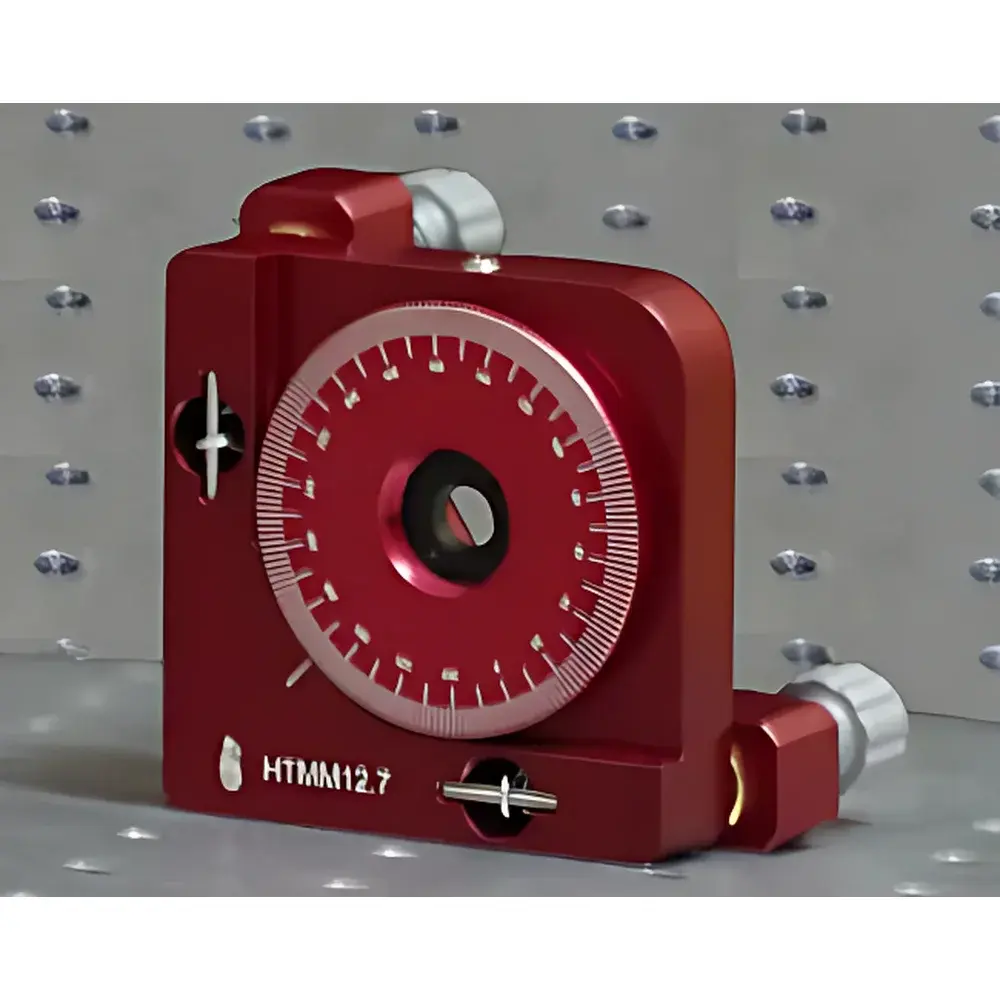
HanDing HTMM12.7 Polarizer Mount
| Brand | HanDing / HT |
|---|---|
| Origin | Jiangsu, China |
| Manufacturer Type | Authorized Distributor |
| Country of Origin | China |
| Model | HTMM12.7 |
| Pricing | Available Upon Request |
Overview
The HanDing HTMM12.7 Polarizer Mount is a precision-engineered optical mounting solution designed for stable, repeatable alignment and secure fixation of linear polarizers, waveplates, and other thin, flat optical elements with 12.7 mm (½-inch) clear apertures. Built on the principles of kinematic constraint and low-stress clamping, this mount utilizes a three-point contact design—two lateral adjustment screws and one central retaining ring—to minimize optical distortion while enabling fine angular positioning in both pitch and yaw. Its modular construction integrates seamlessly into standard optical tables and breadboards via M4 or ¼”-20 tapped holes, supporting both free-space and fiber-coupled polarization control setups common in laser physics, ellipsometry, quantum optics, and polarization-sensitive spectroscopy applications.
Key Features
- High-precision angular adjustment: Dual micrometer-driven screws provide ±3° coarse tilt range with 10 µrad resolution per division, enabling sub-degree alignment stability under thermal and mechanical load.
- Low-birefringence mounting: Anodized aluminum body (6061-T6) eliminates internal stress-induced birefringence; no adhesives or clamping forces act directly on the optical surface.
- Modular compatibility: Standard SM1 (1.035″-40) internal threading accepts lens tubes, filter holders, and adapter rings; external M4 threads allow stacking with translation stages or rotation mounts.
- Optimized for polarization integrity: Minimal metallic shadowing and symmetric clamping geometry preserve extinction ratio (>1000:1) when used with high-performance Glan-Taylor or Rochon polarizers.
- Traceable mechanical repeatability: Positional hysteresis < 5 arcsec after 500 adjustment cycles; calibrated against NIST-traceable autocollimator standards during production sampling.
Sample Compatibility & Compliance
The HTMM12.7 accommodates optical components up to 13.0 mm in diameter and 8.0 mm in thickness, including calcite, α-BBO, and YVO₄ polarizing prisms, zero-order quarter- and half-wave plates, and dichroic thin-film polarizers. It conforms to ISO 10110-7 (optical element mounting interface tolerances) and supports GLP-compliant optical alignment protocols when integrated into validated laboratory workflows. While not certified to IEC 61000-6-3 (EMC) or UL 61010-1 (safety), its passive mechanical design ensures intrinsic compatibility with Class 3B/4 laser environments when used within properly interlocked optical enclosures per ANSI Z136.1.
Software & Data Management
As a purely mechanical mount, the HTMM12.7 requires no firmware, drivers, or software integration. However, it is fully compatible with third-party automated alignment systems—including Thorlabs Kinesis® motion controllers and Newport ESP301 stages—when paired with optional motorized tilt adapters (e.g., HTMM12.7-MT). Alignment records, positional metadata, and maintenance logs may be documented within laboratory information management systems (LIMS) or electronic lab notebooks (ELN) compliant with 21 CFR Part 11 requirements, provided timestamps, user authentication, and audit trails are enabled at the host platform level.
Applications
- Laser cavity polarization control in Ti:sapphire and diode-pumped solid-state oscillators
- Input/output polarization conditioning for Mach-Zehnder and Sagnac interferometers
- Extinction ratio verification in Mueller matrix polarimetry calibration setups
- Polarization-dependent loss (PDL) measurement in fiber-optic component testing
- Teaching labs for undergraduate optics courses covering Malus’ law, Brewster’s angle, and circular polarization generation
FAQ
What is the maximum torque specification for the retaining ring?
The SM1-threaded retaining ring is rated for ≤ 0.35 N·m; exceeding this may deform the aluminum housing and compromise angular repeatability. A torque-limiting screwdriver is recommended during installation.
Can the HTMM12.7 be used in vacuum environments?
Yes—when cleaned per ISO 14644-1 Class 5 protocols and outgassed at 60°C for 24 hours, the anodized aluminum body achieves a water vapor desorption rate < 1×10⁻⁹ g/cm²/s, making it suitable for UHV-compatible optical trains up to 1×10⁻⁶ mbar.
Is thermal drift compensated in the design?
No active compensation is implemented; however, the symmetric CTE-matched construction (α ≈ 23.6 × 10⁻⁶ /K) limits relative angular shift to < 2 arcsec over a 20–30°C ambient range when mounted on granite or Invar optical bases.





