
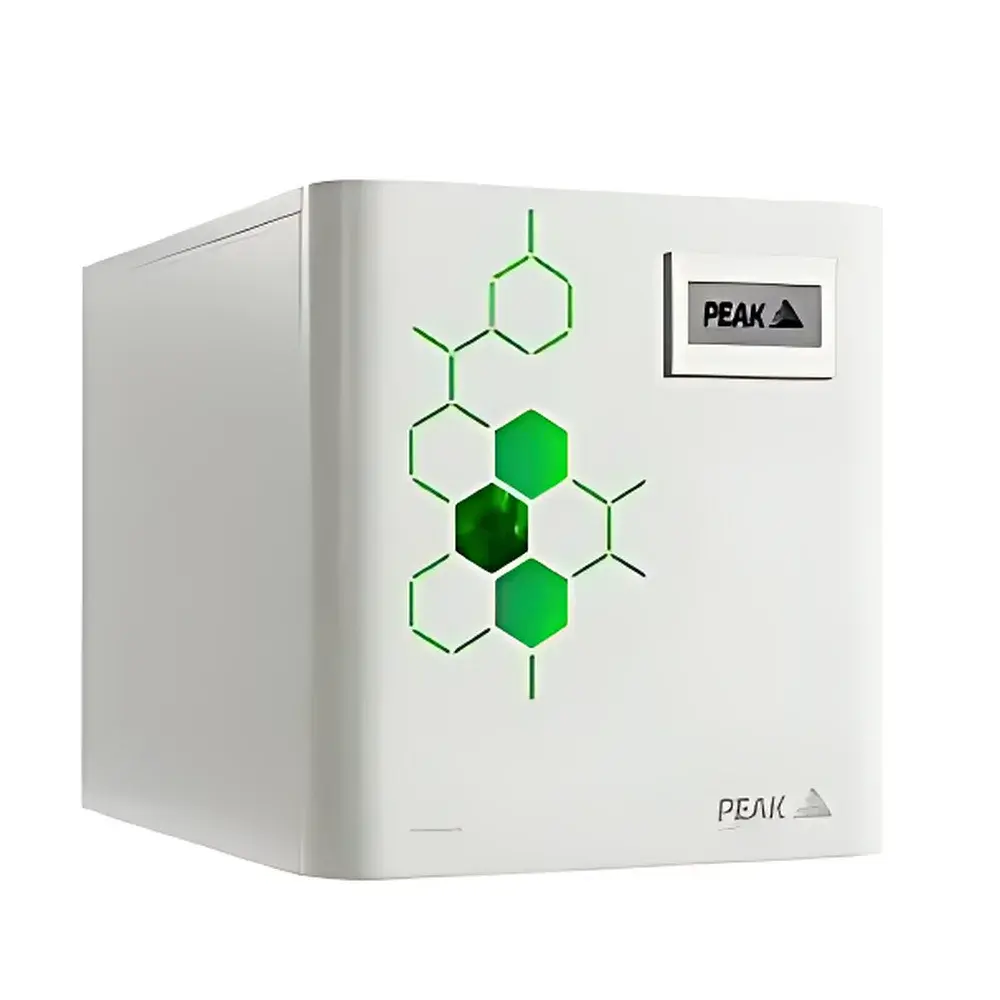
Peak Precision Precision Hydrogen Hydrogen Generator
| Brand | PEAK |
|---|---|
| Origin | United Kingdom |
| Manufacturer Type | Manufacturer |
| Origin Category | Imported |
| Model | Precision Hydrogen |
| Hydrogen Generation Principle | Electrolysis of High-Purity Deionized Water |
| Output Flow Rate | 100–1200 cc/min |
| Output Pressure | 100 psi (6.9 bar) |
| Hydrogen Purity | 99.9995% (Standard Series) / 99.99999% (Trace Series) |
| Power Consumption | 309–787 W |
Overview
The Peak Precision Precision Hydrogen Hydrogen Generator is an engineered solution for laboratories requiring on-demand, high-purity hydrogen gas in analytical applications—particularly as fuel gas for flame ionization detectors (FID), make-up gas for electron capture detectors (ECD), and carrier gas in gas chromatography (GC) and GC–mass spectrometry (GC–MS) systems. Unlike compressed gas cylinders, this generator employs proton exchange membrane (PEM) electrolysis technology to split deionized water into high-purity hydrogen and oxygen, eliminating storage hazards and supply-chain dependencies. The system operates continuously under programmable flow control, delivering stable output across the full 100–1200 cc/min range at a regulated pressure of 100 psi (6.9 bar). Its modular architecture supports integration with single or multiple GC instruments—including simultaneous supply to several FID detectors or dual GC–MS platforms—without compromising purity or pressure stability.
Key Features
- Proton exchange membrane (PEM) electrolysis core ensures rapid start-up, precise flow regulation, and zero hydrocarbon contamination.
- Dual-purity configuration: 99.9995% H₂ (Standard Series) suitable for detector fuel; 99.99999% H₂ (Trace Series), verified by NPL (National Physical Laboratory, UK) via oxygen-content analysis, certified for carrier-grade GC and GC–MS applications.
- Integrated auto-fill pump enables unattended operation with minimal manual intervention—deionized water reservoir replenishment occurs automatically based on level sensing.
- Real-time internal leak detection: built-in hydrogen sensors trigger immediate shutdown and audible/visual alerts upon detecting trace-level leaks within the gas path or enclosure.
- Low operational footprint: power draw ranges from 309 W (at minimum flow) to 787 W (at maximum rated output), optimized for energy efficiency without sacrificing response time or pressure stability.
- No consumables beyond deionized water; no catalyst replacement, no desiccant cartridges, and no periodic membrane cleaning required under normal operating conditions.
Sample Compatibility & Compliance
The Precision Hydrogen Generator is compatible with all major GC and GC–MS platforms—including Agilent, Thermo Fisher, Shimadzu, and PerkinElmer—when configured with standard 1/8″ or 1/4″ stainless-steel tubing and VCR fittings. It meets ISO 8573-1:2010 Class 1 air quality requirements for gaseous contaminants when used with appropriate inlet filtration (e.g., 0.1 µm particulate + hydrocarbon trap). For regulated environments, the system supports audit-ready operation: event logs (including leak events, power cycles, and flow deviations) are timestamped and stored onboard for ≥12 months. While not inherently 21 CFR Part 11 compliant, its logging architecture is compatible with third-party electronic lab notebook (ELN) or LIMS integrations that enforce electronic signature and audit trail requirements per GLP/GMP guidelines.
Software & Data Management
The generator features an embedded microcontroller with RS-232 and optional Ethernet connectivity (via external gateway). Local interface includes a backlit LCD with real-time display of flow rate, pressure, water level, temperature, and system status codes. All operational parameters are accessible via ASCII command protocol for OEM integration or custom SCADA scripting. Event logs—including automatic shutdown triggers, maintenance reminders, and calibration timestamps—are exportable as CSV files. No proprietary software installation is required; configuration and monitoring can be performed via terminal emulator or simple HTTP-based web interface (firmware v3.2+).
Applications
- Fuel gas supply for FID, NPD, and PID detectors in routine and trace-level GC analysis.
- Carrier gas for capillary GC and GC–MS methods requiring ultra-high purity and low baseline drift (Trace Series only).
- Coolant and reaction gas in ICP–MS collision/reaction cell configurations where hydrogen reduces polyatomic interferences (e.g., ArO⁺, ClO⁺).
- Hydrogenation support in benchtop catalytic reactors and hydride generation AAS systems.
- On-site calibration gas generation for sensor validation in safety-critical industrial hygiene labs.
FAQ
What is the maximum number of GC instruments a single Precision Hydrogen generator can supply?
A single unit can support up to three standard FID-equipped GCs operating simultaneously at typical flow rates (30–40 mL/min each), provided total demand remains within the 1200 cc/min limit and pressure drop across distribution manifolds is compensated.
Does the generator require external cooling or ventilation?
No active cooling is required; the unit is convection-cooled and designed for ambient lab operation (15–30°C, non-condensing humidity). Minimum clearance of 10 cm on all sides is recommended for airflow.
How often must the deionized water reservoir be refilled?
With the auto-fill pump enabled and a 5-liter external reservoir, refill intervals typically exceed 7–10 days at continuous 600 cc/min output; frequency scales inversely with average flow demand.
Is ozone or NOx generated during operation?
No. PEM electrolysis produces only hydrogen and oxygen in stoichiometric ratio; no thermal plasma, UV radiation, or nitrogen fixation occurs—eliminating formation of ozone or nitrogen oxides.
Can the generator be integrated into a building-wide gas monitoring system?
Yes—via dry-contact relay outputs (fault, ready, low-water) and Modbus RTU over RS-485 (optional module), enabling interoperability with facility BMS or centralized gas safety controllers.



