
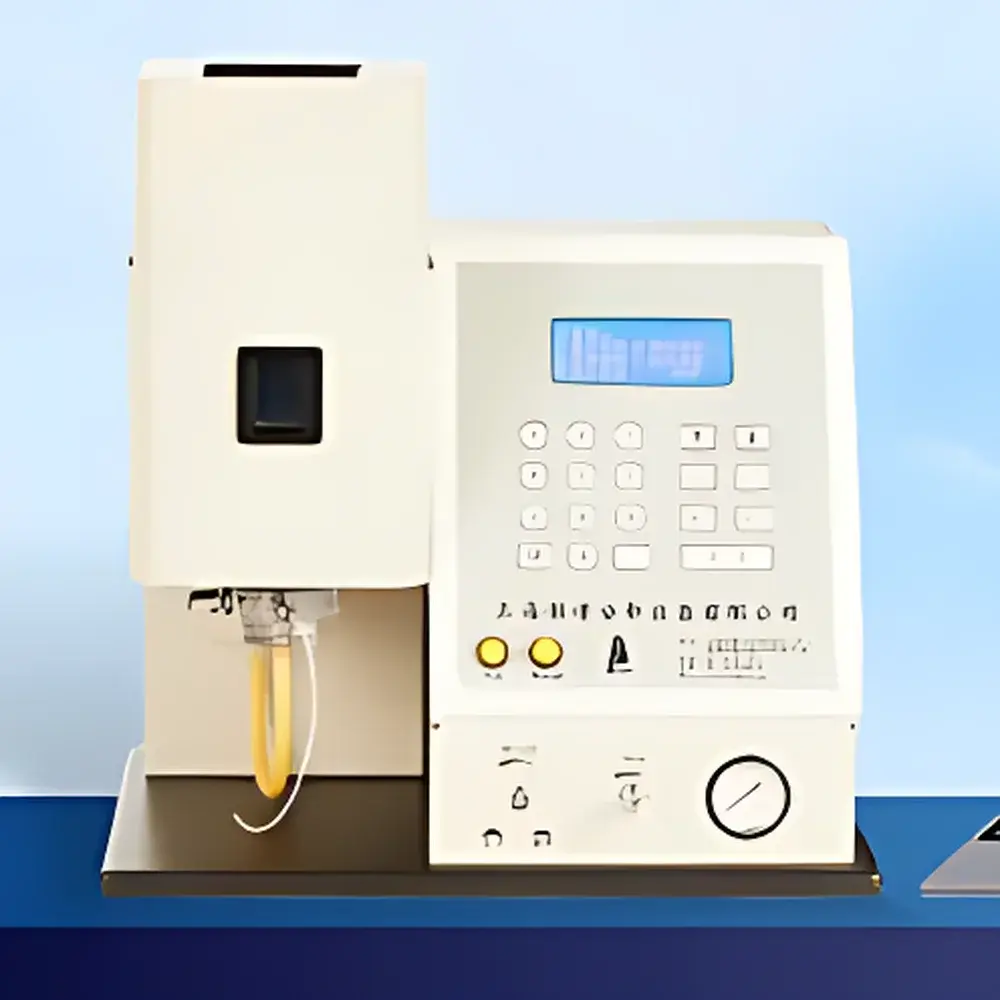
AOPU AP1402 Flame Photometer
| Brand | AOPU |
|---|---|
| Origin | Shanghai, China |
| Manufacturer Type | Direct Manufacturer |
| Model | AP1402 |
| Detection Range | K: 0–100 µg/mL |
| Na | 0–100 µg/mL |
| Li | 0–100 µg/mL |
| Ba | 0–3000 µg/mL |
| Detection Limit | K ≤ 0.0004 mmol/L |
| Response Time | < 8 s |
| Repeatability | ≤ 3% |
| Sample Uptake Rate | < 6 mL/min |
Overview
The AOPU AP1402 Flame Photometer is a benchtop atomic emission spectrometer designed for quantitative analysis of alkali and alkaline earth metals—specifically potassium (K), sodium (Na), lithium (Li), and barium (Ba)—in aqueous solutions. It operates on the principle of flame atomic emission spectroscopy (FAES): liquid samples are nebulized into a stable premixed air–fuel flame (using liquefied petroleum gas, propane, or butane), where metal ions are thermally excited and emit characteristic wavelengths upon relaxation. Emission intensity at element-specific spectral lines is measured via interference filter-based optical isolation and detected by a silicon photovoltaic cell. The instrument delivers direct concentration readouts in µg/mL without requiring internal standardization, making it suitable for routine quality control and regulatory-compliant testing in laboratories with moderate throughput requirements.
Key Features
- Four-channel detection architecture with dedicated interference filters for K, Na, Li, and Ba—enabling simultaneous measurement of up to three elements per run with real-time concentration display.
- Integrated flame safety system featuring automatic ion-sensing flame monitoring: in case of unintended flame extinction, the electrode detects signal loss within 8 seconds and triggers immediate fuel cutoff followed by audible alarm; manual reset via dedicated ignition button restores operation.
- Three calibration curve modes—linear, segmented linear, and quadratic polynomial fitting—supporting flexible method development across wide dynamic ranges and non-ideal matrix effects.
- Touch-sensitive digital keypad with intuitive menu navigation; built-in memory stores multiple calibration curves for rapid method recall.
- RS232 serial interface compliant with standard laboratory data acquisition protocols; supports connection to external PCs or thermal printers for audit-ready reporting.
- Integrated moisture separator ensures consistent aerosol delivery and protects optical components from condensate-induced drift.
- Single-point calibration capability with auto-zero function minimizes daily setup time while maintaining traceable accuracy under GLP-aligned workflows.
Sample Compatibility & Compliance
The AP1402 accepts clarified, low-viscosity aqueous samples with total dissolved solids (TDS) < 0.5% w/v. It is routinely applied in beverage testing (e.g., fruit juice K/Na ratio), clinical serum electrolyte screening, agricultural soil extract analysis (NH4OAc-extractable K/Na), fertilizer nutrient certification, lubricant additive verification (Li-based greases), and petrochemical feedstock impurity profiling (e.g., Na in crude oil distillates). While not certified to ISO/IEC 17025 or FDA 21 CFR Part 11 out-of-the-box, its design supports compliance with ASTM D1944 (Na in water), ISO 11885 (determination of selected elements by FAES), and USP (alkali metal content in pharmaceutical excipients) when operated within validated SOPs—including documented calibration, system suitability checks (e.g., repeatability ≤3%, stability ≤15% over 6 min), and environmental controls (ambient temperature 10–35°C, RH ≤85%, vibration-free mounting).
Software & Data Management
The AP1402 operates as a standalone instrument with embedded firmware controlling all optical, pneumatic, and signal-processing functions. No proprietary software installation is required. Calibration parameters, sample IDs, and measurement results are stored internally and exported via RS232 using ASCII-delimited text format compatible with Excel, LabArchives, or LIMS platforms. Audit trail functionality is enabled through timestamped calibration logs and user-accessible firmware version reporting—facilitating GxP-aligned record retention when paired with institutional electronic signature policies. Raw analog output (0–5 V DC) is available for integration into PLC-controlled process analytical technology (PAT) environments.
Applications
- Fertilizer & Soil Science: Quantification of exchangeable K and Na in Mehlich-3 or ammonium acetate extracts; rapid screening of K content in NPK blends.
- Food & Beverage: Monitoring Na/K balance in dairy products, sports drinks, and infant formula per Codex Alimentarius standards.
- Clinical Chemistry: Semi-quantitative assessment of serum or urine Na/K ratios in point-of-care settings where ICP-OES is unavailable.
- Petrochemical: Detection of catalytic poison metals (Na, K) in refinery feedstocks and turbine oils per ASTM D5185.
- Materials Testing: Analysis of alkali leachables from glass containers (USP ) or cementitious matrices (ASTM C150).
- Lubricants: Verification of Li stearate concentration in multi-purpose greases (NLGI Grade 2).
FAQ
What fuel gases are compatible with the AP1402?
Propane, butane, and commercial LPG (liquefied petroleum gas) meeting EN 589 specifications are supported. Fuel must be free of sulfur compounds, particulates, and heavy hydrocarbons to prevent burner clogging and spectral interference.
Is external air compression required?
Yes—the system includes a built-in oil-free air compressor delivering ≥12 L/min at 200 kPa, eliminating dependency on lab air networks and ensuring consistent nebulization pressure.
Can the AP1402 measure calcium or magnesium?
No. Its optical path is fixed to the four specified emission lines (K: 766.5 nm, Na: 589.0 nm, Li: 670.8 nm, Ba: 553.6 nm); no filter wheel or broadband detector is provided for additional elements.
What is the minimum sample volume per measurement?
Approximately 2 mL is recommended to ensure stable aspiration and representative signal averaging over the 8-second response window.
How often should the nebulizer capillary be cleaned?
After every 20–30 samples when analyzing high-TDS or viscous matrices; use 5% HNO3 followed by deionized water flush. Routine maintenance intervals are documented in the operator’s manual (Rev. 3.2, 2023).





