
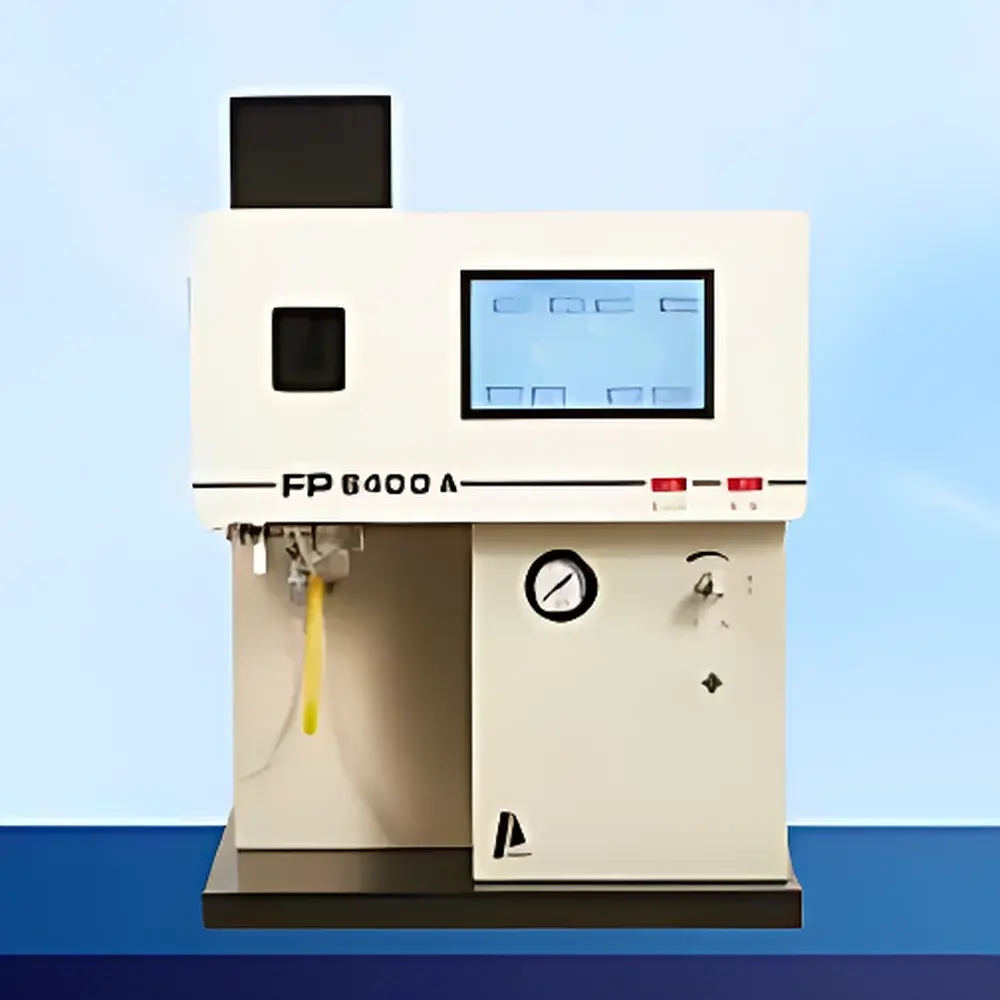
AOPU FP6400A Flame Photometer
| Brand | AOPU |
|---|---|
| Origin | Shanghai, China |
| Manufacturer Type | Direct Manufacturer |
| Model | FP6400A |
| Measurement Range | K: 0–100 µg/mL |
| Na | 0–100 µg/mL |
| Detection Limit | K ≤ 0.004 mmol/L |
| Response Time | < 8 s |
| Repeatability | ≤ 3% |
| Sample Uptake Rate | < 6 mL/min |
| Detector | Silicon Photocell |
| Wavelength Selection | Interference Filter |
| Display | 7-inch Color Touchscreen |
| Ignition System | One-Touch Ignition with Flame Ionization Safety Cut-off |
| Fuel Compatibility | Liquefied Petroleum Gas (LPG), Propane, or Butane |
| Linear Error | K ≤ 0.005 mmol/L |
| Stability | ≤ 3% RSD over 15 s |
| Operating Environment | 10–35 °C, RH ≤ 85%, Stable Horizontal Surface, Grounded 220 V ± 10%, 50 Hz ± 1 Hz, 250 W Max |
| Dimensions | 400 × 250 × 500 mm |
| Weight | 12.5 kg |
Overview
The AOPU FP6400A Flame Photometer is a benchtop atomic emission spectrometer designed for quantitative determination of potassium (K) and sodium (Na) in aqueous solutions via flame atomic emission spectroscopy (FAES). It operates on the fundamental principle that alkali and alkaline earth metal atoms—when introduced into a controlled hydrocarbon flame—are thermally excited to higher electronic energy states; upon returning to ground state, they emit characteristic wavelengths of visible light (e.g., 589.3 nm for Na, 766.5 nm for K). The instrument measures the intensity of this element-specific emission using a silicon photocell detector, enabling direct correlation between signal amplitude and analyte concentration. Engineered for routine analysis in regulated and non-regulated environments, the FP6400A delivers reliable, interference-minimized quantification without requiring complex optical gratings or monochromators—relying instead on high-transmission interference filters for spectral isolation. Its design emphasizes operational robustness, low maintenance, and compatibility with standard clinical, agricultural, and industrial sample matrices.
Key Features
- Simultaneous dual-channel measurement capability for K and Na—enabling rapid comparative analysis in clinical chemistry, quality control, and process monitoring.
- Integrated 7-inch color touchscreen interface with intuitive navigation, real-time calibration curve visualization, and user-configurable measurement protocols.
- One-touch ignition system incorporating flame ionization detection (FID) safety logic: automatic fuel cutoff within 8 seconds of flame extinction, followed by audible/visual alarm and manual reset requirement.
- Dual-range digital readout (0.0–19.9 / 0.0–99.9) optimized for both trace-level and high-concentration samples, minimizing manual dilution steps.
- Stable laminar flame geometry supported by integrated air compressor and pressure-regulated LPG/propane/butane fuel delivery—ensuring consistent atomization and excitation efficiency.
- Onboard linear calibration correction algorithm compensates for matrix-induced nonlinearity across the full dynamic range (0–100 µg/mL).
- Compact footprint (400 × 250 × 500 mm) and lightweight chassis (12.5 kg) facilitate deployment in space-constrained labs, mobile testing units, or field-deployable QA/QC stations.
Sample Compatibility & Compliance
The FP6400A accepts clarified aqueous samples—including serum, plasma, urine, soil extracts, fertilizer digests, cement leachates, and beverage formulations—without derivatization or pre-concentration under standard operating conditions. Sample introduction is achieved via capillary nebulization at <6 mL/min, compatible with standard 13-mm test tubes and volumetric pipettes. The instrument meets baseline functional requirements aligned with ISO 6497:2002 (Animal feeding stuffs — Determination of sodium and potassium) and ASTM D2202-18 (Standard Test Method for Sodium and Potassium in Water by Flame Photometry). While not certified for GLP or GMP environments out-of-the-box, its reproducibility (≤3% RSD), stability (<3% drift over 15 s), and audit-ready parameter logging support integration into validated workflows when paired with documented SOPs and external calibration verification per USP and CLSI EP15-A3 guidelines.
Software & Data Management
Data acquisition and processing are handled entirely through the embedded firmware interface—no external PC required. All measurements are timestamped and stored internally with metadata including calibration date, operator ID (user-defined), sample ID, and instrument status flags (e.g., flame-on duration, pressure warning events). Export is supported via USB flash drive in CSV format for downstream statistical analysis (e.g., Excel, R, JMP). The system maintains a local history buffer of up to 1,000 results and supports manual recall, deletion, and batch export. Audit trail functionality includes immutable event logs for ignition attempts, calibration updates, and range changes—critical for laboratories preparing for internal quality audits or ISO/IEC 17025 accreditation.
Applications
- Clinical Diagnostics: Quantification of serum/plasma K⁺ and Na⁺ for electrolyte panel validation, renal function assessment, and critical care monitoring.
- Agricultural Testing: Rapid analysis of plant tissue digests, irrigation water, and soil extractants for nutrient management and salinity evaluation.
- Industrial QA/QC: Monitoring Na/K content in pharmaceutical excipients, glass batch formulations, ceramic glazes, and cement raw materials.
- Food & Beverage: Verification of mineral fortification levels in dairy products, sports drinks, and infant formulas per Codex Alimentarius standards.
- Environmental Labs: Screening of surface water, wastewater effluents, and landfill leachates for alkali metal contamination.
FAQ
What fuel types are compatible with the FP6400A?
The instrument is calibrated and certified for use with liquefied petroleum gas (LPG), propane, or butane—each requiring appropriate pressure regulation and flashback arrestors per local safety codes.
Is external software required for data export?
No. All data management is self-contained; CSV export is performed directly to USB storage without third-party drivers or licensing.
Can the FP6400A measure lithium or calcium?
No. It is optimized exclusively for potassium and sodium via fixed-wavelength interference filters at 766.5 nm and 589.3 nm, respectively.
What is the minimum detectable concentration for sodium?
The detection limit is specified as ≤0.008 mmol/L (≈0.18 µg/mL), determined per IUPAC definition using 3σ of blank signal variability.
How often must the calibration curve be renewed?
Calibration verification is recommended before each analytical batch; full multi-point calibration is required after instrument relocation, major maintenance, or when drift exceeds ±2% of mid-range standard response.





