
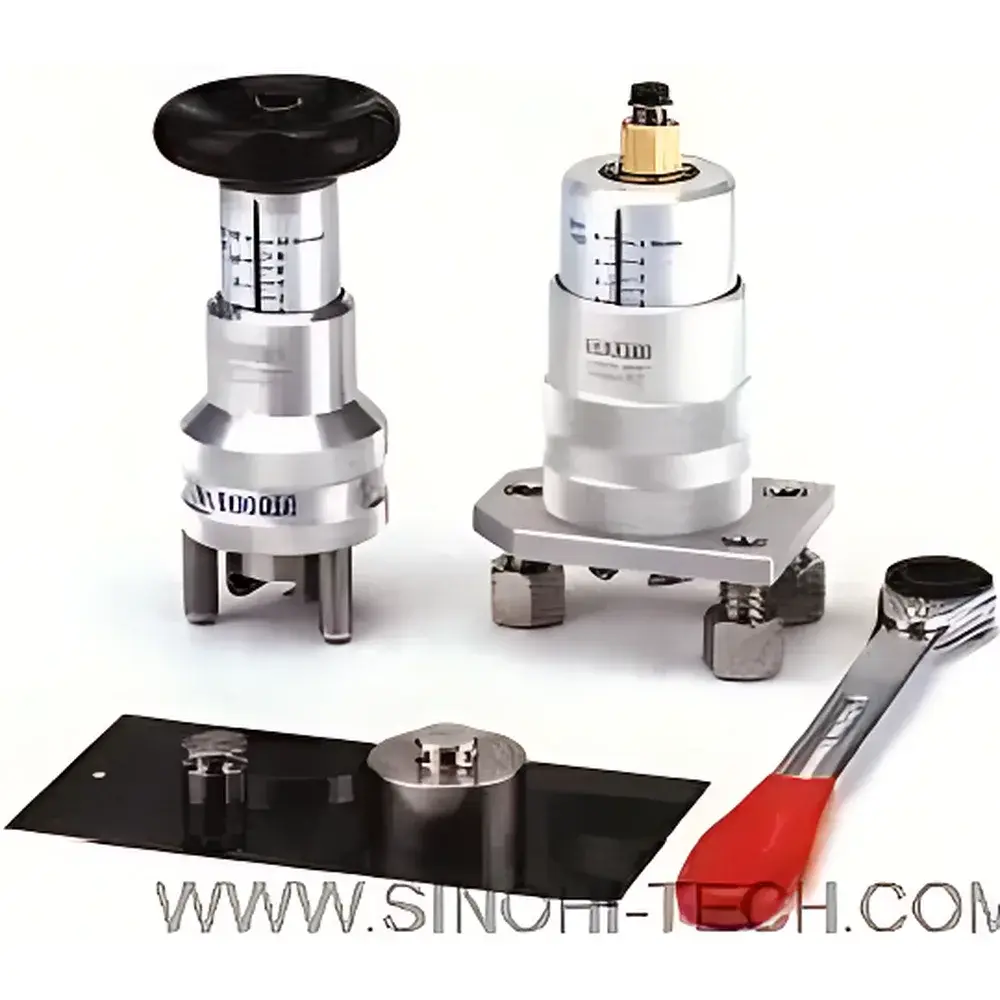
Erichsen #525 Mechanical Pull-Off Adhesion Tester
| Origin | Germany |
|---|---|
| Manufacturer Type | Authorized Distributor |
| Origin Category | Imported |
| Model | #525 Series |
| Pricing | Available Upon Request |
Overview
The Erichsen #525 Mechanical Pull-Off Adhesion Tester is a precision-engineered, fully mechanical instrument designed for quantitative assessment of coating adhesion strength to rigid substrates—including metal, concrete, plasterboard, and cured polymer surfaces. It operates on the principle of direct tensile pull-off per ASTM D4541 (Standard Test Method for Pull-Off Strength of Coatings Using Portable Adhesion Testers), delivering traceable, repeatable force measurements without reliance on electrical power or digital calibration. Unlike shear-based methods such as cross-cut testing (ASTM D3359), the #525 applies a controlled, axially aligned tensile load perpendicular to the coated surface—enabling evaluation of interfacial bond integrity under conditions representative of real-world delamination stress. Its robust all-metal construction, spring-loaded loading mechanism, and dual-scale analog readout ensure operational reliability in field environments, production floors, and third-party inspection labs where portability, environmental resilience, and GLP-compliant manual operation are essential.
Key Features
- Fully mechanical design: No batteries, power supply, or firmware required—ideal for hazardous locations, remote sites, or ISO/IEC 17025-accredited labs requiring minimal instrumentation dependencies.
- Modular spindle system: Interchangeable 20 mm and 50 mm diameter test dollies (spindles) enable optimized pressure distribution across diverse substrate geometries and coating thicknesses.
- Dual-unit analog scale: Simultaneous reading in MPa (N/mm²) and psi (lb/in²) directly from engraved cylindrical dial—eliminates unit conversion errors and supports international reporting requirements.
- Calibrated helical compression spring: Pre-tensioned spring generates linear, hysteresis-minimized force transmission; maximum load retention at peak separation ensures accurate capture of ultimate adhesion strength.
- Three-point tripod base with anti-rotation pin: Ensures axial alignment during pull-off, preventing torque-induced premature failure and preserving measurement fidelity per ASTM D4541 Section 7.3.
- Integrated carrying case: Includes dolly mounting adhesive (e.g., two-part epoxy compliant with ASTM D4541 Annex A1), surface preparation tools, torque wrench, and calibration certificate—enabling immediate deployment.
Sample Compatibility & Compliance
The #525 series is validated for use with solvent-borne, water-borne, powder-coated, and cementitious systems applied to flat or gently curved rigid substrates. It complies with ASTM D4541 (2023 edition), ISO 4624 (2016), and EN 1542 (1999) for pull-off adhesion testing. The 50 mm dolly variant (#525-B) meets additional requirements for low-strength substrates such as cast-in-place concrete (per ACI 503R-17) and render systems, where larger contact area mitigates localized substrate fracture. All models support routine verification via certified reference load cells traceable to national metrology institutes (e.g., PTB, NIST). Instrument design excludes electronic components, thereby exempting it from CE electromagnetic compatibility (EMC) directives—simplifying import compliance for non-EU laboratories.
Software & Data Management
As a purely mechanical tester, the #525 does not incorporate embedded software, data logging, or wireless connectivity. This architecture aligns with regulatory frameworks emphasizing auditability and operator control—including FDA 21 CFR Part 11 (where handwritten records are permitted under §11.10(d)), EU GMP Annex 11 (Section 5.10), and ISO/IEC 17025:2017 Clause 7.5.2 (control of recorded data). Users document results manually in bound lab notebooks or LIMS-integrated forms, with dolly serial numbers, substrate ID, adhesive batch, and environmental conditions (temperature/humidity per ASTM D4541 Section 6.2) retained for full traceability. Optional Erichsen-certified calibration reports include uncertainty budgets per ISO/IEC 17025 Annex A.2.
Applications
- Quality assurance of industrial maintenance coatings on offshore platforms, pipelines, and storage tanks.
- Validation of fireproofing intumescents on structural steel per UL 1709 and ASTM E84.
- Field verification of architectural facade systems—including ceramic tile, natural stone, and fiber-cement cladding—prior to handover.
- R&D screening of novel adhesive primers and corrosion-inhibitive topcoats in automotive OEM paint shops.
- Forensic analysis of coating failures in litigation-support investigations, where chain-of-custody and method transparency are legally mandated.
- Third-party certification audits for ISO 12944 C5-I/C5-M environments requiring documented adhesion thresholds ≥5.0 MPa.
FAQ
Does the #525 require annual recalibration?
Yes—Erichsen recommends recalibration every 12 months or after 500 test cycles, using NIST-traceable deadweight standards. Calibration certificates include expanded uncertainty (k=2) per ISO/IEC 17025.
Can the #525 be used on flexible substrates like PVC membranes?
No—ASTM D4541 explicitly excludes non-rigid substrates. For flexible membranes, refer to ASTM D903 or ISO 8510-2 peel testing protocols.
What adhesive is recommended for dolly bonding?
A two-component, high-modulus epoxy (e.g., Loctite EA 9462 or Hysol EPX 101) meeting ASTM D4541 Annex A1 requirements for cure time, Tg, and bond strength is mandatory.
How is operator bias minimized during testing?
The handwheel-driven loading mechanism enforces standardized ramp rate (1 MPa/s ±0.2 MPa/s per ASTM D4541 Section 8.3); visual confirmation of dolly detachment eliminates subjective endpoint interpretation.
Is the #525 suitable for ISO 12944 high-corrosion environments?
Yes—its stainless-steel and anodized aluminum construction resists salt-spray exposure, and its mechanical operation avoids electronic degradation in C5-I/C5-M zones.



