
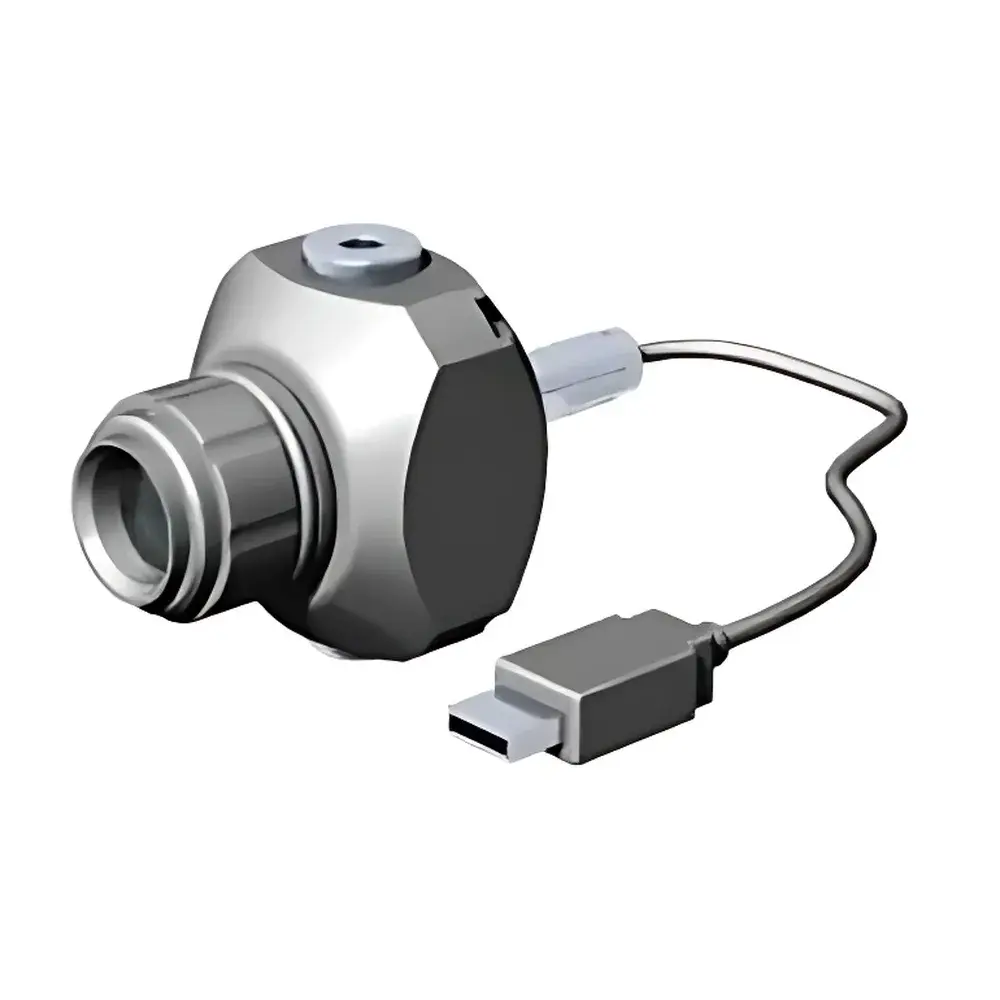
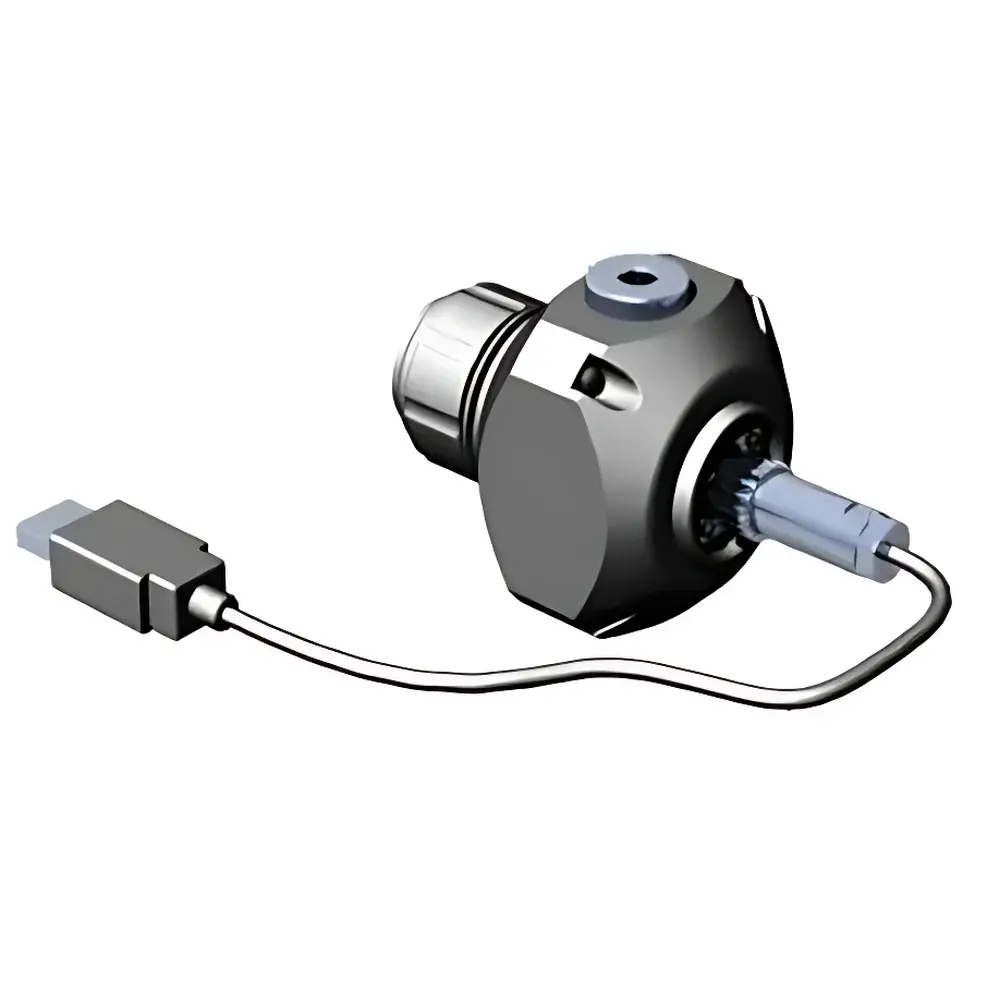
ElectroOptic CONTOUR-IR digit Infrared CMOS Digital Camera
| Brand | ElectroOptic |
|---|---|
| Origin | Russia |
| Model | CONTOUR-IR digit |
| Interface | USB 2.0 (480 Mbps nominal, up to 400 MB/s sustained) |
| Sensor Type | High-sensitivity CMOS with microlens array and enhanced pixel cascade amplification |
| Spectral Range | 400–1700 nm |
| Bit Depth | 8-bit luminance output |
| Frame Rate | Real-time digital video output (dependent on resolution and host system bandwidth) |
| Software Compatibility | WDM driver architecture |
| Power Supply | Bus-powered via USB 2.0 |
Overview
The ElectroOptic CONTOUR-IR digit is a high-performance near-infrared (NIR) and short-wave infrared (SWIR)-capable CMOS digital camera engineered for scientific-grade imaging in demanding optical applications. Unlike conventional visible-light cameras, it employs a custom-enhanced CMOS sensor featuring a monolithic microlens array integrated at the pixel level—significantly increasing quantum efficiency across the 400–1700 nm spectral band. Its measurement principle relies on photon-to-electron conversion within silicon-based photodiodes optimized for extended red response, enabling quantitative intensity mapping without cryogenic cooling. Designed for direct integration into laboratory workstations, the camera operates as a USB 2.0 vision device with full isochronous data streaming capability—supporting real-time acquisition of megapixel-resolution frames at sustained throughput approaching 400 MB/s. This architecture eliminates the need for frame grabbers or proprietary PCIe hardware, reducing system complexity while maintaining deterministic latency for time-critical experiments such as laser beam profiling, thermal emission monitoring, or NIR fluorescence lifetime pre-screening.
Key Features
- USB 2.0 high-speed interface compliant with USB-IF specifications—enabling plug-and-play operation on Windows, Linux, and macOS hosts with standard WDM/Video Class drivers
- Back-illuminated CMOS sensor with pixel-level microlens array and cascaded intra-pixel gain stages—delivering >65% peak QE in the 850–1050 nm range and measurable responsivity down to 400 nm and up to 1700 nm
- 8-bit digital output with programmable gain and offset control—optimized for dynamic range preservation in low-light NIR scenarios
- On-camera auto-functions including exposure time adjustment (10 µs to 1 s), digital gain scaling, and white balance calibration—configurable via host software or hardware-triggered sequences
- Real-time video streaming with adjustable ROI (Region of Interest) cropping—reducing bandwidth load while preserving spatial fidelity for targeted analysis
- Firmware-upgradable architecture supporting future feature expansion—including synchronized multi-camera triggering and metadata embedding (timestamp, exposure, gain)
Sample Compatibility & Compliance
The CONTOUR-IR digit is compatible with standard C-mount and CS-mount optical interfaces, allowing seamless coupling to microscopes, telescopes, collimators, and industrial lenses (with appropriate adapters). It meets CE marking requirements for electromagnetic compatibility (EN 61326-1) and safety (EN 62368-1). While not certified for medical device use under FDA 21 CFR Part 820 or ISO 13485, its design adheres to GLP-aligned documentation practices—including traceable firmware revision logs and calibrated exposure linearity reports available upon request. The camera’s spectral response profile has been validated against NIST-traceable tungsten-halogen and blackbody sources, supporting compliance with ASTM E1548 (Standard Guide for Determining Thermal Emission Characteristics) and ISO 18526-2 (Imaging sensors — Part 2: Measurement methods for spectral responsivity).
Software & Data Management
The camera ships with native WDM drivers compatible with Microsoft DirectShow, enabling integration into commercial image analysis platforms (e.g., Media Cybernetics ImagePro, Thermo Fisher Nicolet OMNIC) and open-source frameworks (OpenCV, Python’s cv2.VideoCapture). SDKs are provided for C/C++, C#, and MATLAB, supporting full parameter control—including binning mode selection, trigger edge polarity, and packet-level buffer management. All acquired frames include embedded EXIF-style metadata (exposure duration, analog gain, timestamp with microsecond resolution), facilitating audit-ready data provenance. Raw image buffers are delivered in uncompressed Bayer or grayscale formats (depending on sensor configuration), ensuring bit-perfect fidelity for post-processing pipelines involving flat-field correction, spectral unmixing, or machine-learning-based feature extraction.
Applications
- Laser diagnostics: Real-time monitoring of diode laser output stability, mode structure, and focal spot geometry in the 780–1550 nm telecom bands
- Biomedical imaging: Non-invasive tissue oxygenation assessment via NIR reflectance spectroscopy and superficial vascular mapping
- Industrial inspection: Detection of subsurface defects in silicon wafers, polymer laminates, and composite materials using SWIR transmission contrast
- Astronomical instrumentation: Low-cost adaptive optics wavefront sensing support and planetary nebulae observation in J/H/K bands (when paired with appropriate filters)
- Materials science: In-situ thermal emissivity mapping during rapid heating cycles, and catalyst surface reaction monitoring via IR luminescence
- Educational optics labs: Quantitative demonstration of Beer-Lambert law deviations in turbid media and wavelength-dependent scattering coefficients
FAQ
Is the CONTOUR-IR digit suitable for quantitative radiometric measurements?
Yes—when used with NIST-traceable calibration targets and calibrated optics, it supports relative radiometry. Absolute radiometric calibration requires optional factory-provided irradiance sensitivity curves.
Does the camera support hardware triggering?
Yes—TTL-compatible external trigger input (positive-edge sensitive) enables synchronization with pulsed lasers, shutter systems, or motion stages.
Can multiple CONTOUR-IR digit units be operated simultaneously on one PC?
Yes—up to four units are supported via USB 2.0 hub configurations with individual bandwidth allocation; driver-level device enumeration ensures independent parameter control.
What is the maximum usable frame rate at full resolution (1280 × 1024)?
Approximately 30 fps under optimal host DMA performance; ROI cropping increases frame rate linearly with reduced pixel count.
Is Linux support available?
Yes—V4L2-compliant kernel modules and user-space utilities are provided for Ubuntu 20.04+ and CentOS 8+, including GStreamer pipeline examples.




