
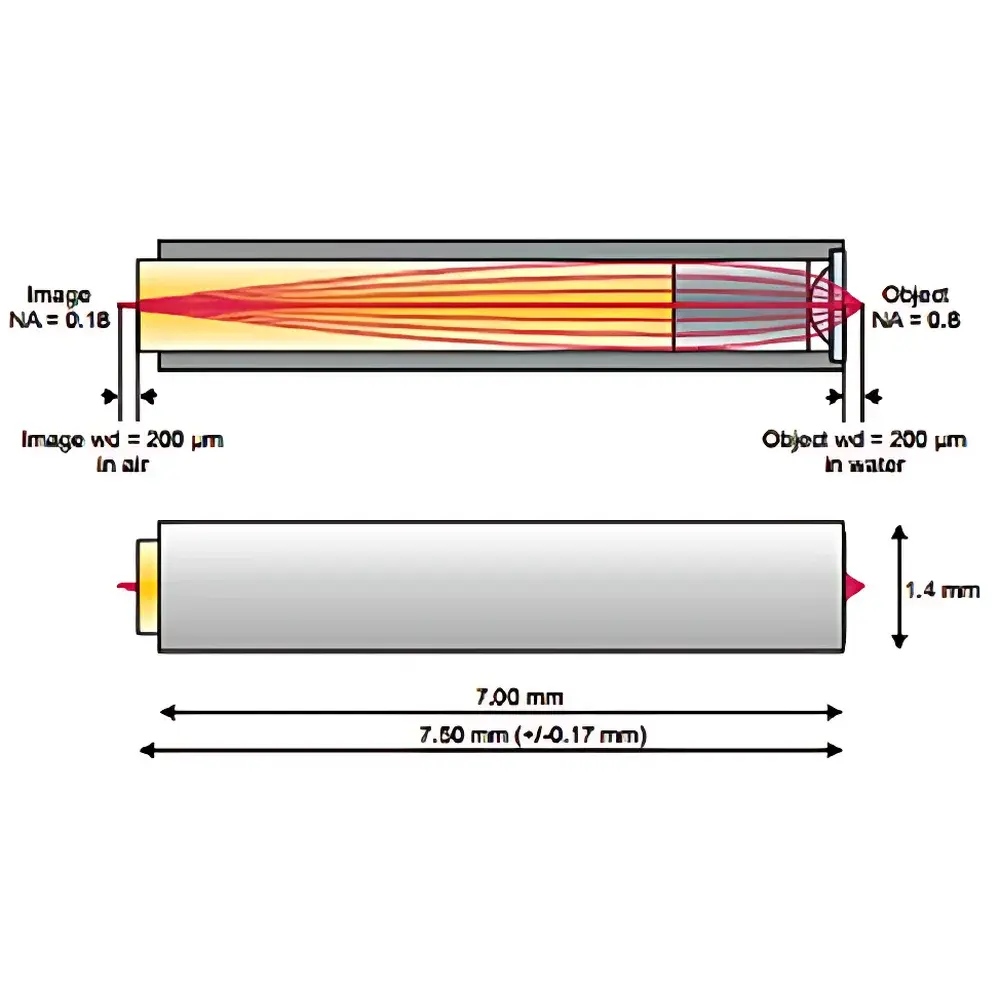
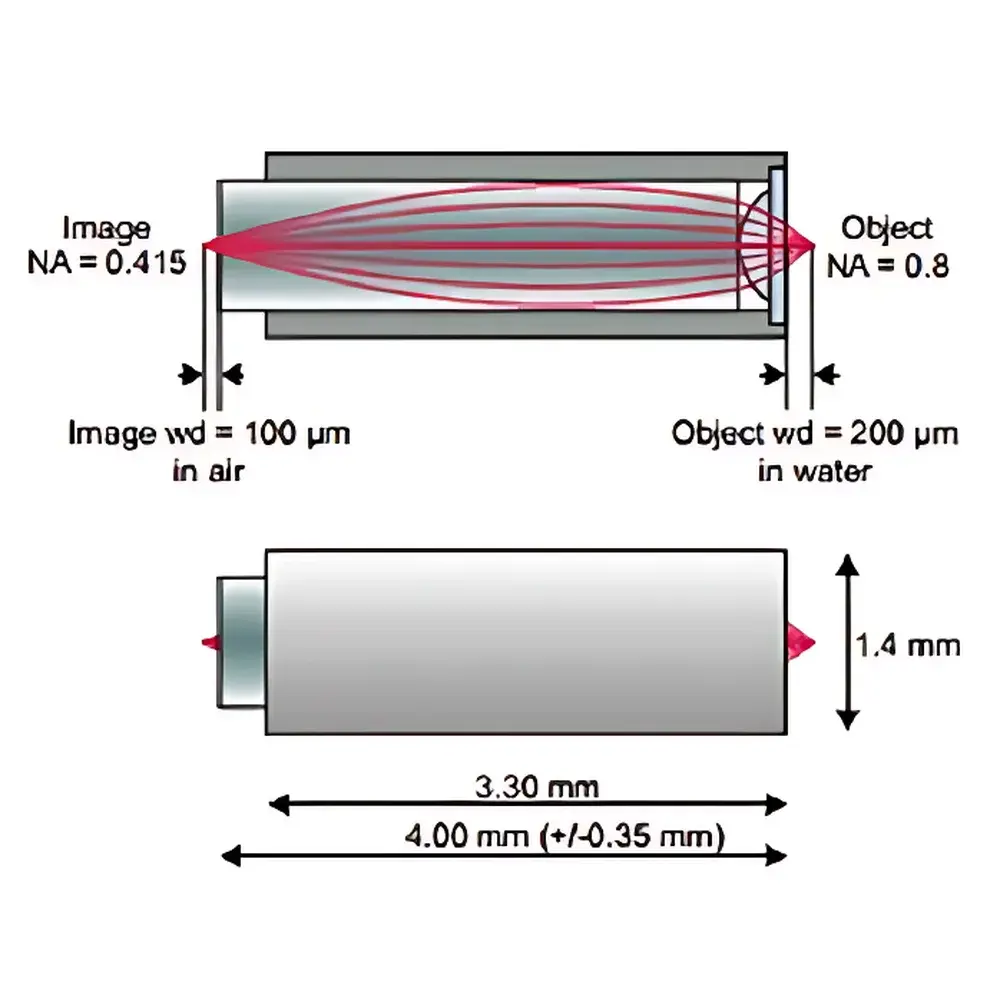
GRINTECH GT-M0-080-018-810 & GT-M0-080-0415-810 High-NA GRIN Lens Objective for Two-Photon Microendoscopy
| Brand | GRINTECH |
|---|---|
| Origin | Canada |
| Model | GT-M0-080-018-810 / GT-M0-080-0415-810 |
| Numerical Aperture (Object-side) | 0.8 |
| Working Distance (in water) | 200 µm |
| Image-side NA | 0.18 / 0.415 |
| Magnification | 4.8× / 1.92× |
| Recommended Excitation Wavelength | 800–900 nm |
| Housing | Stainless Steel Mount |
| Optical Design | Hybrid GRIN + Plano-Convex with Aberration Compensation |
Overview
The GRINTECH GT-M0-080-018-810 and GT-M0-080-0415-810 are high-numerical-aperture (NA) gradient-index (GRIN) lens objectives engineered specifically for minimally invasive two-photon fluorescence microscopy in deep-tissue biological imaging. These objectives integrate a precision-ground plano-convex front element with a custom-designed, aberration-compensated GRIN lens to correct spherical and chromatic aberrations induced by refractive index mismatch at the tissue–optical interface. The resulting object-side NA of 0.8 enables diffraction-limited spatial resolution (~0.4 µm lateral, ~1.2 µm axial under 800 nm excitation) at a working distance of 200 µm in aqueous media—critical for stable in vivo imaging through cranial windows, intravital probes, or flexible endoscopic shafts. Unlike conventional microscope objectives, these GRIN-based systems maintain optical performance within confined geometries (<1 mm outer diameter), making them compatible with chronic implantation protocols and real-time functional monitoring in awake, behaving animal models.
Key Features
- Object-side numerical aperture of 0.8—optimized for efficient two-photon excitation and high signal-to-background ratio in scattering tissue
- Precisely calibrated working distance of 200 µm in water-equivalent medium, ensuring consistent focal plane positioning during in vivo experiments
- Hybrid optical architecture combining a surface-corrected plano-convex lens and a multi-layer GRIN rod for intrinsic monochromatic and spherical aberration compensation
- Two standard configurations: GT-M0-080-018-810 (image-side NA = 0.18, magnification = 4.8×) and GT-M0-080-0415-810 (image-side NA = 0.415, magnification = 1.92×), enabling selection based on coupling efficiency to scan optics or camera sensors
- Stainless steel mechanical housing rated for biocompatible sterilization (autoclave-compatible up to 121°C, 2 bar) and long-term implant stability
- Optimized transmission and dispersion profile across 800–900 nm—covering Ti:sapphire and Yb-fiber laser outputs used in most commercial two-photon platforms
Sample Compatibility & Compliance
These objectives are validated for use in murine, avian, and non-human primate preparations requiring chronic intracranial or gastrointestinal access. Their compact form factor (≤0.9 mm OD) supports integration into custom-built microendoscopes, fiber-bundle-coupled probes, and rigid stereotactic implants. All optical surfaces meet ISO 10110-7 scratch-dig specifications; housing materials comply with ISO 13485 medical device manufacturing standards. The design adheres to optical safety limits defined in IEC 60825-1 for Class 3B laser systems when used with pulsed femtosecond sources. No regulatory submission is required for research-use-only (RUO) applications; however, documentation supports GLP-compliant experimental reporting per OECD Test Guidelines 429/442D for longitudinal imaging studies.
Software & Data Management
While hardware-native, these objectives interface seamlessly with standard two-photon acquisition platforms including ScanImage (Vidrio Technologies), Thorlabs’ Kinesis, and Prairie View (Bruker). Their fixed magnification and known pupil conjugation enable accurate pixel-to-micron calibration without empirical mapping. When deployed in automated imaging workflows, the objectives support metadata tagging via TTL-triggered synchronization with laser pulsing and galvo scanning. For reproducibility tracking, each unit is serialized and supplied with factory-measured wavefront error reports (Zernike coefficients up to n=6), enabling correction in post-processing pipelines using open-source tools such as Python-based pyoptica or MATLAB’s Image Processing Toolbox.
Applications
- Intravital cortical imaging of neuronal calcium dynamics in head-fixed or freely moving mice
- Longitudinal monitoring of tumor angiogenesis and immune cell trafficking in orthotopic xenograft models
- High-resolution structural and functional imaging of intestinal crypts, pancreatic islets, and cardiac Purkinje fibers
- Multi-region simultaneous recording using dual- or triple-probe configurations coupled to wavelength-multiplexed excitation
- Calibration reference for adaptive optics systems targeting tissue-induced wavefront distortion
FAQ
What is the maximum recommended pulse energy for safe operation with Ti:sapphire lasers?
For continuous scanning at 80 MHz repetition rate, peak intensities should remain below 10 GW/cm² at the objective focus to avoid nonlinear absorption damage in GRIN material. Typical safe average power is ≤50 mW at the objective input.
Can these objectives be used with three-photon excitation?
Yes—due to their high NA and broadband AR coating, they support efficient 1300 nm and 1700 nm excitation; however, third-harmonic generation effects require empirical optimization of dispersion pre-compensation.
Is custom mounting or OEM integration supported?
GRINTECH provides mechanical drawings (STEP/IGES), tolerance stacks, and thermal expansion data under NDA for embedded system developers; stainless steel housings can be modified for fiber-optic feedthrough or electrical feedthrough integration.
How is alignment verified during surgical implantation?
Each objective includes a fiducial mark etched onto the housing and a calibrated depth gauge scale visible under surgical microscope illumination, enabling sub-10 µm axial registration relative to dura or epithelial surface.
Are there documented longevity benchmarks for chronic in vivo use?
Published studies report stable optical performance over >12 weeks in murine cortical implants (e.g., Nature Methods 18, 1156–1164, 2021), with no measurable degradation in MTF or transmission after repeated saline immersion and thermal cycling.






