
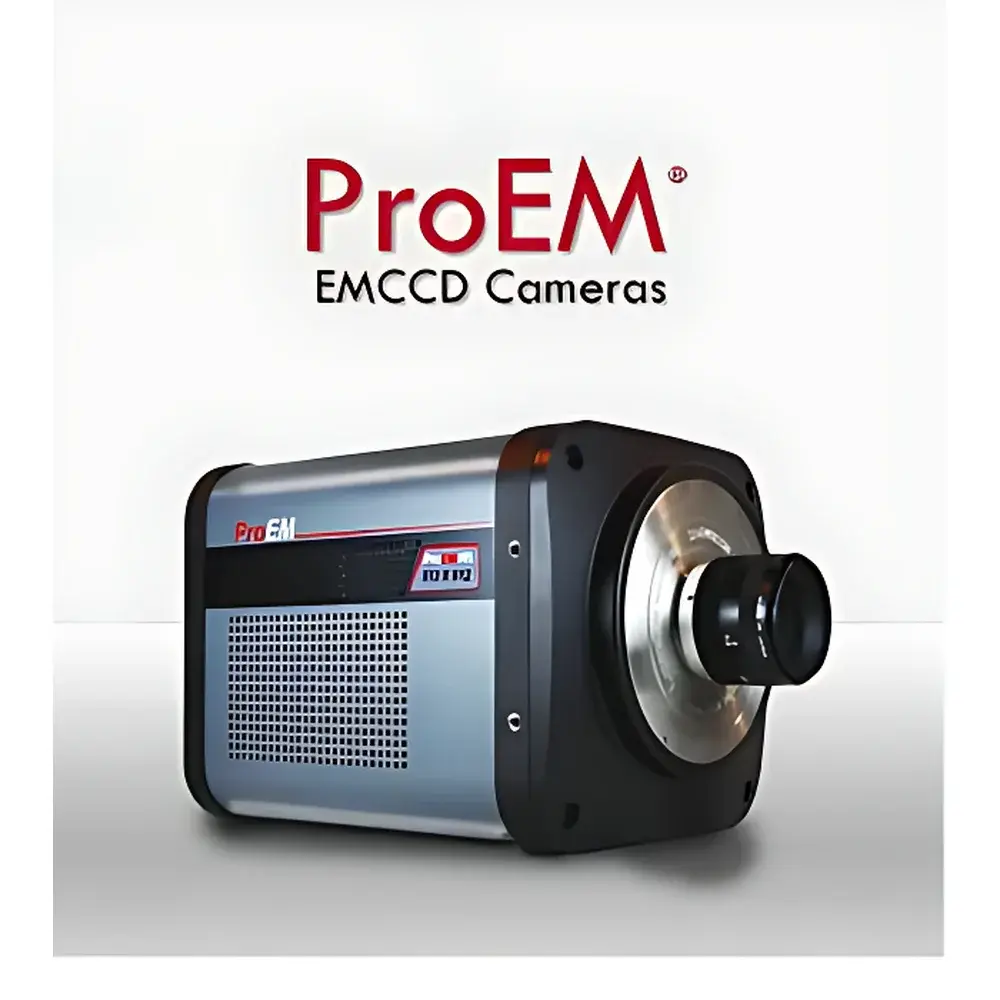
Teledyne Princeton Instruments ProEM Series eXcelon3 EMCCD Camera
| Brand | Teledyne Princeton Instruments |
|---|---|
| Origin | USA |
| Model Variants | 512BX3, 1024BX3, 1600 eXcelon3 |
| Pixel Size | 13 × 13 µm, 16 × 16 µm |
| Spectral Range | 180–1100 nm |
| Peak Quantum Efficiency | >95% |
| Cooling | −70°C vacuum-sealed thermo-electric |
| Readout Speed | Up to 34 fps full-frame |
| Interface | GigE Vision compliant |
| Data Depth | True 16-bit |
| Calibration | Built-in OptiCAL reference source with automated gain/offset correction |
Overview
The Teledyne Princeton Instruments ProEM Series eXcelon3 EMCCD Camera represents the culmination of over three decades of scientific imaging engineering focused on ultra-low-light detection. Engineered for photon-starved applications in spectroscopy and time-resolved imaging, the ProEM platform leverages electron-multiplying charge-coupled device (EMCCD) architecture with frame-transfer (FT) capability to deliver single-photon sensitivity without compromising temporal resolution or spatial fidelity. At its core lies a back-illuminated sensor architecture enhanced by proprietary eXcelon3 technology—a monolithic, anti-reflection-coated, deep-depletion silicon structure that eliminates etaloning artifacts in the near-infrared (NIR) while maximizing quantum efficiency (QE) across an unprecedented 180–1100 nm spectral band. The camera achieves effective read noise below 0.01 electrons rms through on-chip multiplication gain, enabling quantitative signal recovery where conventional CCDs reach fundamental detection limits. Its thermoelectric cooling to −70°C ensures dark current suppression to <0.001 e⁻/pix/sec, critical for long-exposure applications such as astronomical photometry or slow luminescence decay analysis.
Key Features
- eXcelon3 technology: Monolithic back-illuminated sensor with Unichrome UV-enhancing coating and deep-depletion design—delivering >95% peak QE and eliminating NIR interference fringes
- Vacuum-sealed hermetic package: Lifetime vacuum warranty ensures stable QE and gain characteristics without periodic reconditioning
- Spectra-Kinetics acquisition mode: Enables >300 kHz spectral line rates via sub-frame region-of-interest (ROI) readout with synchronized laser triggering
- OptiCAL internal calibration system: Integrated LED reference source enables automated, traceable EM gain and bias voltage calibration—ensuring reproducibility across multi-user labs and longitudinal studies
- GigE Vision-compliant interface: 1000BASE-T connectivity supports true 16-bit data streaming at up to 10 MHz pixel clock speeds—compatible with standard industrial PCs and laptops without frame grabbers
- Multiple readout architectures: Full-frame, frame-transfer, and kinetic-mode operation support both static imaging and time-resolved spectroscopy without mechanical shutter dependency
- Bias stability engine: Real-time offset correction maintains flat baseline integrity during extended acquisitions—essential for ratiometric or differential measurements
Sample Compatibility & Compliance
The ProEM series is designed for integration into regulated and non-regulated research environments requiring traceable, repeatable photonic measurement. Its hardware and LightField software comply with key principles of Good Laboratory Practice (GLP) and Good Manufacturing Practice (GMP), including audit-trail logging of acquisition parameters, user authentication, and metadata embedding per image/spectrum (e.g., exposure time, gain setting, temperature, calibration state). While not FDA 21 CFR Part 11–certified out-of-the-box, the system supports electronic signature workflows when deployed with validated IT infrastructure. Sensor response is characterized per ISO 15739:2013 (photographic sensitivity) and NIST-traceable spectral irradiance standards. The 180–1100 nm spectral coverage meets ASTM E275 (UV-Vis-NIR spectrophotometer verification) requirements for broad-band optical characterization.
Software & Data Management
LightField 64-bit acquisition software serves as the native control and analysis environment. It provides intuitive drag-and-drop experiment sequencing, real-time background subtraction, flat-field correction, and pixel defect mapping—all applied non-destructively to raw data streams. Spectral processing includes Intellical wavelength calibration using Hg/Ar/Ne lamp libraries, intensity normalization against NIST SRM references, and automated peak fitting using Levenberg-Marquardt algorithms. Data export supports HDF5, TIFF, and vendor-neutral SPE formats compatible with MATLAB, Python (via pymeasure or spefile), and commercial spectroscopy suites (e.g., OceanView, GRAMS). All acquisition metadata—including sensor temperature, EM gain value, and OptiCAL calibration timestamp—is embedded in file headers per DICOM-SR and FAIR data principles.
Applications
- Ultra-low-light spectroscopy: Raman scattering from single molecules, surface-enhanced Raman spectroscopy (SERS), and resonance Raman of catalytic intermediates under ambient or high-pressure conditions
- Time-resolved luminescence: Microsecond-to-second phosphorescence decay profiling in OLED materials, quantum dot photoluminescence kinetics, and triplet-state dynamics in photocatalysts
- Astronomical photometry: High-speed transit photometry of exoplanets, speckle interferometry of binary stars, and narrowband emission-line mapping in planetary nebulae
- Quantum optics: Hanbury Brown–Twiss intensity correlation measurements, Bose-Einstein condensate (BEC) absorption imaging, and matter-wave interferometry
- Combustion diagnostics: Laser-induced fluorescence (LIF) and spontaneous Raman scattering in turbulent methane-air flames at pressures exceeding 10 atm
- Nanomaterial characterization: Plasmonic hot-spot mapping, dark-field scattering from colloidal nanoparticles, and cathodoluminescence spectroscopy in SEM-integrated setups
FAQ
What distinguishes eXcelon3 from previous eXcelon generations?
eXcelon3 introduces a monolithic, stress-free silicon substrate with optimized anti-reflection coatings across UV-VIS-NIR—eliminating etaloning in the 700–1000 nm range while improving QE uniformity and reducing inter-pixel crosstalk.
Is the vacuum seal serviceable or replaceable?
No—the vacuum enclosure is permanently bonded and warranted for life; no maintenance, pumping, or re-evacuation is required throughout the operational lifetime.
Can the ProEM operate in photon-counting mode?
Yes—when operated with sufficient EM gain (>100×) and appropriate thresholding in LightField, the camera supports photon-event list mode acquisition with timestamp resolution down to 10 ns.
Does LightField support automated batch processing of spectral time-series?
Yes—via Python scripting API (PICAM SDK) or built-in macro recorder, users can define workflows for drift correction, peak integration, and CSV export across thousands of spectra.
How is calibration traceability maintained across multiple instruments?
OptiCAL uses a stabilized internal LED with NIST-traceable spectral output; calibration files include instrument-specific gain maps and are digitally signed to prevent tampering.



