
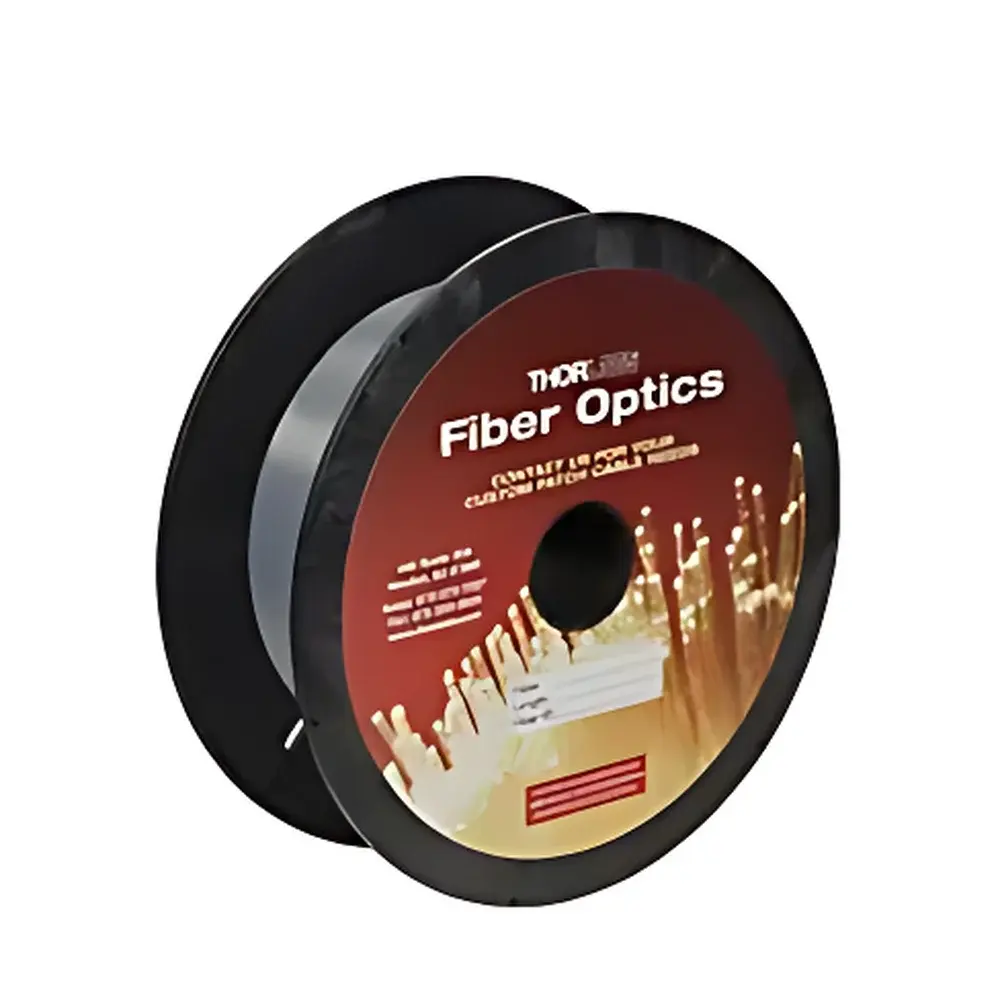
Thorlabs SPL-P2 Optical Fiber Components
| Brand | Thorlabs |
|---|---|
| Origin | USA |
| Manufacturer Type | Authorized Distributor |
| Import Status | Imported |
| Model | SPL-P2 |
| Pricing | Available Upon Request |
Overview
The Thorlabs SPL-P2 is a modular optical fiber component platform designed for precision photonic integration in research, industrial sensing, and advanced laser systems. Unlike monolithic fiber assemblies, the SPL-P2 series comprises a curated catalog of discrete, interoperable fiber types—each engineered to meet stringent specifications for numerical aperture (NA), mode field diameter, polarization extinction ratio, dispersion profile, and radiation-hardened or photosensitive dopant configurations. The platform supports both free-space and pigtailed interfacing, enabling seamless coupling into collimators, isolators, modulators, and fiber amplifiers. Its design adheres to ITU-T G.652.D, G.655, and G.657.A1 standards for single-mode transmission, while multimode variants comply with ISO/IEC 11801 and TIA-492AAAC for graded-index performance. Measurement principles are rooted in guided-wave optics governed by Maxwell’s equations and mode propagation theory—ensuring predictable beam confinement, low bend-induced loss, and high modal stability under thermal and mechanical stress.
Key Features
- Single-mode fibers with NA = 0.28 and 0.35—optimized for 1310 nm and 1550 nm telecom windows, offering <0.2 dB/km attenuation and dispersion parameters aligned with ITU-T G.652.D.
- Polarization-maintaining (PM) fibers featuring stress-applying parts (SAPs) and elliptical core geometry; typical extinction ratio >25 dB over 1 m length at 1550 nm.
- High-power multimode fibers with NA = 0.10—designed for kilowatt-level CW laser delivery in material processing applications, incorporating low-OH silica cladding and thermally stable acrylate coatings.
- Graded-index multimode fibers with NA = 0.22, 0.37/0.39, and 0.48—supporting bandwidths up to 2 GHz·km (OM3) and 4.7 GHz·km (OM4), compliant with ISO/IEC 11801-1 Ed. 3.
- Photosensitive single-mode fibers doped with germanium and boron—enabling UV-induced Bragg grating inscription with reflectivity >99% and thermal stability up to 300 °C.
- Rare-earth-doped fibers (e.g., Er/Yb co-doped, Tm-doped)—configured for cladding-pumped amplifier and laser cavity integration, with absorption cross-sections traceable to NIST-certified reference spectra.
- Dispersion-compensating single-mode fibers with negative chromatic dispersion (−100 to −200 ps/nm·km) at 1550 nm—used in DWDM system equalization per ITU-T G.655.
- Photonic crystal fibers (PCF) with air-hole microstructure—offering endlessly single-mode guidance, anomalous dispersion tuning, and enhanced nonlinear coefficient (γ > 10 W⁻¹·km⁻¹) for supercontinuum generation.
Sample Compatibility & Compliance
The SPL-P2 fiber portfolio is validated for use in Class 1 and Class 4 laser environments per IEC 60825-1:2014. All silica-based fibers meet RoHS Directive 2011/65/EU and REACH Regulation (EC) No. 1907/2006. PM fibers undergo batch-level polarization extinction testing per Telcordia GR-1221-CORE. Photosensitive and rare-earth-doped variants include full spectral absorption/emission characterization reports (350–2000 nm), traceable to NIST SRM 2035 and SRM 2036. Documentation packages support GLP/GMP-aligned lab workflows—including lot-specific certificates of conformance, refractive index profiles (measured via near-field scanning), and proof-test records (100 kpsi tensile strength verification).
Software & Data Management
While the SPL-P2 itself is a passive optical component, Thorlabs provides complementary digital tools for system-level design and validation: the free Fiber Optic Toolbox (v3.2+) enables mode field diameter calculation, splice loss estimation (using Gaussian overlap integral), and dispersion slope modeling across temperature ranges (−40 °C to +85 °C). All product data sheets, mechanical drawings (STEP/IGES), and spectral attenuation curves are hosted on Thorlabs’ secure portal with audit-trail logging—fully compatible with FDA 21 CFR Part 11-compliant electronic record systems when deployed in regulated QC/QA environments.
Applications
- Fiber Bragg grating (FBG) sensor arrays for structural health monitoring in aerospace and civil infrastructure.
- Ultrafast laser pulse compression and nonlinear frequency conversion using PCF and highly nonlinear SMF.
- High-fidelity analog RF-over-fiber links requiring phase-stable PM fiber spools.
- Medical laser delivery systems (e.g., urology, dermatology) leveraging high-NA multimode fibers rated for >500 W peak power.
- DWDM network test beds incorporating dispersion-compensating fiber modules for channel equalization.
- Quantum optics experiments utilizing polarization-entangled photon sources based on type-II SPDC in birefringent PM fiber.
FAQ
What is the minimum bend radius specification for SPL-P2 single-mode fibers?
Standard G.652.D-compliant SPL-P2 SMF has a long-term bend radius of 30 mm and short-term radius of 15 mm per IEC 60793-2-50.
Are SPL-P2 photosensitive fibers compatible with standard UV writing systems (e.g., 244 nm excimer lasers)?
Yes—photosensitivity is optimized for 244 nm and 248 nm exposure; grating inscription requires controlled hydrogen loading (100 bar, 72 h) prior to UV irradiation.
Can SPL-P2 multimode fibers be used in FDA-regulated medical device OEM assemblies?
Yes—biocompatible acrylate coatings and ISO 10993-5 cytotoxicity-tested jacketing options are available upon request with full regulatory documentation.
Do Thorlabs provide cut-and-polish services for SPL-P2 fibers?
Yes—custom cleaving, angle-polishing (8° APC), and connectorization (FC/APC, SC/APC, SMA905) are offered with interferometric end-face inspection and IL/RL certification reports.





