
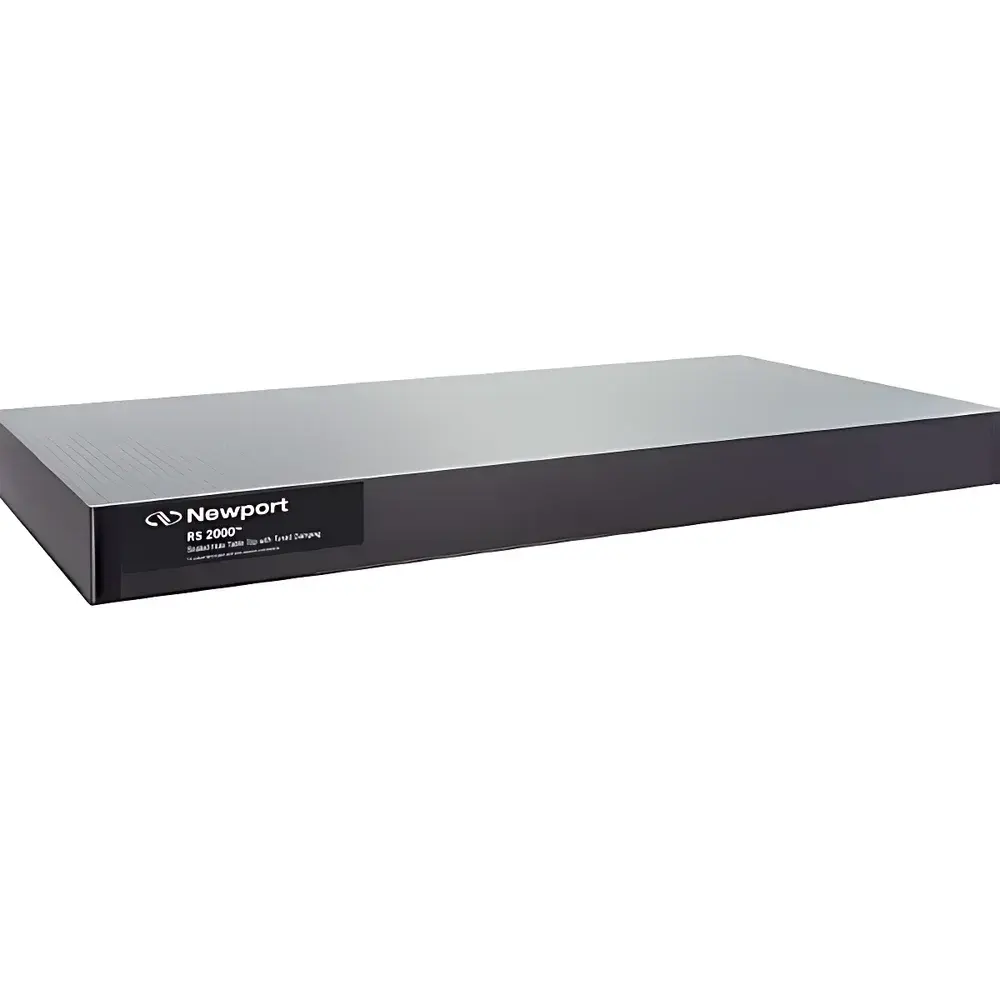
Newport RS4000 Tuned-Damping High-Performance Optical Table
| Brand | Newport |
|---|---|
| Origin | USA |
| Model | RS4000 |
| Surface Thickness | 4.8 mm |
| Core Construction | Vertically Bonded Trussed Honeycomb (0.010 in. Steel Sheets) |
| Damping System | 6 Precision-Tuned Mass-Damping Units (25–525 Hz) |
| Mounting Holes | 1/4"-20 or M6, 19 mm Depth, Conical Polymer Cups |
| Grid Pitch | 1.0 in. (25 mm for M-version) |
| Edge Finish | Composite |
| Load Interface | Triple-Core Truss Interface |
| Dimensions | 1200 × 2400 × 305 mm (48 × 96 × 12 in.) |
Overview
The Newport RS4000 Tuned-Damping High-Performance Optical Table is engineered for laboratories where sub-micron positional stability and ultra-low vibrational transmissibility are non-negotiable. Unlike conventional broadband-damped optical tables that dissipate energy uniformly across a wide frequency spectrum, the RS4000 implements a physics-based, resonance-targeted passive isolation strategy: Tuned Mass Damping (TMD). Each of its six independently adjustable dampers is precisely calibrated to counteract dominant structural modes—specifically the first four fundamental flexural and torsional resonances—and their harmonics. This approach delivers peak damping efficacy at discrete frequencies (25–525 Hz), minimizing displacement amplification at critical modal peaks while preserving structural rigidity. The table’s performance envelope is validated via dynamic compliance curves, where measured deflection under controlled excitation remains within 10 nm/µN above 10 Hz—well below the rigid-body limit—making it suitable for applications demanding coherence times exceeding seconds, such as heterodyne interferometry, quantum optics alignment, and live-cell super-resolution microscopy with >10 s exposure durations.
Key Features
- 6 precision-tuned mass-damping units, individually adjustable for optimal resonance suppression across primary structural modes and harmonics
- Vertically bonded trussed honeycomb core constructed from 0.010 in. (0.25 mm) ferromagnetic stainless steel sheets, providing high specific stiffness and minimal thermal drift
- 4.8 mm thick 430 stainless steel working surface with constrained-layer damping architecture: viscoelastic interlayer sandwiched between steel laminae, combined with composite edge reinforcement
- Triple-core interface technology enhances point-load capacity and reduces local deformation under concentrated loads (e.g., heavy laser mounts or vacuum chambers)
- Individually sealed conical polymer mounting cups (19 mm deep, non-corrosive high-impact polymer), preventing particulate ingress and enabling solvent-compatible cleaning without compromising damping integrity
- Alphanumeric grid etching for rapid coordinate referencing; 1.0 in. (25 mm for metric version) orthogonal hole pattern with 1/4″-20 or M6 threading
Sample Compatibility & Compliance
The RS4000 platform is compatible with standard optical components (lenses, mirrors, translation stages, piezo actuators) and integrates natively with Newport’s S-2000A active leveling isolators and LabLegs support systems. Its surface flatness (≤ ±15 µm over 1 m²) and thermal coefficient of expansion (10.8 × 10⁻⁶ /°C for 430 SS) ensure long-term alignment stability in temperature-controlled cleanrooms (ISO Class 5–7). While not certified to ISO 14644 or ASTM E1773 per se—optical tables are infrastructure elements, not measurement devices—the RS4000 meets the mechanical stability prerequisites for GLP-compliant instrumentation setups and supports FDA 21 CFR Part 11 audit-trail requirements when deployed in regulated analytical labs (e.g., metrology validation workflows, laser-based particle sizing calibration).
Software & Data Management
The RS4000 is a passive mechanical system and does not incorporate embedded electronics, firmware, or proprietary software. However, its dynamic performance data—including published compliance curves, modal analysis reports (per ASTM E756), and finite element simulation outputs—are available in Newport’s technical documentation portal for integration into lab validation protocols. Users may import these datasets into MATLAB, Python (SciPy), or COMSOL Multiphysics for custom vibration transmission modeling, particularly when designing multi-stage isolation configurations or assessing coupling between floor-borne noise sources and sensitive payloads.
Applications
- Long-coherence-length interferometry (Michelson, Mach–Zehnder, Twyman–Green) requiring phase stability < λ/20 over ≥60 s
- Single-molecule fluorescence imaging and STORM/PALM microscopy with exposure times >5 s
- Laser cavity alignment for ultra-stable frequency combs and narrow-linewidth CW lasers
- Atomic force microscopy (AFM) and scanning tunneling microscopy (STM) in non-vacuum or low-vibration ambient environments
- Gravitational wave detector prototype testing and quantum optomechanics experiments
- Calibration of high-accuracy coordinate measuring machines (CMMs) and laser trackers per ISO 10360
FAQ
What distinguishes Tuned Mass Damping (TMD) from broadband damping?
TMD targets specific resonant frequencies using inertial mass-spring-damper subsystems tuned to match structural modes; broadband damping relies on distributed viscoelastic layers that attenuate energy across a wide band but with lower peak effectiveness.
Can the RS4000 be used without external isolators?
Yes—it provides intrinsic passive damping, but optimal performance in vibration-sensitive environments requires pairing with S-2000A or SL-series isolators to suppress sub-10 Hz floorborne disturbances.
Is the RS4000 compatible with vacuum chamber mounting?
Yes; its stainless steel surface and polymer cup seals are UHV-compatible when cleaned per ASTM F1524; outgassing rates meet NASA SP-R-0022A specifications.
How often do the tuned dampers require recalibration?
None—mechanical tuning is factory-set and stable over decades; no maintenance or recalibration is specified under normal laboratory conditions.
Does Newport provide modal analysis data for custom-cut RS4000 tables?
Yes—finite element-derived mode shapes and natural frequencies are supplied upon request for non-standard dimensions, supporting experimental design validation.



