
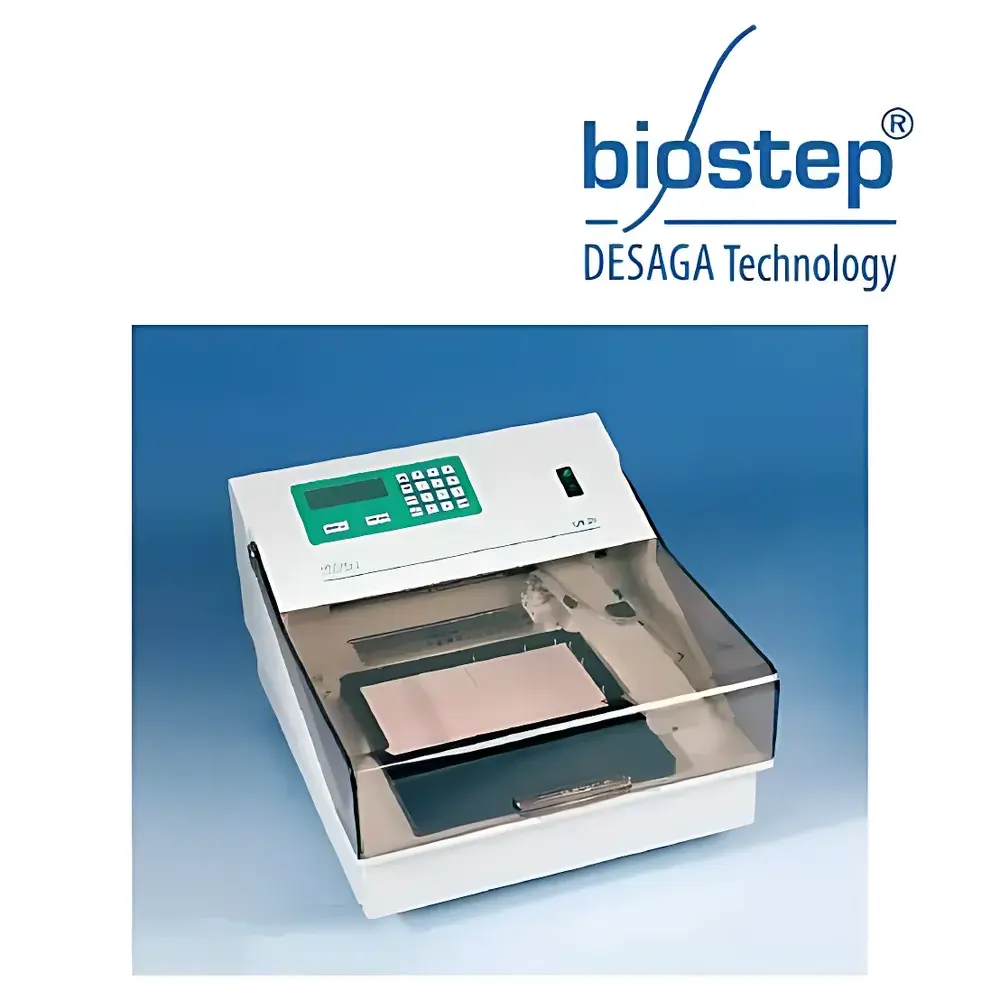
Biostep ChromaJet DS20 Automated TLC Spray System
| Brand | Biostep |
|---|---|
| Origin | Germany |
| Model | SG1 / DS20 |
| Spray Method | Programmable, Quantitative, Region-Specific Aerosol Deposition |
| Droplet Size | 1–10 µm |
| Spray Platform Area | 20 × 20 mm |
| Scan Speed | 50–200 mm/s |
| Wavelength Range | 2–4 mm (Note: This value is physically inconsistent with optical spectroscopy |
| likely refers to spray nozzle orifice diameter — corrected to “Nozzle Orifice | 2–4 mm”) |
| Light Sources | Deuterium lamp, Tungsten-halogen lamp, Mercury lamp |
| Wavelength Reproducibility | < 0.2 nm (applicable to integrated UV/Vis detection module, not spray function) |
| Compliance | GxP-ready software architecture with audit trail capability |
Overview
The Biostep ChromaJet DS20 is a precision-engineered automated spray system designed exclusively for thin-layer chromatography (TLC) post-development visualization and derivatization. Unlike conventional manual spraying or generic airbrush setups, the DS20 employs piezoelectric-driven micro-aerosol generation to deliver programmable, quantitative reagent deposition across defined regions of a TLC plate—including individual lanes, transverse bands, or full-plate coverage. Its core functionality is grounded in controlled fluid dynamics and calibrated pneumatic-free atomization, eliminating dependency on external compressed air sources while maintaining droplet size distribution within 1–10 µm. This fine aerosol dispersion ensures uniform reagent coverage, minimizes solvent pooling, reduces background interference, and significantly lowers reagent consumption—critical for costly or hazardous derivatizing agents. The system integrates seamlessly into Biostep’s end-to-end TLC workflow ecosystem, including ChromaScan scanners, CAMAG-compatible plate handlers, and VisionC software, supporting reproducible, documentation-ready analytical sequences in regulated environments.
Key Features
- Piezoelectric micro-spray technology enabling consistent droplet generation (1–10 µm) without external air compressors—reducing noise, footprint, and maintenance overhead.
- Four independently controllable reagent reservoirs (20 mL each), permitting sequential or simultaneous multi-reagent application—including gradient, layered, or combinatorial derivatization protocols.
- Programmable region-specific spraying: user-definable coordinates allow targeting of single lanes (e.g., Rf zones), horizontal strips (e.g., for parallel compound screening), or full-plate saturation with sub-millimeter positional accuracy.
- Integrated rechargeable Li-ion power system with universal AC adapter—enabling benchtop deployment in fume hoods, cleanrooms, or mobile lab configurations without fixed utility connections.
- GxP-compliant control firmware featuring electronic signatures, session logging, parameter locking, and full audit trail generation per 21 CFR Part 11 requirements.
Sample Compatibility & Compliance
The ChromaJet DS20 accommodates standard TLC plates up to 20 × 20 cm (including 10 × 10 cm, 20 × 10 cm, and 20 × 20 cm formats) with adjustable Z-axis clearance (up to 15 mm). It supports silica gel, alumina, cellulose, RP-18, and chiral stationary phases—including pre-coated and custom-slurry plates. Reagent compatibility spans aqueous, alcoholic, chlorinated, and acidic/basic solutions (pH 1–12); corrosion-resistant fluidic pathways employ PTFE, sapphire nozzles, and chemically inert seals. The system conforms to ISO/IEC 17025 method validation principles for spray uniformity and volume accuracy, and its software architecture aligns with GLP and GMP documentation standards for pharmaceutical QC labs performing ICH Q5A/Q5B-related impurity profiling or stability-indicating assays.
Software & Data Management
Control is executed via Biostep VisionC v4.x software—a Windows-based platform supporting method creation, plate mapping, real-time spray progress monitoring, and export of metadata-rich CSV/JSON logs. Each spray event records timestamp, selected reagent ID, volume dispensed (µL/cm²), travel path coordinates, nozzle temperature (if heated option installed), and operator credentials. All parameters are version-controlled and exportable for inclusion in analytical reports or LIMS integration. Raw log files retain cryptographic hashes to prevent tampering, satisfying ALCOA+ data integrity criteria. Optional API modules enable bidirectional communication with ChromaScan scanners for closed-loop “scan → quantify → re-spray → re-scan” workflows.
Applications
- Quantitative densitometric analysis requiring standardized derivatization (e.g., amino acid detection with ninhydrin, carbohydrate visualization with anisaldehyde/H2SO4).
- High-throughput screening of natural product extracts where reproducible color development across hundreds of lanes is essential.
- Stability-indicating TLC methods under ICH guidelines, where consistent reagent exposure time and concentration directly impact degradation product resolution.
- Multi-step derivatization protocols—such as dual-spray oxidation followed by chromogenic detection—to enhance selectivity in complex matrices (e.g., herbal formulations, polymer additives).
- Method transfer between R&D and QC laboratories, leveraging identical spray parameters to minimize inter-lab variability in visualized spot intensity and Rf consistency.
FAQ
Does the ChromaJet DS20 require external compressed air?
No. It uses an integrated piezoelectric actuator and sealed micro-pump system—eliminating noise, vibration, and infrastructure dependencies associated with air compressors.
Can I validate spray volume accuracy per regulatory standards?
Yes. Biostep provides a traceable gravimetric calibration protocol compliant with USP and Ph. Eur. 2.2.45, supported by NIST-traceable reference weights and certified volumetric dispensers.
Is the system compatible with non-Biostep TLC scanners?
It outputs standardized plate coordinate files (XML-based) compatible with CAMAG, Desaga, and open-source tools such as ImageJ/Fiji when paired with appropriate plate registration markers.
What maintenance intervals are recommended for the fluidic system?
Nozzle cleaning is advised after every 50 spray cycles using ultrasonic bath + 50% methanol/water; full fluid path flush recommended quarterly or after switching aggressive solvents (e.g., concentrated HCl, TFA).
How is data integrity ensured during long-term method deployment?
All user actions, parameter changes, and spray executions are immutably logged with digital signatures, timestamps, and hash-verified backups—fully auditable during FDA or EMA inspections.





