
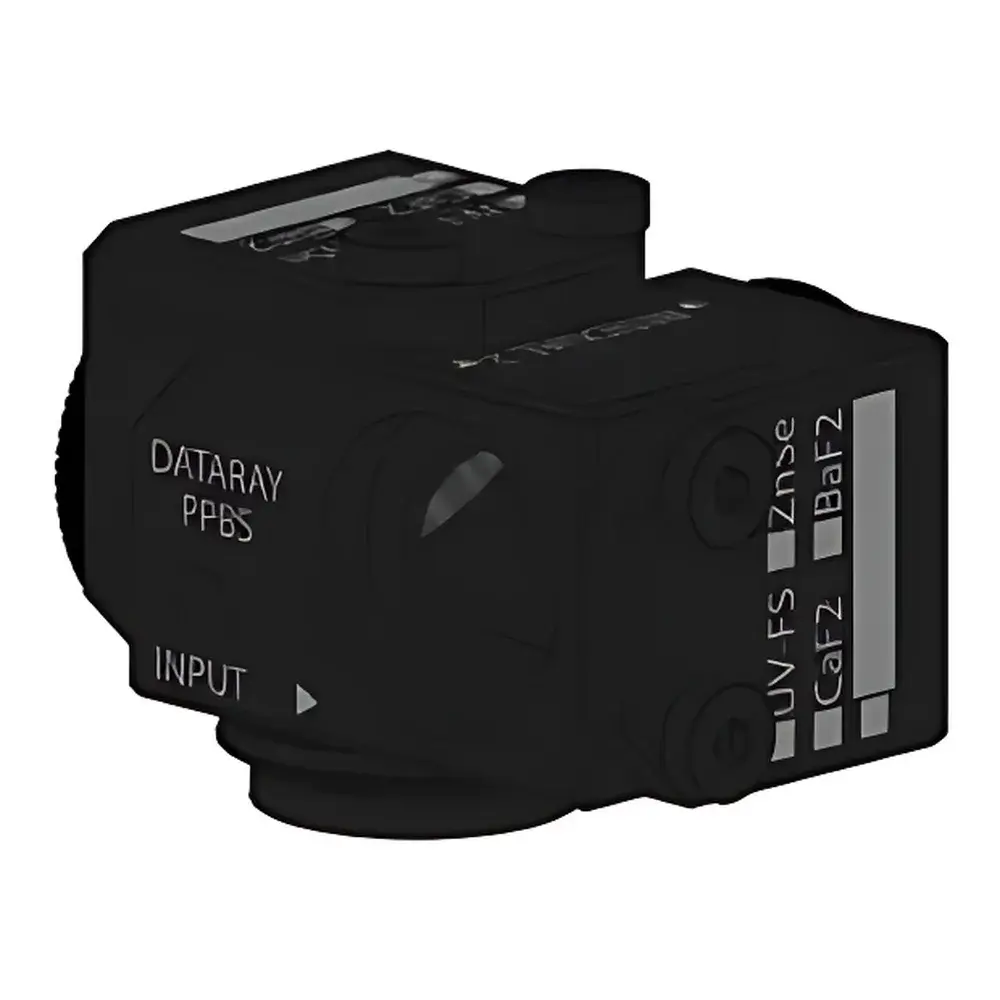
DataRay Polarization-Maintaining Beam Sampler (PPBS) and Accessories
| Brand | DataRay |
|---|---|
| Origin | USA |
| Manufacturer Type | Authorized Distributor |
| Import Status | Imported |
| Model | PPBS |
| Price Range | USD $0–7,200 (est.) |
Overview
The DataRay Polarization-Maintaining Beam Sampler (PPBS) is an optomechanical component engineered for high-fidelity sampling of polarized laser beams in beam profiling and characterization systems. Unlike conventional pellicle or plate beam splitters, the PPBS employs a precision-aligned orthogonal dual-wedge architecture—fabricated from fused silica or CaF₂ substrates—to extract a stable, low-distortion sample beam while rigorously preserving the incident polarization state. This design eliminates parasitic interference from multiple air-glass reflections by ensuring only one effective optical interface per wedge, thereby maintaining wavefront fidelity and minimizing depolarization. The device operates on the principle of controlled geometric beam displacement rather than amplitude splitting, enabling quantitative beam analysis without introducing polarization crosstalk or spatial distortion—critical for applications requiring polarization-resolved M² measurement, mode decomposition, or real-time alignment feedback in ultrafast or quantum optics setups.
Key Features
- Polarization-maintaining architecture: Orthogonal dual-wedge configuration preserves input linear/circular polarization with <0.5° retardance deviation across specified spectral bands
- Wide spectral coverage: 190 nm to 16 µm—achieved via interchangeable wedge materials (e.g., UV-grade fused silica for 190–2.5 µm; ZnSe or KRS-5 for mid- to far-IR)
- High-power compatibility: Rated for continuous-wave (CW) laser operation up to 50 W average power with appropriate thermal management
- Large clear aperture: 17.5 mm diameter usable area supports collimated beams up to Ø15 mm without vignetting
- Predictable attenuation ratio: Nominal ~1000:1 (0.1% sampling) with wavelength-dependent variation ±15%; calibrated transmission data provided per unit
- Mounting interface: Standard SM1 (1.035″-40) threading compatible with Thorlabs, Newport, and DataRay beam profiling mounts
Sample Compatibility & Compliance
The PPBS is designed for integration into ISO/IEC 17025-accredited laser metrology workflows and complies with relevant sections of ANSI Z136.1 (Safe Use of Lasers) and IEC 60825-1 for Class 3B/4 laser interfacing. It supports beam diameters from 1 mm to 15 mm and accommodates divergence angles up to ±2.5 mrad without significant wavefront error. When used with DataRay WinCamD or Beam’R2 sensors, the system meets ASTM E1423-22 requirements for beam parameter measurement uncertainty (<±3% for beam width, <±5% for centroid position). The device is suitable for GLP-compliant environments when paired with audit-trail-enabled software (e.g., DataRay’s BeamGage v7.0 with FDA 21 CFR Part 11 compliance options).
Software & Data Management
The PPBS functions as a passive front-end element within DataRay’s full beam analysis ecosystem. When integrated with BeamGage Professional software, it enables polarization-aware beam diagnostics—including Stokes parameter mapping, degree-of-polarization (DoP) calculation, and Mueller matrix reconstruction (when combined with rotating waveplate modules). All raw intensity data are stored in vendor-neutral HDF5 format with embedded metadata (wavelength, sampling ratio, calibration timestamp, operator ID). Software-generated reports include NIST-traceable uncertainty budgets and support automated pass/fail evaluation against user-defined specifications (e.g., ISO 11146-1:2022 beam quality thresholds).
Applications
- Laser manufacturing QC: Real-time monitoring of polarization stability during fiber laser welding, ultrafast ablation, and selective laser sintering
- Free-space optical communications: Characterization of polarization-mode dispersion (PMD) in coherent transceivers and quantum key distribution (QKD) testbeds
- Biomedical laser systems: Validation of polarization purity in ophthalmic femtosecond lasers (e.g., LDV platforms) and photodynamic therapy sources
- Scientific instrumentation: Alignment and diagnostic sampling in cavity-dumped OPOs, frequency combs, and cold-atom trapping lasers
- LIDAR & sensing: Calibration of polarization-sensitive time-of-flight (ToF) receivers and atmospheric backscatter analyzers
- R&D labs: Enabling non-invasive beam diagnostics in vacuum-compatible or radiation-hardened enclosures (optional custom housing available)
FAQ
Can the PPBS be used with pulsed lasers?
Yes—rated for nanosecond to femtosecond pulses at repetition rates up to 1 MHz, provided peak fluence remains below 0.5 J/cm² for UV wavelengths and 5 J/cm² for IR wavelengths.
Is calibration data provided with each unit?
Each PPBS ships with a factory-measured spectral transmission curve (200 nm–12 µm), polarization extinction ratio (PER > 30 dB), and angular alignment tolerance report.
How does the PPBS compare to fiber-based polarization-maintaining taps?
Unlike fiber couplers, the PPBS introduces zero modal noise, no bending loss, and no wavelength-dependent coupling drift—making it preferred for broadband or multi-wavelength beam analysis.
Are custom wedge materials or coatings available?
Yes—custom AR coatings (R<0.25% @ specific λ), Brewster-angle wedges, or substrate substitutions (e.g., MgF₂ for deep-UV) are available under NRE agreement.
Does the PPBS require recalibration after thermal cycling?
No—mechanical stability is validated over –20°C to +60°C; transmission ratio drift is <±0.8% across this range per MIL-STD-810G thermal shock testing.




