
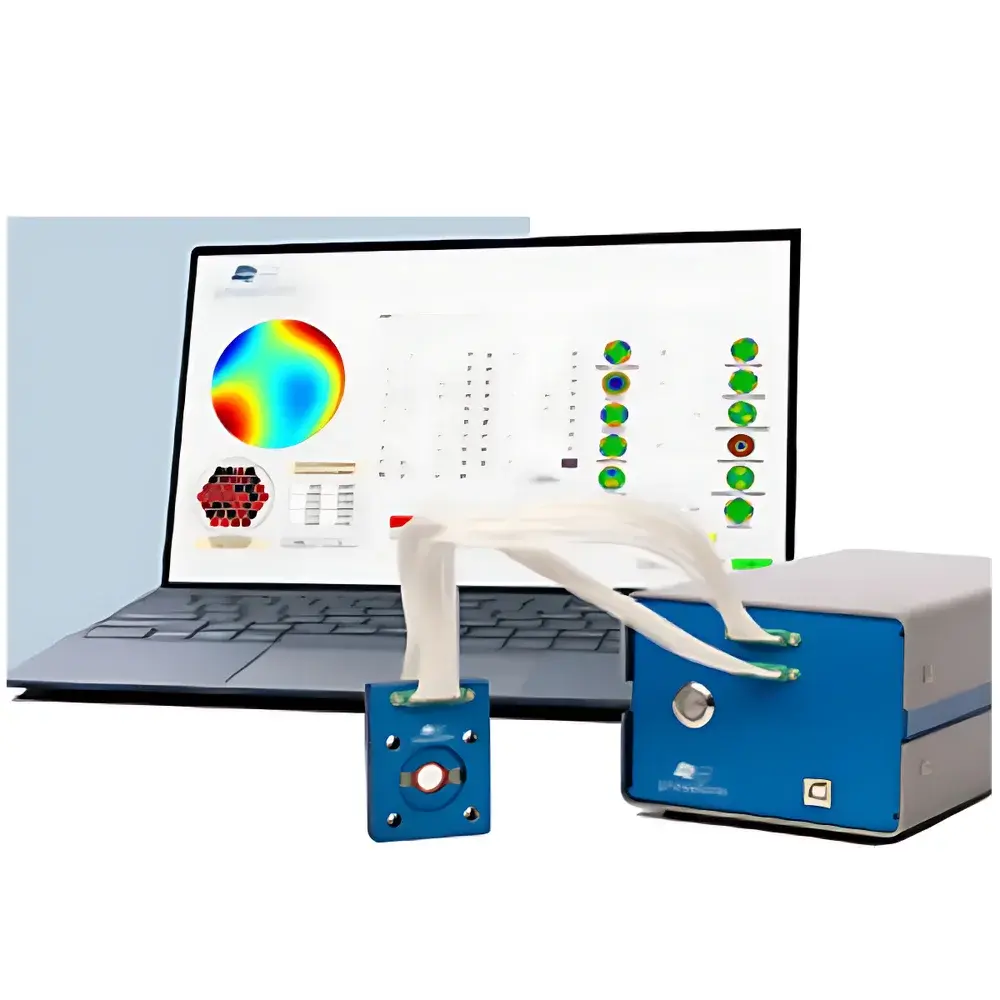
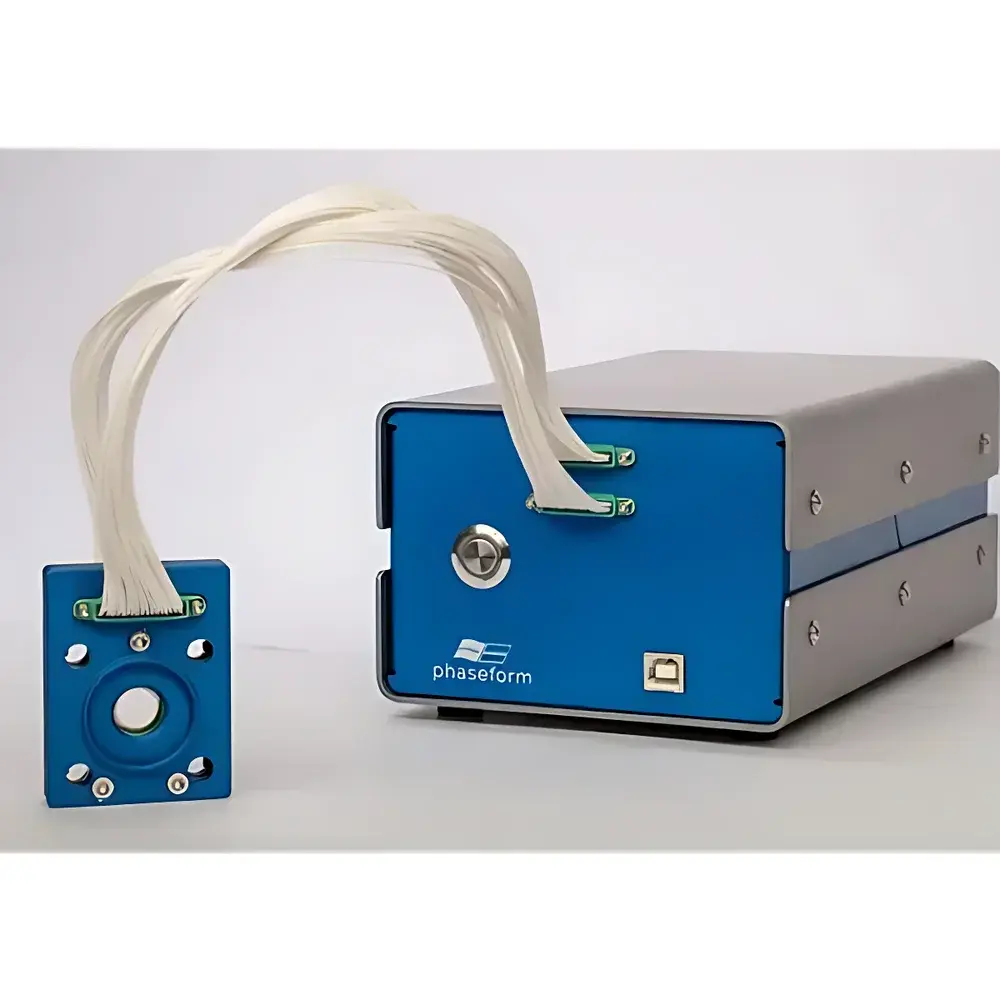
Phaseform Transmissive Wavefront Modulator – Deformable Phase Plate (DPP)
| Brand | Phaseform |
|---|---|
| Origin | Germany |
| Type | Imported Optical Component |
| Mounting | Transmissive, Polarization-Insensitive |
| Operating Principle | Refractive Microfluidic MEMS-Based Phase Modulation |
| Zernike Mode Support | Up to 7th Radial Order (Open-Loop) |
| Wavelength Range | Visible Spectrum (400–700 nm) |
| Aperture | Standard Clear Pupil Diameter (Customizable) |
| Electrode Layout | Intra-Aperture Electrode Array |
| Compliance | ISO 10110-7 (Optical Surface Irregularity), RoHS, CE Marked |
| Software Interface | Phaseform DPP Control SDK (C++/Python), Compatible with Zemax OpticStudio & Code V Ray Tracing Environments |
Overview
The Phaseform Transmissive Wavefront Modulator – Deformable Phase Plate (DPP) is a micro-opto-electro-mechanical system (MOEMS) engineered for high-fidelity, real-time wavefront shaping in demanding optical research and industrial applications. Unlike conventional adaptive optics (AO) devices—such as deformable mirrors (DMs) or liquid crystal spatial light modulators (LC-SLMs)—the DPP operates on a refractive, transmissive principle enabled by an integrated microfluidic actuation architecture. Developed from foundational research at the Institute of Microsystems Engineering (IMTEK), University of Freiburg, the DPP leverages precision MEMS fabrication and optofluidic encapsulation to generate continuous, analog phase profiles across its clear aperture without beam folding or polarization constraints. Its core functionality resides in a monolithic, planar glass substrate containing an array of individually addressable microelectrodes embedded beneath a transparent, elastomeric fluid layer. Voltage application induces localized hydrostatic pressure gradients, deforming an ultra-smooth polymer–air interface to produce programmable optical path differences. This mechanism delivers diffraction-limited phase modulation with sub-nanometer surface repeatability and zero hysteresis—critical for closed-loop AO systems requiring long-term stability and metrological traceability.
Key Features
- Transmissive architecture: No beam deviation, no polarization dependence, no need for relay optics or fold mirrors—enables direct in-line integration into collimated or convergent beams.
- Compact form factor: Sub-25 mm × 25 mm footprint with <10 mm total thickness; compatible with standard kinematic mounts and OEM optical breadboards.
- High spatial fidelity: Supports continuous Zernike polynomial decomposition up to 7th radial order (Z70, Z7±7); maintains >98% fidelity for Z20 (defocus) and Z40 (primary spherical aberration) under open-loop control.
- Visible-spectrum optimization: Engineered for broadband operation from 400 nm to 700 nm with <0.5% transmission loss per surface and <λ/50 RMS wavefront error in static configuration.
- Intra-aperture electrode design: All active electrodes reside within the clear optical pupil—eliminating edge diffraction artifacts and enabling full-pupil wavefront correction without vignetting.
- MEMS-grade reliability: Hermetically sealed optofluidic cavity with >10⁷ actuation cycles lifetime; qualified per MIL-STD-883H mechanical shock and thermal cycling protocols.
Sample Compatibility & Compliance
The DPP is designed for integration into Class I and Class II laser safety-compliant optical trains operating under ANSI Z136.1 and IEC 60825-1 standards. Its all-glass construction and absence of metallic coatings ensure compatibility with UV-curable adhesives, vacuum environments (<10⁻⁴ mbar), and cleanroom-compatible handling (ISO Class 5). The device conforms to ISO 10110-7 for surface figure tolerance (≤λ/20 PV over clear aperture), EN 61326-1 for electromagnetic compatibility in laboratory instrumentation, and RoHS Directive 2011/65/EU. For regulated life science applications—including ophthalmic imaging and confocal microscopy—the DPP supports audit-ready logging when paired with Phaseform’s SDK-enabled control firmware, meeting GLP-aligned data integrity requirements (ALCOA+ principles).
Software & Data Management
Phaseform provides a cross-platform Software Development Kit (SDK) supporting C++, Python 3.8+, and MATLAB R2021b+. The SDK includes native drivers for PCIe and USB 3.2 Gen 1 interfaces, real-time waveform generation engines, and Zernike coefficient mapping utilities. Integrated ray-tracing interoperability enables bidirectional data exchange with Zemax OpticStudio (via .ZBF binary export) and CODE V (using ASCII-based surface sag import). A standalone DPP Digital Twin model—distributed as a compiled optical propagation engine—allows users to simulate phase response, diffraction efficiency, and Strehl ratio degradation under arbitrary aberration loads prior to physical implementation. All control sessions support timestamped metadata logging (including voltage history, temperature telemetry, and actuator status), compliant with FDA 21 CFR Part 11 electronic record requirements when deployed with validated IT infrastructure.
Applications
- Biomedical Microscopy: Real-time compensation of specimen-induced spherical aberration in multiphoton and light-sheet imaging; integration with adaptive illumination for structured illumination microscopy (SIM).
- Ophthalmic Diagnostics: Dynamic correction of higher-order ocular aberrations in Shack–Hartmann aberrometers and adaptive optics scanning laser ophthalmoscopes (AOSLO).
- Microfabrication: Beam shaping for two-photon polymerization and direct laser writing systems, enabling voxel-level intensity and phase control in 3D nanolithography.
- Extended Reality Optics: Dynamic focus rendering in varifocal near-eye displays; chromatic aberration correction across RGB subpixels using wavelength-dependent Zernike tuning.
- Industrial Metrology: In situ wavefront calibration of high-NA objective lenses and EUV lithography projection optics; alignment-free interferometric reference generation.
FAQ
What is the maximum applicable optical power density for continuous-wave lasers?
The DPP is rated for ≤500 mW/mm² at 532 nm (CW), with thermal management verified via finite-element modeling and IR thermography under sustained irradiation.
Can the DPP be used in vacuum or inert gas environments?
Yes—hermetic packaging allows operation at pressures down to 10⁻⁴ mbar; nitrogen-purged housings are available for moisture-sensitive applications.
Is closed-loop operation supported out of the box?
The DPP itself is an open-loop actuator; however, Phaseform offers optional Hartmann–Shack sensor integration kits and PID feedback modules compatible with third-party wavefront sensors.
How is calibration performed, and how often is recalibration required?
Factory calibration includes Zernike mode crosstalk matrix measurement and voltage–phase transfer function characterization; field recalibration is recommended annually or after 10⁶ actuation cycles.
Does the SDK support real-time control with sub-millisecond latency?
Yes—USB 3.2 Gen 1 achieves <800 µs round-trip latency for 32-electrode configurations; PCIe variants achieve <120 µs with deterministic timing via RTOS-compatible drivers.




