
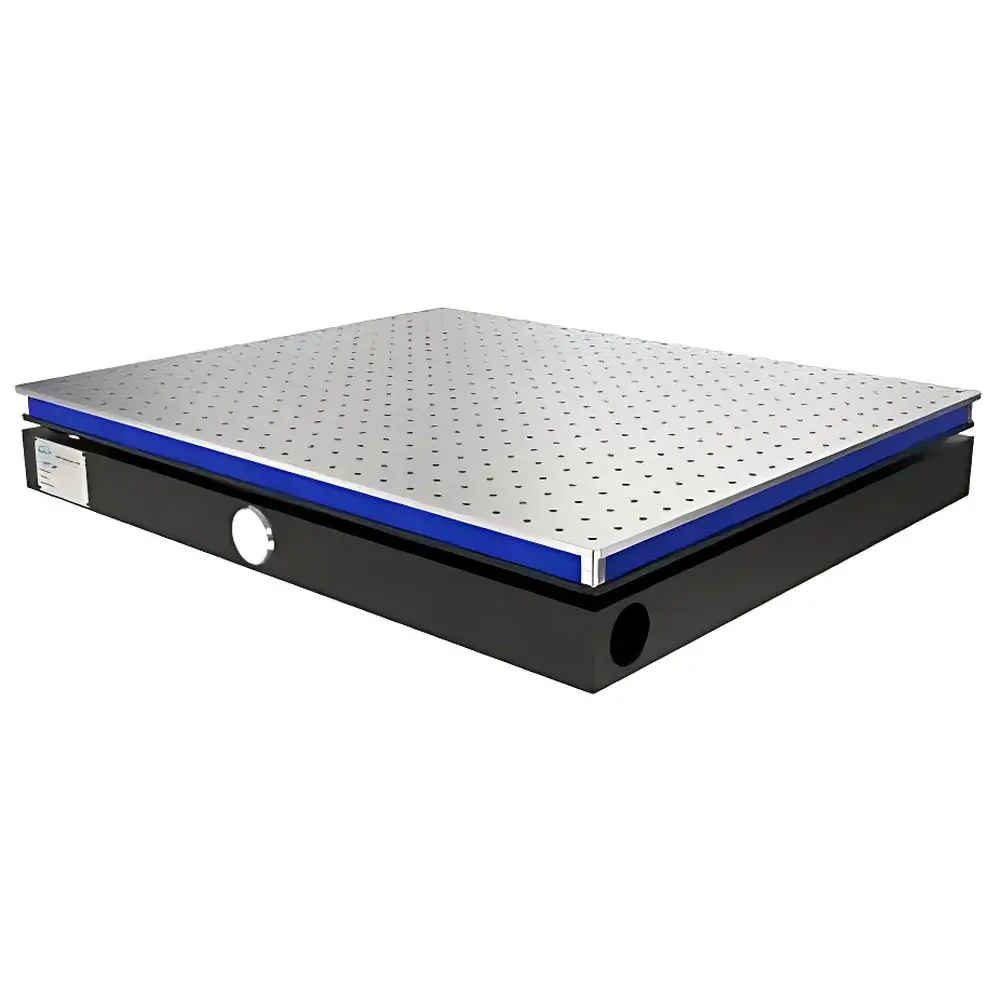
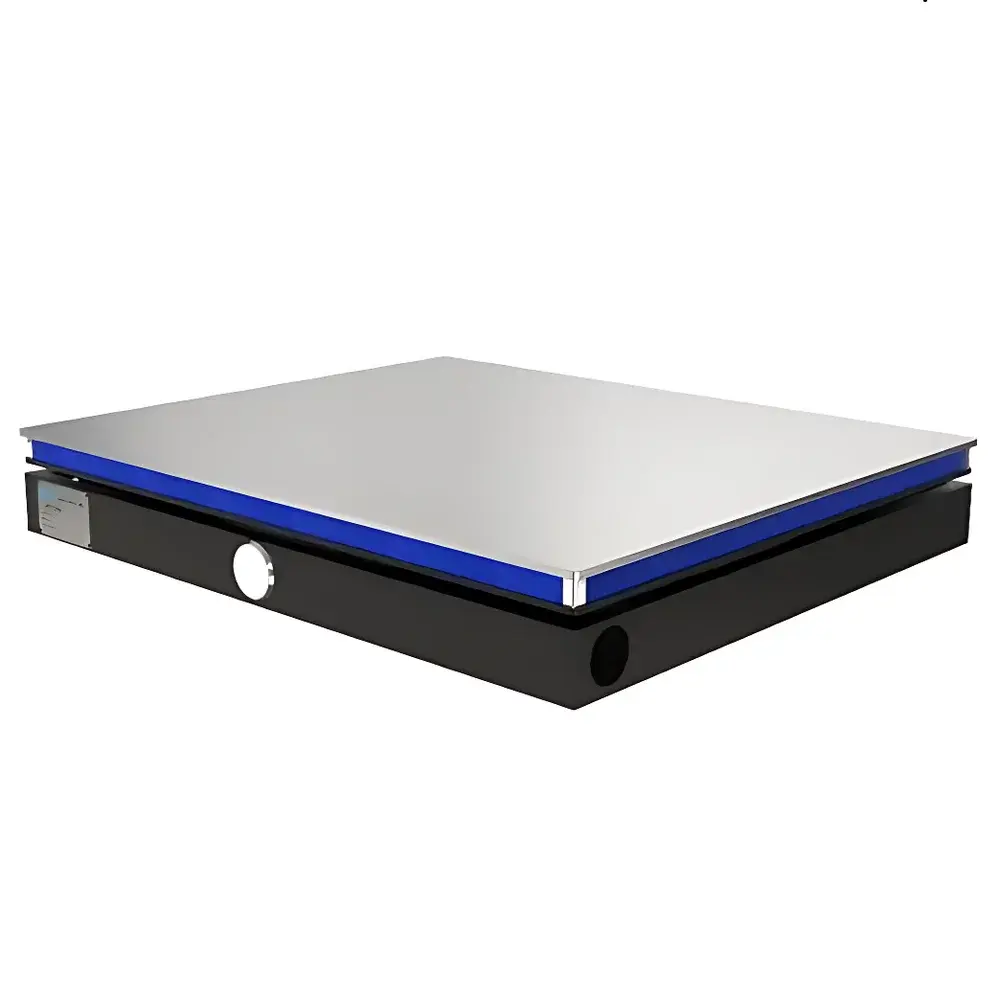
SPL PD-Series Desktop Pneumatic Optical Isolation Platform with M6 Tapped or Smooth Surface
| Brand | SPL |
|---|---|
| Origin | Zhejiang, China |
| Model | SPLPD-0504-M6, SPLPD-0504-X |
| Platform Dimensions (L×W×H) | 530×430×109 mm (incl. rubber feet) |
| Top Plate Material | SUS430 cold-rolled ferritic stainless steel |
| Base Plate Material | SS400 structural steel |
| Isolation Mechanism | Soft compression-molded diaphragm air springs |
| Auto-leveling System | Three-point pneumatic height sensor array |
| Natural Frequency | 2–3 Hz (vertical & horizontal, load-dependent) |
| Load Capacity | 100 kg |
| Surface Options | 25×25 mm M6 tapped grid or optically smooth finish |
| Weight | 46–118 kg (model-dependent) |
| Accessories | Included leveling gauge |
Overview
The SPL PD-Series Desktop Pneumatic Optical Isolation Platform is an engineered solution for vibration-sensitive optical setups requiring high-stability mechanical support in space-constrained laboratory environments. Designed around a rigid, low-profile welded honeycomb-core structure—commonly referred to as a “grid-welded” or “well-structured” base—the platform integrates a passive pneumatic isolation system using ultra-soft compression-molded diaphragm air springs. This architecture achieves a natural frequency range of 2–3 Hz in both vertical and horizontal directions under typical operational loads (up to 100 kg), effectively attenuating floor-borne vibrations above ~5 Hz—a critical threshold for interferometry, confocal microscopy, laser alignment, and quantum optics experiments. Unlike active isolation systems, the PD-Series relies on intrinsic mechanical compliance and gas-damped resonance suppression, offering long-term stability without electronic feedback loops or power dependency. Its compact form factor (as low as 109 mm total height including integrated rubber leveling feet) makes it suitable for benchtop integration beneath microscopes, optical tables, or modular photonics workstations.
Key Features
- Rigid dual-layer construction: Top plate fabricated from corrosion-resistant SUS430 cold-rolled ferritic stainless steel; base plate formed from high-yield SS400 structural steel—optimized for stiffness-to-weight ratio and thermal dimensional stability.
- Self-leveling pneumatic support: Integrated three-point height-sensing system automatically equalizes platform elevation across uneven surfaces, minimizing tilt-induced beam path deviation during alignment procedures.
- Modular surface configuration: Two variants available—M6-threaded grid (25 × 25 mm pitch, full coverage) for direct mounting of kinematic mounts, lens holders, and translation stages; or optically smooth surface (no tapped holes) for applications requiring unbroken reflective or scattering surfaces, such as wavefront sensing or holographic recording.
- Low-profile mechanical design: Total height of only 109 mm—including integrated non-marking rubber leveling feet—enables seamless integration into multi-tier optical benches or under existing equipment enclosures.
- Load-adaptive isolation performance: Natural frequency remains within 2–3 Hz across the full 0–100 kg operational load range, verified per ISO 10816-1 guidelines for vibration severity assessment in precision instrumentation.
Sample Compatibility & Compliance
The PD-Series supports standard optical components including but not limited to HeNe lasers, fiber-coupled diodes, CCD/CMOS imaging sensors, piezo-driven nanopositioners, and compact spectrometers. It complies with general mechanical safety requirements outlined in IEC 61000-6-2 (immunity to industrial electromagnetic environments) and meets static load certification criteria per EN 1090-1 for structural steel assemblies. While not certified to ISO 14644 cleanroom standards, its non-outgassing stainless steel top plate and absence of adhesives or organic coatings make it compatible with Class 1000 (ISO 6) environments when used with appropriate air filtration. The platform does not require electrical grounding for vibration control, though grounding is recommended for ESD-sensitive optical detectors mounted upon it.
Software & Data Management
As a purely mechanical isolation system, the SPL PD-Series operates without embedded firmware, digital interfaces, or proprietary software. No drivers, calibration files, or firmware updates are required. All adjustment parameters—including leveling verification and pressure maintenance—are performed manually using the included precision bubble level gauge and external regulated air supply (0.4–0.6 MPa recommended). For laboratories operating under GLP or GMP frameworks, maintenance logs—including date of air pressure check, visual inspection of diaphragm integrity, and leveling verification—can be documented in standard instrument logbooks compliant with FDA 21 CFR Part 11 when paired with electronic signature-capable LIMS platforms.
Applications
- Benchtop laser interferometry and cavity ring-down spectroscopy where sub-micron positional stability is essential.
- Confocal and multiphoton microscope staging systems requiring decoupling from building HVAC-induced vibrations.
- Quantum optics testbeds involving single-photon sources, entangled pair generation, and homodyne detection.
- Educational optics labs deploying portable Michelson or Mach–Zehnder interferometers with minimal infrastructure overhead.
- Calibration facilities performing ISO 10110-compliant surface flatness measurements on optical flats and reference mirrors.
FAQ
What air pressure is required for optimal performance?
A regulated supply of 0.4–0.6 MPa (4–6 bar) is recommended. Lower pressures may compromise self-leveling response time; higher pressures risk over-compression of diaphragm springs and elevated natural frequency.
Is an air compressor included with the platform?
No. A clean, oil-free, desiccated compressed air source must be provided separately. SPL recommends compressors meeting ISO 8573-1 Class 2:2:2 specifications for particulate, water, and oil content.
Can the platform be used in vacuum environments?
No. The pneumatic isolation system requires ambient atmospheric pressure to function. Diaphragm air springs are not rated for vacuum operation.
How often should the leveling system be recalibrated?
Under stable environmental conditions, annual verification is sufficient. In dynamic lab settings (e.g., adjacent to centrifuges or pumps), quarterly checks using the supplied bubble level gauge are advised.
Are custom surface finishes or hole patterns available?
Standard configurations are limited to M6-grid or smooth-surface variants. Custom machining (e.g., counterbored holes, alignment dowel inserts) is available upon request with extended lead time and NRE fee.





