
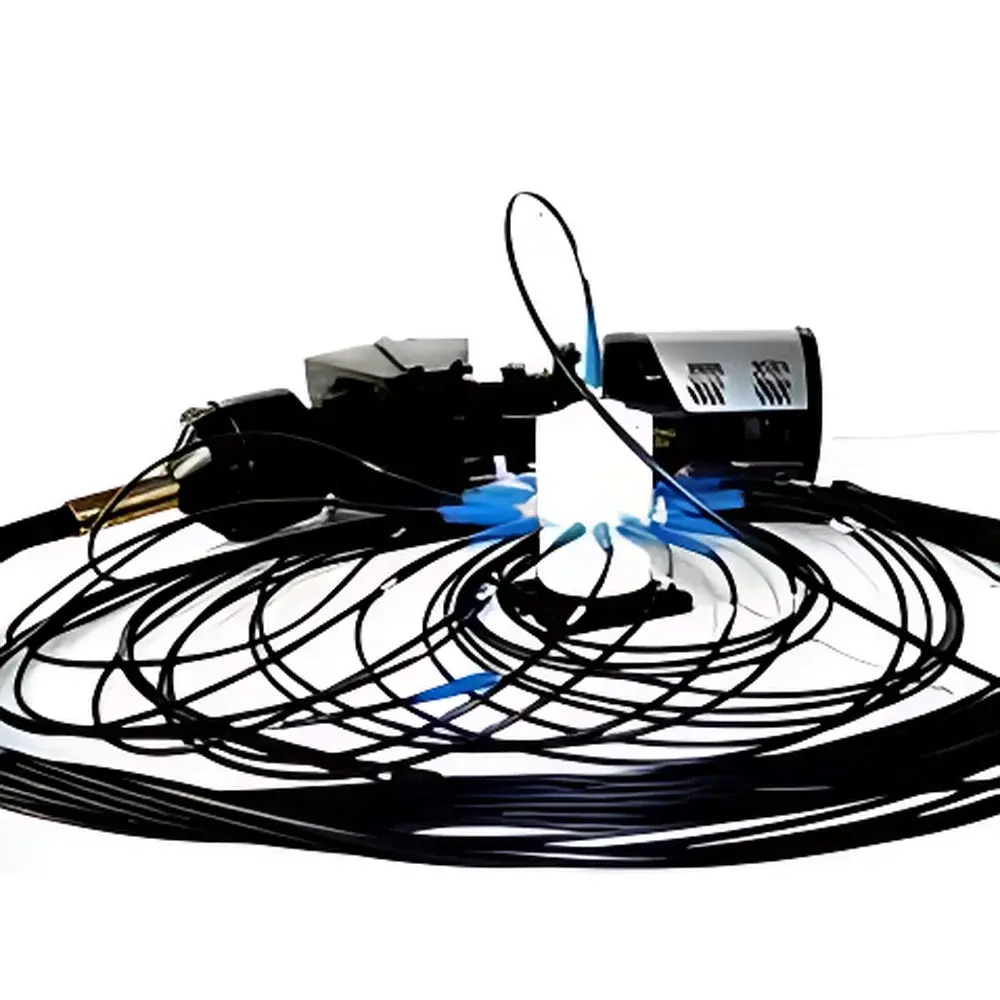
SPL Photonics HyperChannel Hyperspectral Imaging Spectrometer
| Origin | USA |
|---|---|
| Supplier Type | Authorized Distributor |
| Import Status | Imported |
| Model | HyperChannel Hyperspectral Imaging Spectrometer |
| Pricing | Available Upon Request |
Overview
The SPL Photonics HyperChannel Hyperspectral Imaging Spectrometer is a high-throughput, snapshot-based imaging spectrometer engineered for simultaneous spatial-spectral data acquisition without mechanical scanning. It operates on the principle of image-cube (x, y, λ) acquisition using a custom optical architecture that integrates spatially multiplexed spectral encoding with a high-quantum-efficiency scientific CMOS or CCD detector array. Unlike conventional push-broom or tunable-filter systems, HyperChannel captures over 200 spectrally resolvable channels in parallel—each corresponding to a discrete spatial location—within a single integration time. This eliminates temporal misregistration artifacts common in dynamic or time-sensitive measurements, such as live-cell spectroscopy, combustion diagnostics, or rapid material sorting. Its core design emphasizes temporal fidelity, photometric stability, and compatibility with standard C-mount or F-mount optics, enabling direct integration into microscope, macro-imaging, or industrial inspection platforms.
Key Features
- Snapshot hyperspectral acquisition: No moving parts or wavelength scanning—full spectral-spatial data cube captured in one exposure
- ≥200 independently resolvable spectral channels per frame, with configurable spectral sampling density
- High optical throughput enabled by optimized fore-optics and low-stray-light grating design
- Modular configuration options: UV-VIS (200–800 nm), VIS-NIR (400–1000 nm), or extended NIR (900–1700 nm) variants available
- Native support for external triggering, TTL synchronization, and hardware-level exposure control for time-resolved experiments
- Robust mechanical housing with thermal stabilization provisions for long-duration acquisitions
- Compatible with standard 16-bit or 12-bit scientific detectors offering >60 dB dynamic range and sub-electron read noise
Sample Compatibility & Compliance
The HyperChannel system supports diverse sample geometries—from microscopic tissue sections and semiconductor wafers to macro-scale agricultural specimens and industrial components—without requiring sample translation or spectral tuning. Its non-contact, non-destructive measurement modality complies with routine laboratory safety protocols and aligns with ISO/IEC 17025 requirements for analytical instrument validation. When deployed in regulated environments (e.g., pharmaceutical QC or food safety labs), the system can be integrated into validated workflows supporting audit trails, user access control, and electronic record retention—consistent with FDA 21 CFR Part 11 and EU Annex 11 expectations when paired with compliant software infrastructure.
Software & Data Management
The HyperChannel is delivered with SPL Photonics’ HyperStudio™ software suite—a platform built on Qt and Python-based backend libraries for cross-platform operation (Windows/Linux). HyperStudio provides real-time preview, spectral calibration (using NIST-traceable lamp standards), radiometric correction, and export to HDF5, ENVI, or MATLAB-native formats. Advanced processing modules include PCA-based anomaly detection, spectral unmixing (with constrained least-squares algorithms), and batch processing pipelines compatible with Jupyter-based analysis workflows. All software logs acquisition metadata—including exposure time, gain settings, temperature, and calibration timestamps—enabling full traceability and GLP/GMP-aligned documentation.
Applications
- Biomedical research: Label-free histopathology, cellular metabolism monitoring via autofluorescence spectral signatures
- Materials science: Spatial mapping of bandgap variations in perovskite thin films or strain distribution in 2D materials
- Environmental analysis: Remote sensing simulation, soil organic carbon quantification, and microplastic identification in aqueous suspensions
- Industrial QA/QC: Real-time sorting of polymer blends, coating thickness verification, and defect localization in OLED panels
- Chemical imaging: In situ reaction monitoring in catalytic reactors or electrochemical cells using operando spectral tracking
FAQ
What spectral resolution can be achieved with the HyperChannel system?
Spectral resolution is configuration-dependent and determined by the selected grating groove density, pixel pitch, and focal length. Typical FWHM values range from 2.5 nm to 10 nm across standard configurations; higher resolution variants are available upon request with trade-offs in throughput and field-of-view.
Is the system compatible with third-party microscopy platforms?
Yes—HyperChannel supports C-mount, F-mount, and custom adapter interfaces. Integration with upright/inverted microscopes (e.g., Nikon Eclipse, Zeiss Axio) has been validated using relay lens coupling and Köhler illumination alignment procedures.
Does SPL Photonics provide calibration services and documentation?
All systems ship with factory spectral and radiometric calibration certificates traceable to NIST standards. On-site or remote calibration validation and re-certification services are available under annual service agreements.
Can the HyperChannel operate in low-light conditions?
With optional back-illuminated sCMOS detectors and cooled sensor options (−15 °C stabilized), the system achieves effective detection limits below 100 photons/pixel/frame in optimized configurations.
Is there SDK support for custom application development?
Yes—C++ and Python APIs are provided, including full access to low-level camera control, memory-mapped data buffers, and real-time trigger event handling. Documentation includes Doxygen-generated references and working code examples.





