
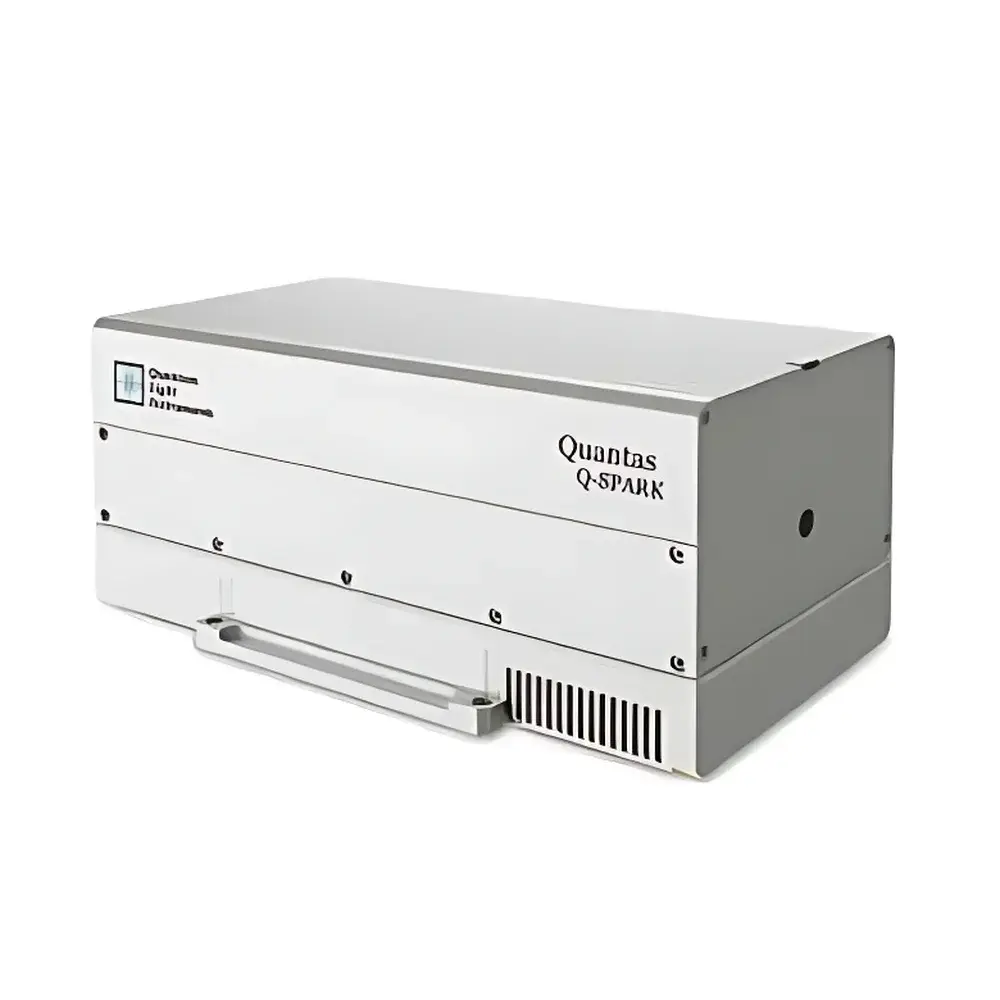
QLI Quantans-1064/1053 Compact Air-Cooled Q-Switched Nanosecond Laser Systems
| Origin | Lithuania |
|---|---|
| Manufacturer Type | OEM Laser System Supplier |
| Origin Category | Imported |
| Models | Quantans-1064 (Q1B/Q1C/Q1D/Q2-20/Q2-50/Q2-50HE/Q2-100), Quantans-1053 (Q1B/Q1C/Q1D/Q2-10/Q2-20HE), Q-spark (<2 ns), Q1-100 Series, Q-pico (700 ps), Q-tune (OPO-based tunable), RYB wavelength converters |
| Key Components | Diode-pumped solid-state (DPSS) Q-switched laser heads, harmonic generation modules, integrated TEC-based air-cooling architecture, digital controller with RS232/USB interface |
Overview
The QLI Quantans-1064/1053 series comprises a family of compact, air-cooled, diode-pumped solid-state (DPSS) Q-switched nanosecond lasers engineered for high-reproducibility pulsed operation in demanding scientific and industrial environments. Based on Nd:YAG (1064 nm) and Nd:YLF (1053 nm) gain media, these lasers employ electro-optic or acousto-optic Q-switching to generate temporally stable pulses with durations ranging from <2 ns (Q-spark) to 10 ns (standard Q1/Q2 configurations). Unlike conventional water-cooled systems, the Quantans platform integrates thermoelectric cooler (TEC)-assisted forced-air thermal management—eliminating external chillers while maintaining thermal stability across ambient temperatures from 15 °C to 30 °C. All models deliver near-diffraction-limited beam profiles (TEM00-like, Gaussian approximation >75%), low beam divergence (<1.5 mrad typical), and sub-nanosecond timing jitter (<0.5 ns RMS), making them suitable for time-resolved spectroscopy, nonlinear frequency conversion, and precision ablation where spatial coherence and pulse-to-pulse fidelity are critical.
Key Features
- Compact monolithic architecture: Laser head dimensions as small as 113 × 230 × 112 mm³ (Q1 base model), enabling integration into space-constrained optical tables, portable LIBS platforms, or OEM instrumentation.
- Air-cooled thermal design: No recirculating chiller required; TEC-assisted convection cooling ensures stable output over extended duty cycles without degradation in pulse energy or pointing stability.
- High spectral purity & beam quality: M² 75% fit), and divergence ≤1.5 mrad support efficient coupling into fibers, OPOs, and nonlinear crystals.
- Multi-wavelength capability: Fundamental outputs at 1064 nm or 1053 nm, with optional harmonic generation modules delivering 532 nm, 355 nm, 266 nm, and 213 nm—maintaining >10% conversion efficiency down to deep UV.
- Digital control interface: RS232 and USB connectivity with QLI’s LaserControl software for remote parameter adjustment (repetition rate, delay, burst mode), real-time energy monitoring, and firmware updates.
- Low temporal jitter: <0.5 ns RMS (Q1-100 series) enables synchronization with ultrafast detectors, streak cameras, or pump-probe setups compliant with ISO 11146 and ANSI Z136.1 safety standards.
Sample Compatibility & Compliance
The Quantans platform is compatible with standard optical components rated for nanosecond pulsed operation at peak powers up to 10 MW/cm² (1064 nm, 10 ns). Harmonic modules meet IEC 60825-1:2014 Class 4 laser safety requirements when properly enclosed. All systems comply with CE marking directives (EMC 2014/30/EU, LVD 2014/35/EU) and RoHS 2011/65/EU. For regulated applications—including pharmaceutical process analytical technology (PAT), GLP-compliant LIBS analysis, or FDA 21 CFR Part 11–aligned data acquisition—the controller supports audit-trail-enabled logging via timestamped ASCII output files. Beam delivery paths are optimized for compatibility with commercial OPOs (e.g., Opotek, Continuum), Ti:sapphire amplifiers, and fiber-coupled spectrometers meeting ASTM E2926 (LIBS) and ISO 21348 (spectral irradiance) specifications.
Software & Data Management
QLI provides LaserControl v3.x—a cross-platform application (Windows/macOS/Linux) supporting full device configuration, real-time pulse energy readout (via integrated photodiode), and automated calibration routines. The software exports energy history logs in CSV format with UTC timestamps, enabling traceability per ISO/IEC 17025:2017 clause 7.7. Optional LabVIEW and Python SDKs allow integration into custom DAQ architectures. All firmware updates preserve user-defined presets and retain factory calibration coefficients. For GMP environments, optional 21 CFR Part 11 compliance packages include electronic signature workflows, role-based access control, and immutable log archiving.
Applications
- Laser-Induced Breakdown Spectroscopy (LIBS): Stable pulse energy (<0.5% RMS) and low divergence ensure consistent plasma initiation across heterogeneous samples—from geological cores to alloy surfaces—meeting ASTM E2926-22 requirements for quantitative elemental analysis.
- OPO and dye laser pumping: High peak power and excellent beam quality enable efficient optical parametric oscillation in BBO, LBO, and KTP crystals; Q-tune variants extend tunability from 410 nm to 2300 nm with <5 cm⁻¹ linewidth.
- Laser desorption/ionization (LDI) and MALDI source development: Sub-2 ns Q-spark variants provide optimal temporal confinement for soft ionization of biomolecules without fragmentation.
- Laser cleaning and thin-film ablation: Precise energy control (0.1 mJ resolution) and Gaussian profile minimize substrate thermal damage during microscale removal of oxides, polymers, or contaminants.
- Time-of-flight mass spectrometry (TOF-MS) and fluorescence lifetime imaging (FLIM): Sub-nanosecond jitter enables synchronization accuracy required for picosecond-scale temporal gating in gated ICCDs or SPAD arrays.
- Remote sensing and LIDAR: Compact footprint and air-cooling support deployment in UAV-mounted atmospheric monitoring systems operating under variable thermal loads.
FAQ
What cooling method does the Quantans laser use?
It employs an integrated thermoelectric cooler (TEC) with forced-air convection—no external water chiller is required.
Can the Quantans series be fiber-coupled?
Yes; Q1-100 models offer optional fiber coupling at 1064 nm and 532 nm, with maximum coupled pulse energy up to 25 mJ into 365 µm, 550 µm, or 910 µm core fibers.
Is OPO integration supported out of the box?
The Q-tune variant includes a fully integrated OPO stage with motorized wavelength tuning, while other Quantans models are designed for external OPO pumping per standard 3 mm input beam diameter specifications.
What is the typical pulse-to-pulse energy stability?
All Quantans models achieve <0.5% RMS energy stability under constant ambient conditions; Q-spark-ps maintains <0.5% RMS at 50 Hz repetition rate.
Are calibration certificates provided with shipment?
Each unit ships with a factory calibration report traceable to NIST-traceable reference detectors, including measured pulse energy, beam diameter, divergence, and M² values.



