
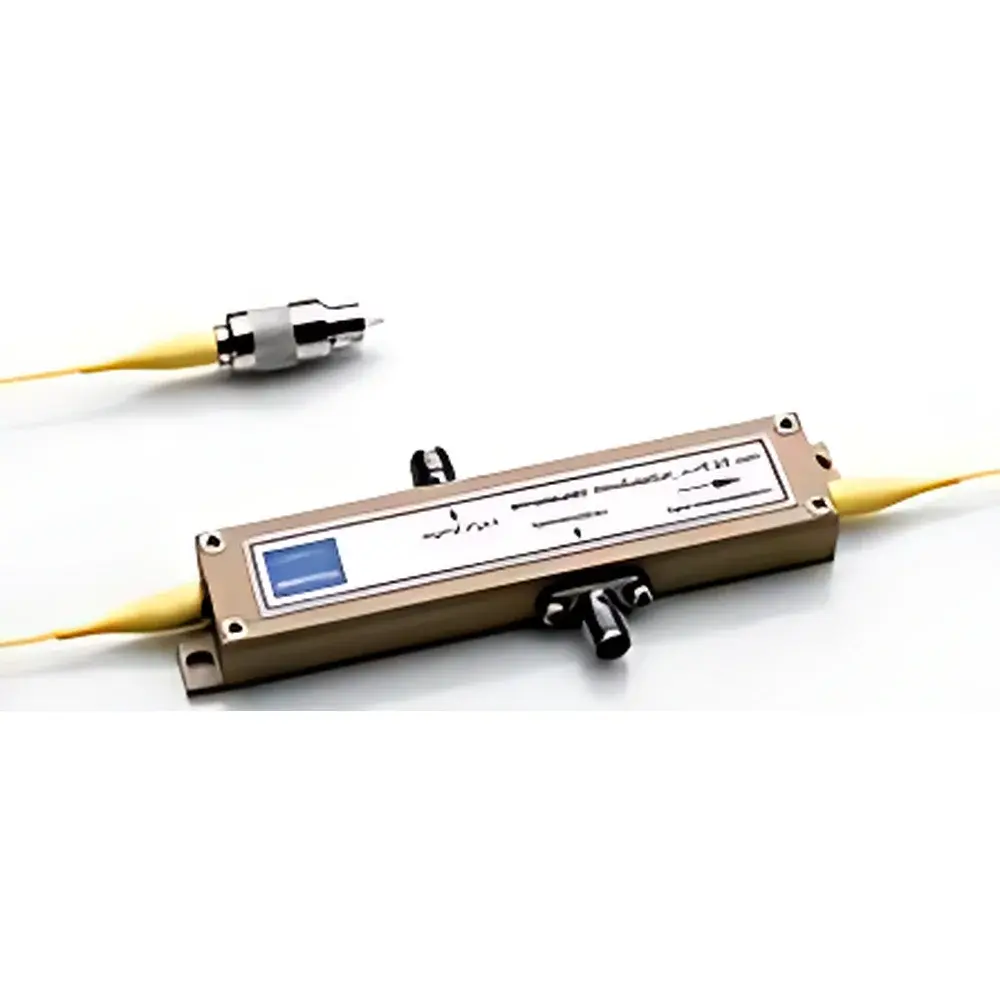
Jenoptik Integrated Optical Phase Modulator
| Brand | Jenoptik |
|---|---|
| Origin | Germany |
| Model | Integrated Optical Phase Modulator |
| Substrate Material | MgO:LiNbO₃ / LiNbO₃ |
| Operating Wavelength Range | 400–2000 nm (Visible to IR) |
| Modulation Bandwidth | DC to >1 GHz |
| Fiber Coupling | Polarization-Maintaining Single-Mode Fiber (PM-SMF) |
| RF Input | SMA or K-type connector |
| Half-Wave Voltage (Vπ) | Typically 3–6 V (depends on design & wavelength) |
| Optical Damage Threshold | >500 mW (CW), >1 MW/cm² (pulsed) |
| Operating Temperature | 15–35 °C |
| Compliance | RoHS, CE |
Overview
The Jenoptik Integrated Optical Phase Modulator is a high-performance, waveguide-based electro-optic phase modulator engineered for precision control of optical phase in free-space and fiber-coupled photonic systems. Built on single-crystal MgO-doped lithium niobate (MgO:LiNbO₃) and stoichiometric LiNbO₃ substrates, it leverages the linear electro-optic (Pockels) effect to induce voltage-controlled phase shifts with exceptional linearity, stability, and bandwidth. Unlike bulk modulators, its planar lightwave circuit (PLC) architecture enables monolithic integration, minimal insertion loss (<3.5 dB typical), and intrinsic polarization-maintaining operation via PM-SMF pigtails. Designed for demanding applications requiring sub-nanosecond temporal response and low drive voltage, it supports continuous-wave (CW) and pulsed operation across the visible (400 nm) through near-infrared (2000 nm) spectrum—making it suitable for ultrafast optics, coherent detection, and quantum photonics infrastructure.
Key Features
- Monolithic LiNbO₃ waveguide platform with MgO doping for enhanced photorefractive resistance and thermal stability
- DC–>1 GHz modulation bandwidth—optimized for analog and digital phase encoding schemes
- Polarization-maintaining single-mode fiber input/output (PM980 or PM1550, customizable)
- Low half-wave voltage (Vπ) of 3–6 V, enabling efficient drive with standard RF amplifiers
- High optical power handling: >500 mW CW, >1 MW/cm² peak intensity (10 ns pulses)
- Hermetically sealed TO-style or butterfly package options with integrated thermistor and TEC for temperature stabilization
- Customizable RF interface (SMA, K, or V-connectors) and optional integrated bias tee or broadband amplifier
Sample Compatibility & Compliance
This phase modulator is compatible with standard telecom-grade and research-grade fiber systems, including FC/APC, SC/APC, and custom ferrule configurations. It interfaces seamlessly with distributed feedback (DFB) lasers, external cavity diode lasers (ECDLs), fiber amplifiers, and interferometric setups. All units are manufactured under ISO 9001-certified processes at Jenoptik’s Jena facility and comply with EU directives including RoHS 2011/65/EU and CE marking requirements for electromagnetic compatibility (EMC Directive 2014/30/EU). While not inherently FDA- or IEC 61000-4 certified as a standalone component, it meets the optical subsystem qualification criteria for Class 1 laser products per IEC 60825-1 when integrated into compliant host systems. Traceable calibration reports (phase shift vs. applied voltage, insertion loss, polarization extinction ratio) are available upon request.
Software & Data Management
As a passive electro-optic component, the modulator does not include embedded firmware or native software control. However, it is fully interoperable with industry-standard instrumentation control environments: LabVIEW™ (via NI PXI or USB DAQ), Python (PyVISA, NIDAQmx), MATLAB® Instrument Control Toolbox, and Keysight PathWave. When paired with a calibrated RF source and vector network analyzer (VNA), users can perform full S-parameter characterization (S21 phase response), dynamic linearity analysis (SFDR), and harmonic distortion mapping. For GxP-regulated environments (e.g., OCT system validation under ISO 13485), audit trails for test conditions—including drive voltage sweep parameters, temperature logs, and optical power monitoring—can be captured using compliant data acquisition frameworks supporting 21 CFR Part 11 electronic signatures (when deployed with validated software layers).
Applications
- Coherent optical communications: IQ modulation, carrier suppression, and advanced constellation shaping
- Optical coherence tomography (OCT): Carrier-phase stabilization, Doppler shift encoding, and dispersion compensation
- Interferometric sensing: High-resolution displacement metrology, gravitational wave detector readout, and fiber optic gyroscopes
- Quantum optics: Qubit state manipulation in photonic quantum computing platforms, time-bin qubit generation
- Spectroscopy: Sideband generation for frequency comb referencing, cavity ring-down phase tagging
- Laser stabilization: Pound–Drever–Hall (PDH) locking loops for narrow-linewidth lasers and Fabry–Pérot cavities
FAQ
What is the typical insertion loss for this modulator?
Insertion loss ranges from 2.8 dB to 3.5 dB depending on wavelength, fiber type, and packaging configuration. Values are measured at 1550 nm with PM1550 fiber and include coupling losses.
Can the device be used for both analog and digital phase modulation?
Yes. Its linear electro-optic response supports analog phase ramping and sinusoidal modulation, while its >1 GHz bandwidth enables NRZ and RZ digital formats up to 2.5 Gbaud without significant intersymbol interference.
Is temperature control required for stable operation?
For sub-radian phase stability over hours, active temperature regulation (±0.1 °C) is recommended—especially at wavelengths >1550 nm where thermo-optic drift increases. Integrated TEC options are available for OEM integration.
Does Jenoptik provide optical phase calibration data?
Yes. Each unit ships with a factory-measured phase transfer function (Δφ vs. VRF) at one or more reference wavelengths, traceable to NIST-traceable optical power and RF standards.
Can the modulator be integrated into a vacuum or UHV environment?
Standard packages are not UHV-rated. However, custom hermetic ceramic or Kovar housings with UHV-compatible feedthroughs (e.g., SMA-Vac) can be engineered upon request for specialized applications such as atomic physics experiments.




