
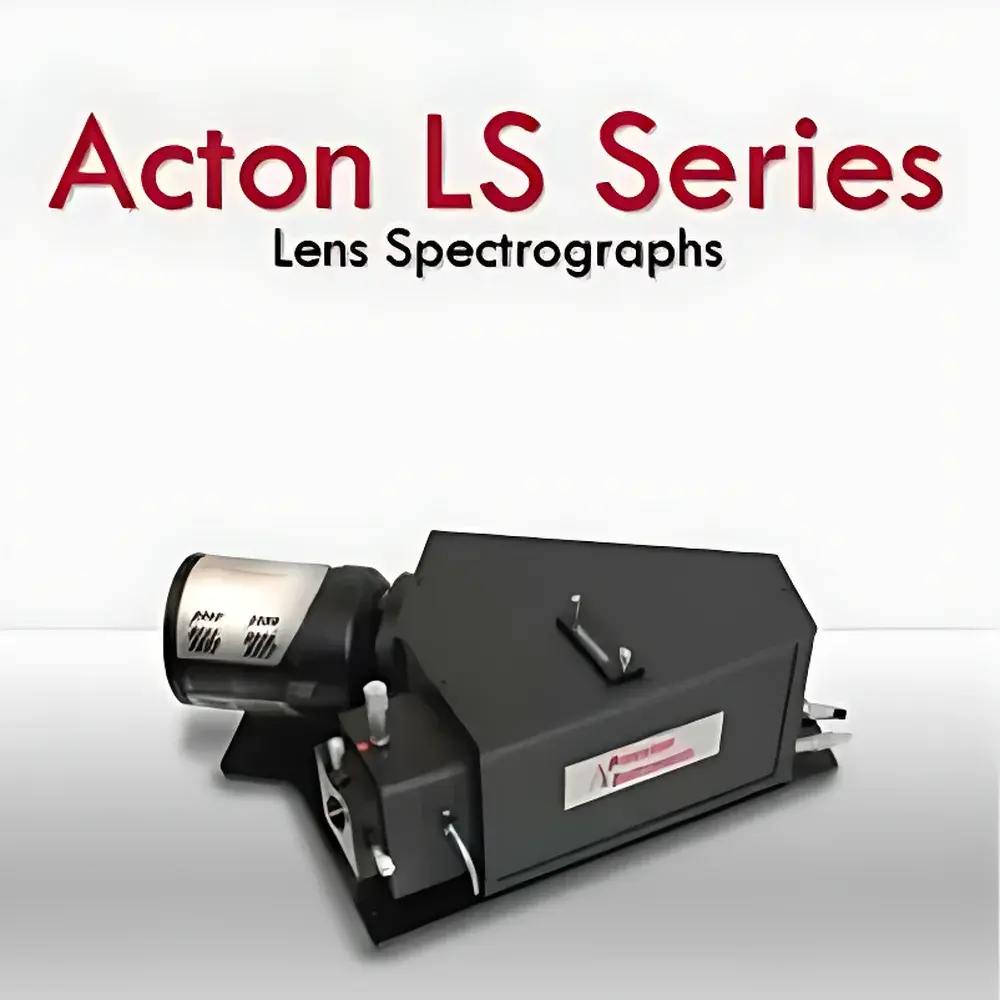
LS Series Prism Spectrograph – Acton LS 785 by Teledyne Princeton Instruments
| Brand | Teledyne Princeton Instruments |
|---|---|
| Origin | USA |
| Model | Acton LS 785 |
| Focal Length | 85 mm |
| Aperture Ratio | f/2.0 |
| Spectral Resolution | 5 cm⁻¹ (with 25 µm fiber) |
| Linear Dispersion | 6.13 nm/mm @ 900 nm |
| Grating | 1200 g/mm, gold-coated |
| Wavelength Range | 750–1100 nm (tunable via micrometer-driven grating stage) |
| Optical Design | Prism-based, AR-coated fused silica prism + optimized f/2 imaging optics |
| Detector Compatibility | Fully compatible with Teledyne Princeton Instruments PIXIS and PyLoN deep-depletion CCD cameras |
Overview
The Acton LS 785 is a high-throughput, prism-based spectrograph engineered for demanding near-infrared (NIR) spectral applications where photon efficiency, spatial fidelity, and reproducible wavelength calibration are critical. Unlike conventional grating-based instruments operating at f/4 or slower, the LS 785 employs an f/2 optical architecture centered on a custom antireflection-coated fused silica prism—delivering up to four times the light throughput of comparable reflective spectrographs when coupled to 0.22 NA optical fibers. Its compact 85 mm focal length design maintains rigorous imaging quality across the full focal plane, enabling diffraction-limited performance without compromising field uniformity. The spectrograph operates on the principle of angular dispersion via refractive index variation in the prism medium, optimized for minimal aberration and maximal transmission between 750 nm and 1100 nm. This makes it especially suited for low-signal NIR Raman spectroscopy, time-resolved photoluminescence, and multi-channel microspectroscopic configurations requiring high radiometric sensitivity and stable spectral registration.
Key Features
- f/2 optical system with proprietary AR-coated fused silica prism for >92% average transmission across 750–1100 nm
- Micrometer-actuated grating stage enabling precise, repeatable wavelength selection within the 750–1100 nm range
- Integrated focus adjustment via precision micrometer for optimal coupling with deep-depletion CCD detectors
- Optimized for use with Teledyne Princeton Instruments PIXIS and PyLoN series cameras—supporting 64-bit LightField software control and hardware synchronization
- Zero-aberration imaging design ensures uniform spectral sampling and minimal smile/distortion across the full detector width
- Robust aluminum housing with thermal stabilization provisions for long-duration acquisitions under ambient lab conditions
Sample Compatibility & Compliance
The LS 785 supports flexible sample interface configurations including fiber-coupled (SMA 905, 0.22 NA), free-space collimated input, and direct microscope port integration. It is routinely deployed in GLP-compliant laboratories for quantitative NIR absorption and Raman intensity mapping, with traceable calibration protocols aligned with NIST-traceable wavelength standards. When paired with LightField software, the system supports audit-trail logging, electronic signatures, and data integrity features compliant with FDA 21 CFR Part 11 requirements for regulated environments. Its optical path contains no hygroscopic or organic components, ensuring long-term stability in ISO Class 5–7 cleanroom-compatible installations.
Software & Data Management
Control and acquisition are fully integrated via LightField 64-bit software—a platform developed specifically for Teledyne Princeton Instruments’ scientific detectors and spectrographs. LightField provides real-time spectral preview, automatic dark/reference subtraction, multi-region-of-interest (ROI) extraction, and batch-processing pipelines for kinetic or hyperspectral datasets. All instrument parameters—including grating position, exposure time, binning, and gain—are stored as metadata within industry-standard HDF5 files. Export options include CSV, ASCII, and vendor-neutral SPE format for third-party analysis in MATLAB, Python (via pypylon or specutils), or commercial chemometrics packages. Firmware updates and calibration file management are handled through secure, version-controlled repositories accessible via authenticated enterprise network access.
Applications
- NIR Raman spectroscopy of pharmaceutical solids, polymers, and battery materials—with resolution sufficient to resolve rotational-vibrational bands at 5 cm⁻¹
- In vivo and ex vivo biological tissue characterization using diffuse reflectance and fluorescence lifetime decoupling
- Multi-channel spectral monitoring in catalytic reaction chambers and plasma diagnostics
- Confocal microspectroscopy setups integrating with inverted research microscopes (e.g., Nikon Eclipse Ti, Zeiss Axio Observer)
- Time-resolved photoluminescence decay profiling in perovskite and quantum dot thin films
- Calibration reference sources validation for FT-NIR and dispersive OEM modules
FAQ
What is the spectral resolution specification of the LS 785, and how is it measured?
Spectral resolution is specified as 5 cm⁻¹ when used with a 25 µm core optical fiber input under standard alignment conditions—determined via the full-width-at-half-maximum (FWHM) of the instrumental line profile using a neon emission lamp.
Can the LS 785 be used with detectors other than Princeton Instruments cameras?
Yes—mechanical and electrical interfaces follow standard C-mount and 34-pin D-sub conventions; however, full software integration, pixel-to-wavelength mapping, and automated calibration require LightField-compatible detectors.
Is the grating stage motorized or manual?
The standard configuration uses a manual micrometer-driven grating rotation stage for fine wavelength tuning; motorized versions are available upon request with programmable step resolution down to 0.05 nm per step.
Does the LS 785 support vacuum or purged operation?
It is designed for ambient air operation; optional nitrogen purge ports can be added to minimize atmospheric water vapor absorption features in the 930–960 nm region.
How is wavelength calibration performed and maintained?
Factory calibration uses NIST-traceable Hg/Ne/Ar spectral lines; users may perform recalibration using built-in LED references or external lamps, with coefficients stored per-detector in LightField’s persistent calibration database.




