
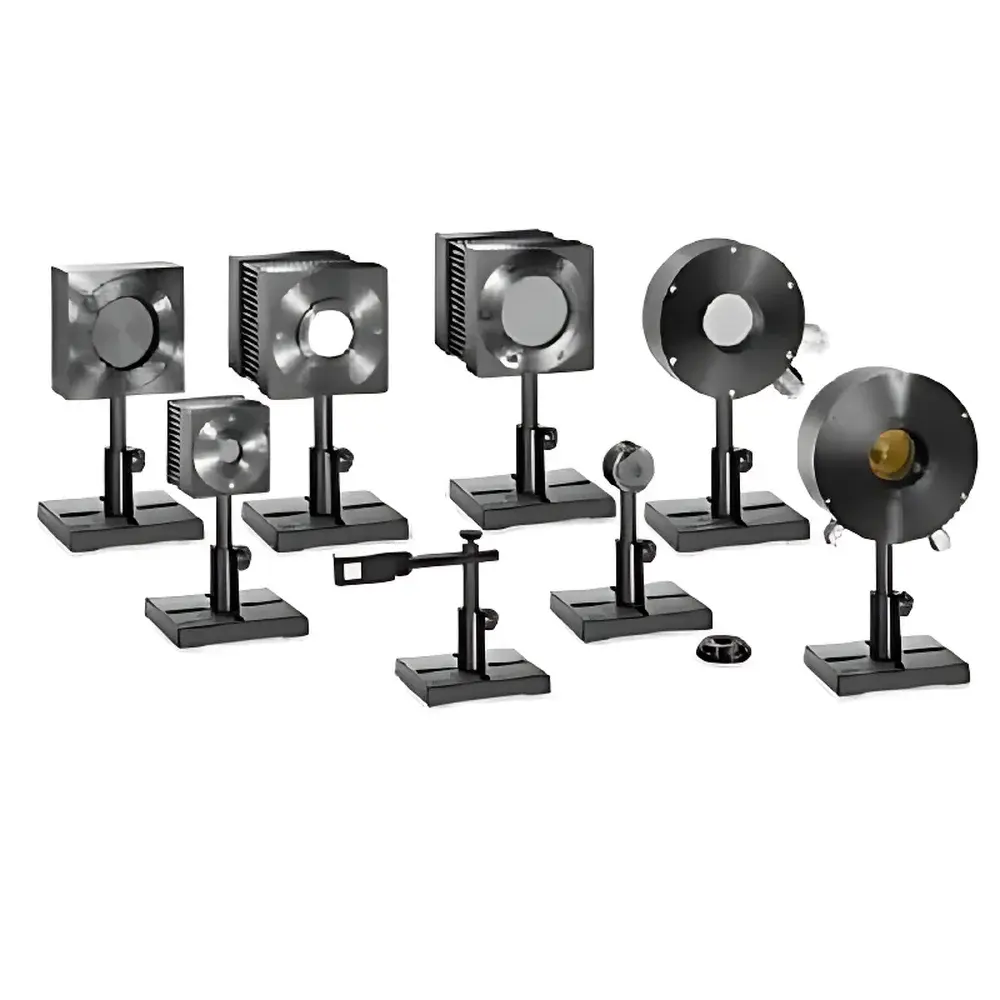
OPHIR PD Series Photodiode-Based Laser Power Meter
| Brand | OPHIR |
|---|---|
| Origin | Israel |
| Manufacturer Type | Authorized Distributor |
| Origin Category | Imported |
| Model | PD Series |
| Measurement Range (Typical) | 10 pW to 3 W |
| Sensor Type | Silicon/UV-enhanced/InGaAs Photodiode |
| Spectral Range | 190 nm – 1800 nm (model-dependent) |
| Interface | USB, RS-232, Analog Output |
| Software Compatibility | OPHIR StarLab, LabVIEW™ Drivers, MATLAB® Support |
| Compliance | ISO/IEC 17025 Accredited Calibration Available |
| Optional Accessories | Rotatable Mount, Neutral Density Filters, Fiber Adapters, SM1-Compatible Threaded Housing |
Overview
The OPHIR PD Series is a family of high-sensitivity, photodiode-based laser power meters engineered for precision measurement of continuous-wave (CW) and low-repetition-rate pulsed laser output across ultraviolet (UV), visible (VIS), and near-infrared (NIR) spectral bands. Leveraging calibrated silicon, UV-enhanced silicon, or InGaAs photodetectors, the PD Series operates on the principle of photocurrent generation proportional to incident optical power—enabling traceable, linear response from as low as 10 picowatts up to 3 watts. Designed for integration into R&D laboratories, production QC environments, and clinical laser system validation workflows, these instruments deliver stable, low-noise readings with minimal thermal drift. Each sensor head undergoes individual calibration at OPHIR’s ISO/IEC 17025-accredited facility in Israel, with full uncertainty budgets and NIST-traceable documentation supplied with every unit.
Key Features
- Ultra-wide dynamic range: spans 10 pW–3 W within a single sensor platform, eliminating frequent sensor swaps during multi-power-level characterization
- Rotatable sensor mount with 360° azimuth adjustment—critical for alignment-constrained setups such as fiber-coupled systems or confined optical benches
- Patented background subtraction algorithm actively compensates for ambient light and dark current drift in real time, enhancing measurement fidelity under variable lab conditions
- Modular optical interface options: free-space input, SMA/FC fiber coupling, and interchangeable ND filters (OD1–OD6) for extended range and spectral shaping
- SM1-threaded housing (1.035″-40) on circular variants ensures seamless mechanical integration with standard optomechanics from Thorlabs®, Newport®, and Edmund Optics®
- Dual-mode analog output (0–5 V / 0–10 V) and digital communication via USB 2.0 or RS-232 support both standalone operation and automated test systems
Sample Compatibility & Compliance
The PD Series accommodates divergent beam profiles—including Gaussian, top-hat, and multimode outputs—from solid-state lasers, diode lasers, DPSS sources, and fiber lasers operating between 190 nm and 1800 nm. Sensor selection is guided by wavelength sensitivity and damage threshold requirements: UV-enhanced models are validated for excimer and frequency-tripled Nd:YAG applications; InGaAs variants cover telecom and SWIR bands up to 1800 nm. All sensors comply with IEC 61340-5-1 (electrostatic discharge control), and calibration certificates conform to ISO/IEC 17025:2017. For regulated environments—including FDA-regulated medical laser manufacturing and pharmaceutical phototherapy device validation—the PD Series supports audit-ready data logging with optional 21 CFR Part 11-compliant software modules (via StarLab v4.x).
Software & Data Management
OPHIR StarLab v4 is the native Windows-based application for real-time acquisition, statistical analysis (min/max/avg/std dev), and export to CSV, Excel, or MATLAB® formats. The platform includes built-in pass/fail thresholds, time-stamped measurement logs, and GLP/GMP-compliant audit trails when enabled. LabVIEW™ drivers (NI-VISA compatible) and Python SDKs allow direct integration into custom automation frameworks. Raw analog outputs enable connection to DAQ systems (e.g., National Instruments PXI) for synchronized multi-channel monitoring in laser stability or MOPA qualification tests.
Applications
- Laser diode aging studies requiring sub-pW baseline stability tracking over 1000+ hour burn-in cycles
- Optical coating reflectance/transmittance verification using ratio-metric power measurements before and after sample insertion
- Fiber optic component testing—including isolators, couplers, and WDMs—using calibrated fiber-coupled PD heads
- Medical laser safety compliance (ANSI Z136.1) through periodic output verification at treatment wavelengths (e.g., 810 nm, 980 nm, 1064 nm)
- Ultrafast oscillator power monitoring where average power stability—not pulse energy—is the primary KPI
- Photonic integrated circuit (PIC) wafer-level testing with spatially constrained sensor placement enabled by the rotatable mount
FAQ
What is the typical calibration uncertainty for PD Series sensors?
Calibration uncertainty ranges from ±0.7% to ±2.5% (k=2), depending on wavelength, power level, and sensor model—fully documented in the certificate shipped with each unit.
Can the PD Series measure pulsed lasers?
Yes—provided pulse repetition rates exceed 10 Hz and average power remains within the sensor’s specified range; peak power must stay below the sensor’s damage threshold (e.g., <10 kW/cm² for silicon models).
Is firmware upgrade supported in-field?
Yes—StarLab auto-detects connected sensors and prompts for verified firmware updates via USB without requiring service center return.
How is traceability to SI units maintained?
Each sensor is calibrated against primary standards maintained at OPHIR’s metrology lab, which participates in international key comparisons coordinated by BIPM and holds ISO/IEC 17025 accreditation through the Israeli ILAC-MRA signatory body.
Do PD Series sensors require warm-up time?
No active warm-up is needed; however, stabilization to ambient temperature (±0.5°C) is recommended prior to high-accuracy measurements to minimize thermal offset drift.



