Pranalytica 1101-XX-QCW-YYYY-EGC-UC-PF OEM High-Average-Power Wavelength-Stabilized QCW Quantum Cascade Laser System
| Brand | Pranalytica |
|---|---|
| Origin | USA |
| Manufacturer Type | Authorized Distributor |
| Origin Category | Imported |
| Model | 1101-XX-QCW-YYYY-EGC-UC-PF |
| Configuration | Solid-State Laser System Platform |
| Cooling | Passive (Conduction-Cooled) |
| Operating Mode | Quasi-Continuous Wave (QCW) |
| Wavelength Range | 3.8–12.0 µm |
| Avg. Output Power | >1.5 W @ 4.6 µm, >1.0 W @ 4.0 µm |
| Package | Hermetically Sealed Butterfly Module with Integrated Grating-Based Wavelength Stabilization |
| Beam Delivery | Collimated Free-Space Output |
| Control Interface | DC Power Input Only (No External Modulation Required) |
| Compliance | MIL-STD-810G (Shock/Vibration), RoHS, CE Marked for Industrial Use |
Overview
The Pranalytica 1101-XX-QCW-YYYY-EGC-UC-PF is a high-reliability, OEM-optimized quantum cascade laser (QCL) system engineered for precision mid-infrared spectroscopy and sensing applications requiring stable, high-average-power quasi-continuous wave (QCW) emission. Unlike conventional interband diode lasers, QCLs operate on intersubband transitions within a repeated cascade of precisely engineered quantum wells—typically exceeding 500 periods—enabling single-electron injection to generate multiple photons per carrier. This unipolar architecture supports robust, room-temperature operation across the 3.8–12.0 µm spectral range, covering key atmospheric transmission windows (3–5 µm and 8–12 µm) critical for molecular absorption fingerprinting. The 1101 platform integrates a hermetically sealed butterfly-packaged QCL chip with an internal grating-based external cavity configuration (EGC), delivering passive wavelength stabilization without active feedback electronics. Its conduction-cooled, DC-powered architecture eliminates moving parts, water cooling, or complex driver subsystems—making it suitable for embedded integration into portable analyzers, industrial process monitors, and defense-grade countermeasure systems.
Key Features
- High average optical power: >1.5 W at 4.6 µm and >1.0 W at 4.0 µm under standard QCW drive conditions (e.g., 100 ns pulse width, 100 kHz repetition rate)
- Passive wavelength stabilization via integrated Littrow-mounted diffraction grating, achieving <0.05 cm⁻¹ spectral reproducibility over 8-hour continuous operation
- Fully sealed butterfly package compliant with MIL-STD-810G for mechanical shock (50 g, 11 ms) and broadband vibration (10–2000 Hz, 8.6 g RMS)
- Collimated free-space output beam (M² < 1.3) with divergence < 2 mrad, enabling direct coupling into multipass gas cells or fiber-coupled modules
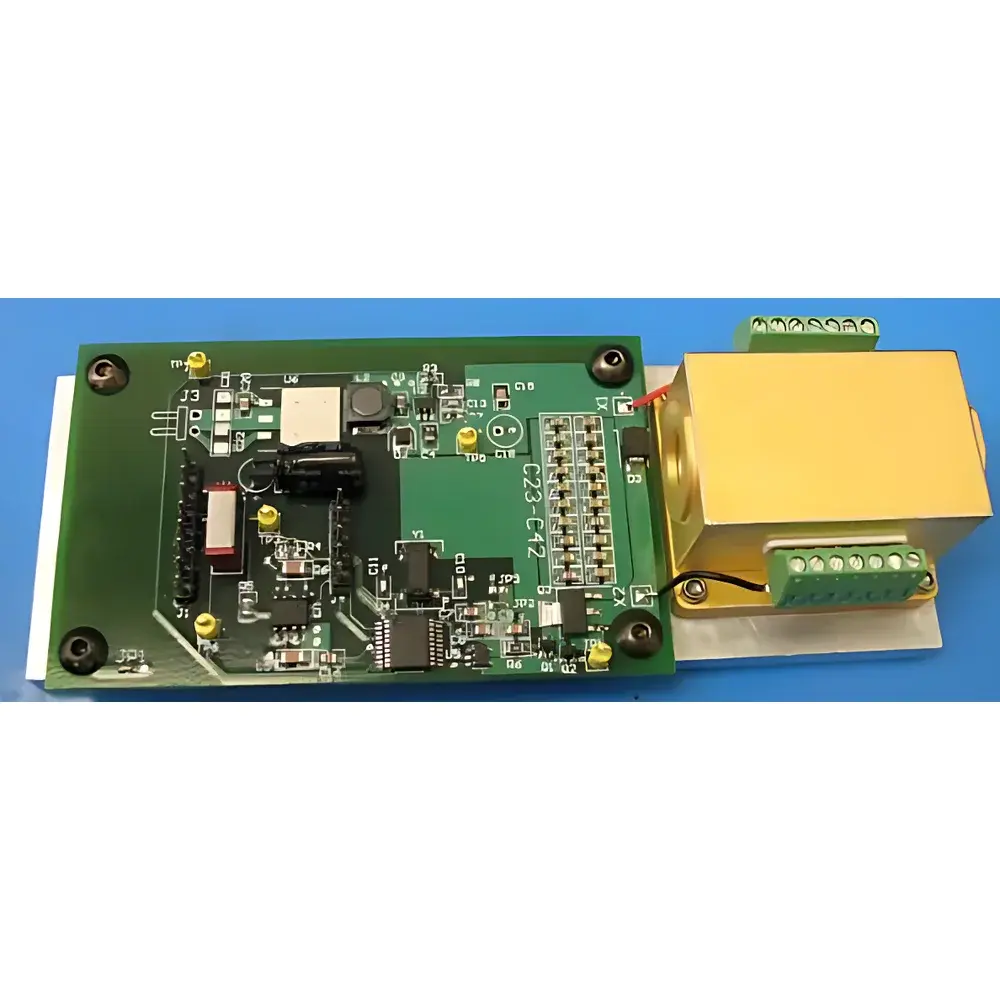
- OEM-optimized form factor: PCB-mounted driver electronics co-located with laser head; minimal footprint (<120 × 60 × 35 mm) and weight (<280 g)
- No alignment required post-installation; factory-calibrated wavelength targeting and power response ensure plug-and-play integration
Sample Compatibility & Compliance
The 1101 system is designed for direct integration into analytical platforms requiring trace-gas detection, isotopic analysis, or real-time process monitoring. Its broad tunability supports quantitative measurement of fundamental vibrational-rotational transitions in target molecules including CO, CO₂, NO, NO₂, NH₃, CH₄, H₂S, HF, and volatile organic compounds (VOCs). The laser meets ISO/IEC 17025-relevant environmental test requirements for laboratory and field-deployable instrumentation. It operates within Class 1M laser safety limits when used with appropriate beam containment—certified per IEC 60825-1:2014 and FDA 21 CFR Part 1040.10. For regulated environments, the system’s passive thermal design and absence of software-controlled parameters facilitate compliance with GLP/GMP documentation workflows and audit-ready installation qualification (IQ) protocols.
Software & Data Management
As a hardware-only OEM module, the 1101 does not include embedded firmware or user-facing software. It interfaces exclusively via stable DC voltage input (±5% tolerance) and TTL-compatible enable/disable triggering. All spectral control—including wavelength selection, pulse timing, and power scaling—is implemented externally by the host system using calibrated lookup tables or closed-loop wavelength lock techniques (e.g., referencing to known absorption lines of N₂O or H₂O). This architecture ensures full compatibility with third-party data acquisition systems (e.g., National Instruments PXI, Keysight DAQmx) and spectral analysis suites supporting ASTM E1421-22 (standard practice for FTIR quantitative analysis) or USP (near- and mid-IR spectroscopic methods). Audit trails, calibration logs, and operational history are maintained entirely at the system integrator level.
Applications
- Defense & Security: Infrared countermeasures (IRCM), standoff explosive detection (e.g., TNT, RDX), toxic industrial chemical (TIC) identification, and container screening via backscatter or photoacoustic spectroscopy
- Medical Diagnostics: Non-invasive breath analysis for ammonia (liver/kidney function), acetone (diabetes monitoring), isoprene (oxidative stress), and sevoflurane (anesthetic gas quantification)
- Environmental Monitoring: Mobile emissions testing (on-road vehicles, marine vessels), stack gas CEMS validation, agricultural methane flux studies, and urban air quality networks
- Industrial Process Control: Real-time natural gas composition analysis (C₁–C₅ hydrocarbons), leak detection in petrochemical refineries, and solvent vapor monitoring in pharmaceutical cleanrooms
- Semiconductor Manufacturing: In-situ chamber gas purity verification (NF₃, ClF₃, SiH₄), wafer transfer ambient monitoring, and etch-byproduct detection during plasma processing
FAQ
What is the typical lifetime of the QCL chip under QCW operation?
Pranalytica specifies >10,000 hours MTTF at rated average power and junction temperature ≤ 45°C, validated per Telcordia GR-468-CORE reliability testing.
Can the system be fiber-coupled?
Yes—collimated output is compatible with ZnSe or chalcogenide fiber coupling optics; custom fiber-pigtailed variants (e.g., with 200 µm core As₂S₃ fiber) are available under OEM agreement.
Is wavelength calibration traceable to NIST standards?
Each unit is factory calibrated against certified reference gas cells (NIST-traceable NH₃, CO, or N₂O); calibration certificates include uncertainty budgets per ISO/IEC 17025 Annex A.
Does the system support analog modulation of pulse width or frequency?
No—pulse parameters are fixed at manufacture; modulation must be implemented externally using high-speed gate drivers synchronized to the DC enable signal.
What thermal interface requirements apply for conduction cooling?
A flat, polished aluminum or copper heat spreader (≥ 100 cm² surface area, thermal resistance < 0.5 K/W to ambient) is required; mounting torque must not exceed 0.5 N·m per screw.