
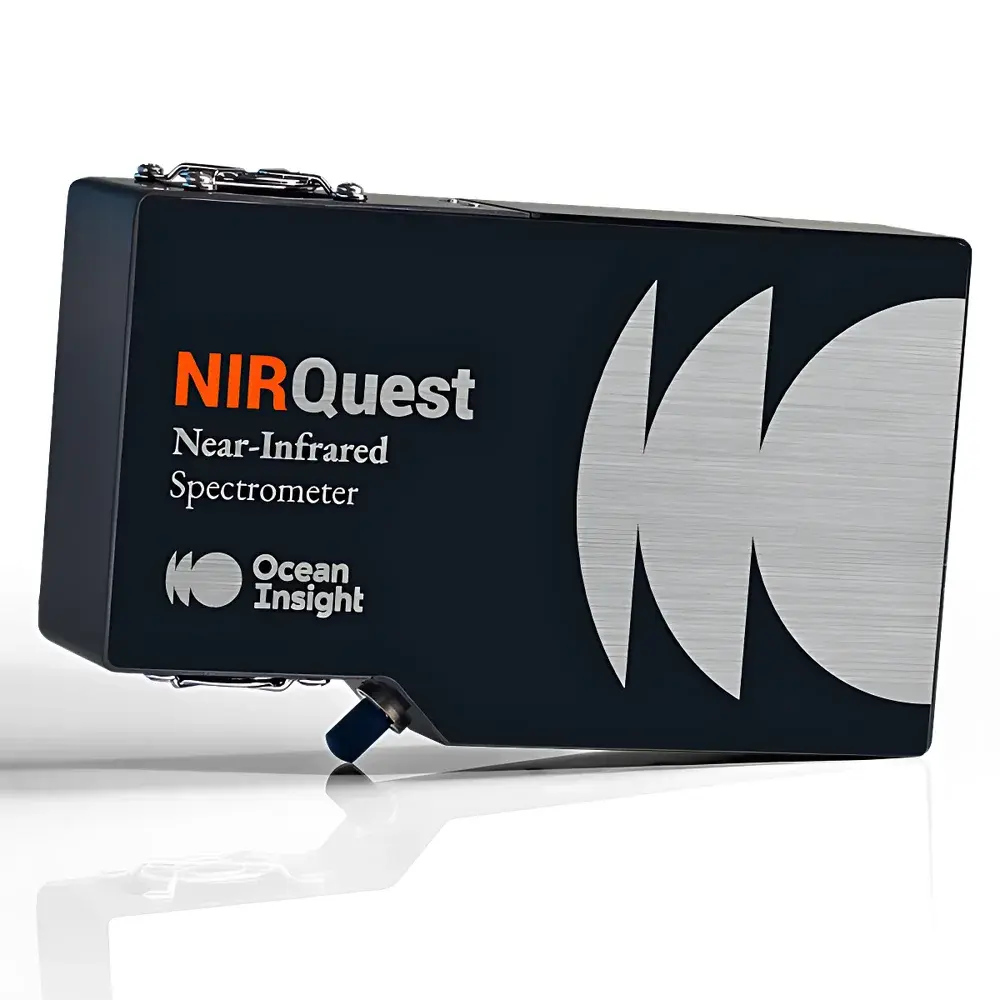
Ocean Optics NIRQuest+ Series Near-Infrared Fiber Optic Spectrometer
| Brand | Ocean Optics |
|---|---|
| Origin | USA |
| Model | NIRQuest+1.7, NIRQuest+2.2, NIRQuest+2.5 |
| Spectral Range | 900 nm – 2500 nm |
| Detector | InGaAs (TE-cooled) |
| Resolution (FWHM) | 3.13 nm (typ.), 5.47 nm (typ.), 6.25 nm (typ.) |
| Integration Time | 1 ms – 200 ms (NIRQuest+2.5), 1 ms – 1 s (NIRQuest+2.2), 1 ms – 120 s (NIRQuest+1.7) |
| SNR | 13,000:1 (typ., NIRQuest+1.7), 10,000:1 (typ., NIRQuest+2.2) |
| Slit Width | 25 µm |
| Dimensions | 182 × 110 × 47 mm³ |
| Weight | 1.18 kg (instrument only) |
| Cooling | Thermoelectric to –20 °C |
Overview
The Ocean Optics NIRQuest+ Series is a high-performance, TE-cooled near-infrared fiber optic spectrometer engineered for precision quantitative and qualitative analysis in demanding industrial, laboratory, and field-deployable environments. Based on the proven optical architecture of Ocean Insight’s legacy NIRQuest platform—and refined through iterative thermal, mechanical, and electronic optimization—the NIRQuest+ leverages InGaAs linear array detection with thermoelectric cooling to deliver enhanced signal-to-noise ratio (SNR), reduced dark current, and improved long-term spectral stability. Its core measurement principle relies on dispersive spectroscopy: incident light is collimated, diffracted by a ruled or holographic grating, and focused onto the InGaAs detector array, enabling full-spectrum acquisition across user-selectable wavelength ranges from 900 nm to 2500 nm. This spectral coverage targets fundamental and overtone vibrational bands of C–H, O–H, and N–H bonds—making the instrument intrinsically suited for non-destructive, calibration-based quantification of moisture, fat, protein, polymer composition, and hydrocarbon content.
Key Features
- Three preconfigured models optimized for distinct NIR sub-bands: NIRQuest+1.7 (900–1700 nm), NIRQuest+2.2 (900–2200 nm), and NIRQuest+2.5 (900–2500 nm)
- Thermoelectric cooling to –20 °C, suppressing dark current drift and enabling stable operation over extended integration periods
- Enhanced optical bench design featuring improved light throughput and reduced stray light, resulting in lower limit of detection (LOD) and higher photometric accuracy
- Modular slit configuration (standard 25 µm, optional replaceable slits) and compatibility with internal mechanical shutter for time-resolved measurements
- Rugged aluminum housing (182 × 110 × 47 mm³, 1.18 kg) designed for integration into OEM systems, production-line conveyors, and portable field analyzers
- USB 2.0 interface with <10 ms readout latency and support for hardware-triggered acquisition—critical for synchronization with external light sources or process control signals
Sample Compatibility & Compliance
The NIRQuest+ accommodates diverse sampling geometries via standardized SMA 905 fiber optic interfaces, supporting reflectance (diffuse or specular), transmittance, and absorbance configurations. It integrates seamlessly with Ocean Insight’s portfolio of calibrated light sources (e.g., tungsten-halogen, pulsed xenon), integrating spheres, contact probes, flow cells, and remote sensing optics. From a regulatory standpoint, the spectrometer supports audit-ready data acquisition when deployed with compliant software environments. Its stable thermal management and factory wavelength calibration (traceable to NIST-traceable emission lines) facilitate adherence to ISO/IEC 17025 requirements for testing laboratories. When paired with validated chemometric models and documented SOPs, the system meets foundational expectations for GLP-compliant QA/QC workflows in pharmaceutical, food, and agricultural applications—particularly where moisture, active pharmaceutical ingredient (API) concentration, or polymer identity verification is required per USP or ASTM E1655.
Software & Data Management
NIRQuest+ instruments are fully supported by Ocean Insight’s OceanView spectroscopy software (Windows/macOS), providing real-time spectral visualization, batch processing, multivariate calibration (PLS, PCR), and export to CSV, HDF5, or MATLAB-compatible formats. For embedded or automated deployments, the Ocean HDX SDK offers C/C++, Python, LabVIEW, and .NET APIs with low-level register access, enabling deterministic timing control and integration into SCADA or MES platforms. All firmware and driver packages comply with Windows Hardware Quality Labs (WHQL) certification standards. Raw spectral data retains metadata including integration time, detector temperature, lamp status, and calibration file hash—supporting 21 CFR Part 11-compliant audit trails when used within validated enterprise software ecosystems. Optional machine learning services include supervised model development for classification (e.g., plastic resin ID) and regression (e.g., % moisture prediction), trained on customer-specific reference datasets under NDA-protected protocols.
Applications
- Real-time moisture monitoring in cereal grains, coffee beans, and dried fruits during drying or storage
- Identification and sorting of post-consumer plastics (PET, HDPE, PP) in recycling streams using spectral fingerprinting
- In-line quantification of ethanol, methanol, or benzene in petroleum fractions via C–H stretch overtone analysis
- Non-invasive assessment of tissue oxygenation and hemoglobin saturation in preclinical research
- QA/QC of tablet coating uniformity and API concentration in solid-dose pharmaceutical manufacturing
- Soil organic carbon and clay content mapping using diffuse reflectance spectroscopy (DRS) in precision agriculture
- Characterization of silicon wafer passivation layers via photoluminescence excitation in the 1100–1700 nm range
FAQ
What wavelength calibration standards are recommended for NIRQuest+?
Argon (AR-2, 696–1704 nm) and xenon (XE-2, 916–1984 nm) emission lamps are recommended for routine wavelength validation; NIST-traceable ceramic reflectance standards (e.g., SRS-99-010) are advised for radiometric calibration.
Can NIRQuest+ operate in continuous scanning mode for process monitoring?
Yes—hardware triggering and USB streaming enable sustained acquisition at up to 100 spectra per second (depending on integration time and ROI settings), suitable for conveyor-belt or flow-cell integration.
Is the detector linearity certified across the full dynamic range?
Linearity deviation is ≤0.5% over 99% of the full-scale signal range, verified per ASTM E275 and documented in the instrument’s Certificate of Conformance.
How does thermoelectric cooling improve measurement reproducibility?
Cooling to –20 °C reduces dark current by >90% versus uncooled operation, minimizing baseline drift and enabling consistent low-light performance across ambient temperature fluctuations (15–35 °C).
Are custom grating or slit options available for OEM integration?
Yes—Ocean Insight provides engineering support for custom optical configurations, including alternative gratings, entrance optics, and hermetic packaging, under NRE and volume agreement terms.




