
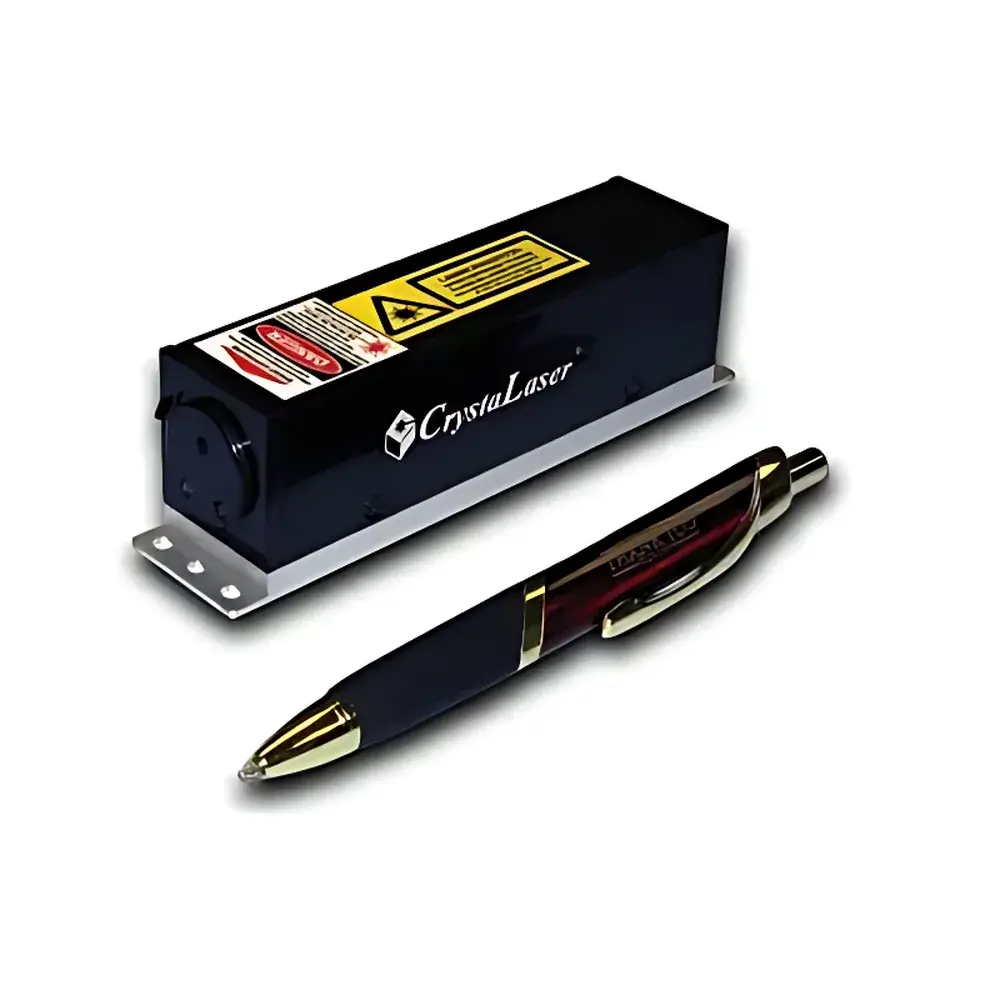
CrystaLaser QL440/QL447/QL473 Q-Switched Blue Diode-Pumped Solid-State (DPSS) Lasers
| Brand | CrystaLaser |
|---|---|
| Wavelengths | 440 nm, 447 nm, 473 nm |
| Max. Avg. Power (at optimal rep. rate) | 50 mW |
| Pulse Energy (at 10 kHz) | 5 µJ |
| Avg. Power Options | 10 mW, 25 mW, 50 mW |
| Pulse Width | 7–100 ns (typ. 15–35 ns) |
| Repetition Rate | 1–100 kHz (internal), 0–200 kHz (external trigger) |
| Transverse Mode | TEM₀₀, M² < 1.2 (typ. < 1.1) |
| Beam Diameter (1/e²) | 0.2 mm |
| Beam Divergence (full angle) | 3–4 mrad |
| Power Stability (rms) | ≤5% after warm-up |
| Beam Pointing Stability | < 0.02 mrad (constant temperature) |
| Polarization | Linear, >100:1 ratio |
| Coherence | Narrow linewidth with long coherence length option available |
Overview
The CrystaLaser QL440, QL447, and QL473 series are compact, air-cooled, diode-pumped solid-state (DPSS) Q-switched lasers engineered for precision applications requiring stable, nanosecond-pulsed blue light. Unlike gas-based blue lasers, these systems utilize Nd:YAG or Nd:YVO₄ crystals frequency-doubled via nonlinear optical crystals (e.g., LBO or BBO) to generate fundamental infrared emission at 880–946 nm, followed by second-harmonic generation (SHG) into the visible blue spectrum. Each model is optimized for a specific nominal wavelength—440 nm (violet-blue), 447 nm (deep blue), and 473 nm (true blue)—enabling spectral selectivity critical in fluorescence excitation, time-resolved spectroscopy, and photoacoustic imaging. The Q-switching mechanism employs an acousto-optic (AO) or electro-optic (EO) modulator, delivering high peak power (>1 kW typical) with excellent pulse-to-pulse reproducibility and low timing jitter (<100 ps RMS). Designed for integration into OEM instrumentation and laboratory setups, the QL series features TTL-compatible external triggering, analog modulation inputs, and RS-232/USB communication for remote parameter control.
Key Features
- Three discrete blue wavelengths: 440 nm, 447 nm, and 473 nm—each factory-optimized for spectral purity and output stability
- Adjustable repetition rate from 1 kHz to 100 kHz (internal oscillator); extended range up to 200 kHz via external TTL or NIM trigger signal
- Pulse width tunability: standard 15–35 ns; optional 7–100 ns range for applications demanding precise temporal control (e.g., pump-probe experiments)
- TEM₀₀ spatial mode with M² < 1.2 (typically < 1.1), ensuring diffraction-limited focusability and high irradiance in confocal or micro-machining configurations
- Beam collimation integrated: 0.2 mm (1/e²) diameter, 3–4 mrad full-angle divergence—minimizing alignment complexity in multi-component optical trains
- Linear polarization >100:1 extinction ratio, enabling seamless integration with polarizers, waveplates, and interferometric systems
- Power stability ≤5% RMS over 8 hours post warm-up (20–30 min thermal stabilization required), compliant with GLP-aligned measurement protocols
Sample Compatibility & Compliance
The QL series is compatible with a broad range of optical components and sample types used in life sciences and materials characterization. Its narrow linewidth and long coherence length option support interferometric applications such as holography and laser Doppler vibrometry. For biological samples, the 447 nm and 473 nm lines efficiently excite common fluorophores including CFP, Alexa Fluor 430, and BODIPY FL without significant phototoxicity at moderate fluences. In industrial metrology, the lasers meet requirements for ISO 11146-compliant beam profiling and ASTM E2849-19 guidelines for pulsed laser parameter verification. All units comply with IEC 60825-1:2014 Class 4 laser safety standards and include integrated interlock circuitry, key switch, and emission indicator per FDA 21 CFR Part 1040.10.
Software & Data Management
CrystaLaser provides the QL Control Suite—a Windows-based application supporting real-time monitoring of output power, repetition rate, pulse energy, and internal temperature via USB or RS-232 interface. The software logs timestamped operational parameters with configurable sampling intervals, generating CSV files suitable for audit trails under GLP/GMP environments. Firmware supports SCPI command syntax, enabling integration with LabVIEW, MATLAB, or Python-based automation frameworks. Critical settings—including trigger mode (internal/external), pulse delay, and power calibration offsets—are stored in non-volatile memory and survive power cycles. Audit-ready features include user-accessible firmware version reporting, error code history, and session-based log export with SHA-256 hash integrity verification.
Applications
- Time-resolved fluorescence lifetime imaging (FLIM) and Förster resonance energy transfer (FRET) assays
- Pump-probe spectroscopy of semiconductor nanostructures and 2D materials (e.g., MoS₂, WS₂)
- Laser-induced breakdown spectroscopy (LIBS) for elemental analysis in ambient air or controlled atmospheres
- Photoacoustic tomography (PAT) source for high-resolution soft-tissue imaging
- Optical clock synchronization and ultrafast electronics testing
- Calibration of single-photon avalanche diodes (SPADs) and streak cameras
- Microfabrication of transparent polymers and bioresorbable scaffolds using two-photon polymerization (2PP) at 447 nm
FAQ
Are these lasers gas-based or solid-state?
These are diode-pumped solid-state (DPSS) lasers—not gas lasers. They use Nd-doped crystals and nonlinear frequency conversion, offering superior wall-plug efficiency, compactness, and reliability compared to argon-ion or krypton-ion blue sources.
What is the warm-up time required for specified power stability?
Typical thermal stabilization time is 20–30 minutes from cold start. Power stability specification (≤5% RMS) applies only after this period under constant ambient temperature (±0.5°C).
Can the pulse width be adjusted independently of repetition rate?
Yes—pulse width is determined by Q-switch driver configuration and cavity design, not directly coupled to repetition rate. The optional 7–100 ns range allows independent optimization for specific duty-cycle or peak-power constraints.
Is FDA 21 CFR Part 11 compliance supported?
While the hardware meets physical security requirements (audit trail logging, user access control), full Part 11 compliance requires implementation within the customer’s validated IT infrastructure and electronic signature workflow—CrystaLaser provides raw data export and metadata tagging to facilitate validation.
Do you offer OEM integration support?
Yes—mechanical drawings, electrical interface schematics, thermal management guidelines, and custom firmware development (e.g., embedded Ethernet, analog modulation mapping) are available under NDA for qualified OEM partners.




