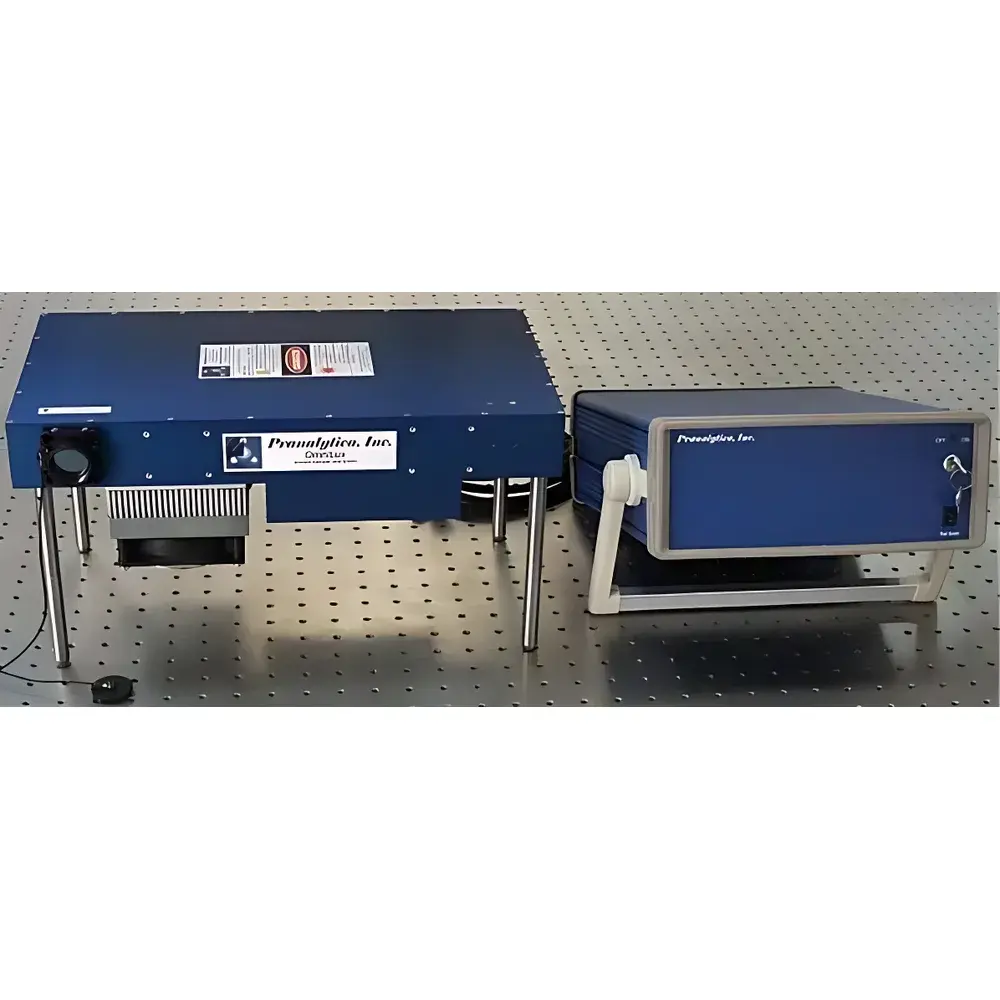
Pranalytica OmniLux™ Multi-Wavelength Tunable QCL System
| Brand | Pranalytica |
|---|---|
| Origin | USA |
| Manufacturer Type | Authorized Distributor |
| Product Category | Imported |
| Model | OmniLux™-XX-XX-XX-XX |
| Configuration | Solid-State Laser System |
| Operating Mode | Quasi-CW (High-Duty-Cycle Pulsed) |
| Wavelength Range | 3.8–12+ µm |
| Output Power per Emitter | Up to 4 W |
| Number of Integrated QCL Emitters | 4 |
| Dimensions | 22 cm (W) × 12 cm (H) × 39 cm (D) |
| Weight | 7 kg |
| Compliance | FDA CDRH Class IV Laser Product Safety Standard (21 CFR 1040.10/1040.11) |
Overview
The Pranalytica OmniLux™ Multi-Wavelength Tunable QCL System is a high-performance, room-temperature-operable coherent infrared light source engineered for precision spectroscopic applications across the mid-wave infrared (MWIR: 3–5 µm) and long-wave infrared (LWIR: 8–12 µm) atmospheric transmission windows. Unlike conventional diode lasers, the system leverages quantum cascade laser (QCL) technology—based on intersubband electron transitions within engineered semiconductor heterostructures—to deliver tunable, narrow-linewidth emission without cryogenic cooling. Each QCL emitter consists of >500 periods of coupled quantum wells, enabling single-electron injection to generate multiple photons per carrier—a fundamental advantage for high-efficiency, high-power mid- to far-IR photon generation. The OmniLux™ platform integrates four independently addressable QCL chips into a compact, thermally stabilized optical bench, supporting simultaneous or sequential operation in quasi-CW mode (duty cycles up to 10–20%, depending on configuration). Its spectral coverage spans 3.8 µm to beyond 12 µm, enabling access to fundamental vibrational absorption bands of numerous gases—including CO, CO₂, NOₓ, CH₄, NH₃, H₂S, HF, and volatile organic compounds (VOCs)—with sub-wavenumber resolution when paired with external scanning optics or interferometric detection.
Key Features
- Four independently controlled, high-brightness QCL emitters integrated into a single chassis
- Wide spectral coverage from 3.8 µm to >12 µm—encompassing two primary atmospheric windows
- Individual emitter output power up to 4 W peak (quasi-CW), among the highest commercially available for room-temperature QCL systems
- Robust thermal management architecture with active temperature stabilization and real-time feedback control
- Synchronized TTL gating output aligned with laser tuning sweep—enabling precise temporal coordination with data acquisition hardware (e.g., lock-in amplifiers, digitizers, FTIR spectrometers)
- Compact form factor (22 × 12 × 39 cm) and low mass (7 kg) suitable for integration into mobile platforms, field-deployable sensors, and OEM instrumentation
- Compliance with U.S. FDA CDRH safety requirements for Class IV laser products (21 CFR 1040.10/1040.11), including interlock-ready design and embedded beam shutter functionality
Sample Compatibility & Compliance
The OmniLux™ system is designed for use with standard gas-phase, liquid-phase, and solid-surface samples in reflection or transmission geometries. It supports both open-path and multipass cell configurations (e.g., Herriott, White cells) up to 100 m effective pathlength. Its wavelength agility enables multi-species detection in complex matrices without hardware reconfiguration. From a regulatory standpoint, the system meets IEC 60825-1:2014 (Edition 3) for laser product safety and incorporates engineering controls required under ANSI Z136.1–2022. For regulated environments—including pharmaceutical process analytical technology (PAT), environmental monitoring under EPA Method TO-14/TO-15, and defense-related IR countermeasure development—the platform supports audit-trail-capable software logging (when used with compliant host systems) and may be configured to align with GLP/GMP documentation workflows. While the laser source itself does not carry ISO/IEC 17025 accreditation, it is routinely deployed as a core excitation module in ISO 14064-1–validated GHG monitoring systems and ASTM E2857–22–compliant trace gas analyzers.
Software & Data Management
The OmniLux™ system ships with Pranalytica’s proprietary QCL Control Suite—a Windows-based application providing full GUI and command-line interface (TCP/IP and USB-VCOM protocols) for wavelength selection, current/voltage ramping, temperature setpoint adjustment, pulse timing, and TTL synchronization. The software implements real-time power normalization, automatic warm-up compensation, and user-defined scan profiles (linear, stepwise, or custom waveform-driven). All operational parameters—including drive current, heatsink temperature, photodiode monitor signal, and gate trigger status—are logged at configurable intervals (down to 1 ms resolution) in CSV or HDF5 format. API libraries (C/C++, Python, MATLAB) are provided for integration into LabVIEW, Python-based spectroscopy pipelines (e.g., PySpectra, SpectroChemPy), or industrial SCADA environments. No cloud connectivity or telemetry is enabled by default; all data remains local unless explicitly exported by the user—supporting air-gapped deployment requirements common in defense and critical infrastructure applications.
Applications
- Defense & Security: Infrared countermeasure (IRCM) simulation, standoff explosive residue detection (e.g., TNT, RDX), toxic industrial chemical (TIC) identification, container screening, and directed infrared countermeasures (DIRCM) subsystem development
- Medical Diagnostics: Non-invasive breath analysis for biomarkers including NH₃ (renal/hepatic function), acetone (diabetes monitoring), isoprene (cholesterol metabolism), and NO (asthma inflammation)
- Environmental Monitoring: Continuous emissions monitoring (CEMS) of stack gases, urban air quality networks (O₃, SO₂, VOCs), marine vessel exhaust profiling, agricultural methane flux quantification, and landfill leachate plume tracking
- Industrial Process Control: Real-time natural gas composition analysis (CH₄/C₂H₆ ratio), refinery flare gas characterization, semiconductor fab cleanroom ambient monitoring (HF, Cl₂, SiH₄), and pharmaceutical lyophilization endpoint detection
- Research & Metrology: High-resolution molecular spectroscopy, cavity-enhanced absorption studies, photoacoustic spectroscopy (PAS) source, and calibration reference for Fourier-transform infrared (FTIR) spectrometers
FAQ
What is the typical tuning range per individual QCL module in the OmniLux™ system?
Each QCL emitter is factory-aligned to a specific center wavelength (e.g., 4.5 µm, 7.8 µm, 9.2 µm, 10.6 µm) with a continuous tuning range of ±5–15 cm⁻¹, depending on operating temperature and drive conditions.
Can the OmniLux™ system operate in true continuous-wave (CW) mode?
No—it operates exclusively in quasi-CW (QCW) mode with programmable pulse widths (100 ns–1 µs) and repetition rates (1–500 kHz), optimized for thermal stability and spectral purity at room temperature.
Is external cooling required for sustained operation?
No. The system includes an integrated thermoelectric cooler (TEC) and closed-loop temperature controller; only standard laboratory AC power (100–240 VAC) and ambient airflow are required.
Does the system support external wavelength calibration using a reference gas cell?
Yes—users may integrate NIST-traceable gas cells (e.g., CO, N₂O, CH₄) and configure the software to trigger automated wavelength-lock routines via second-derivative detection of absorption features.
What level of spectral resolution can be achieved when using this system with a grating spectrometer?
Resolution is determined by the downstream spectrometer—not the QCL source. However, the intrinsic linewidth of each emitter is <0.001 cm⁻¹ (FWHM), enabling sub-Doppler resolution in saturated absorption or frequency-modulation spectroscopy configurations.