
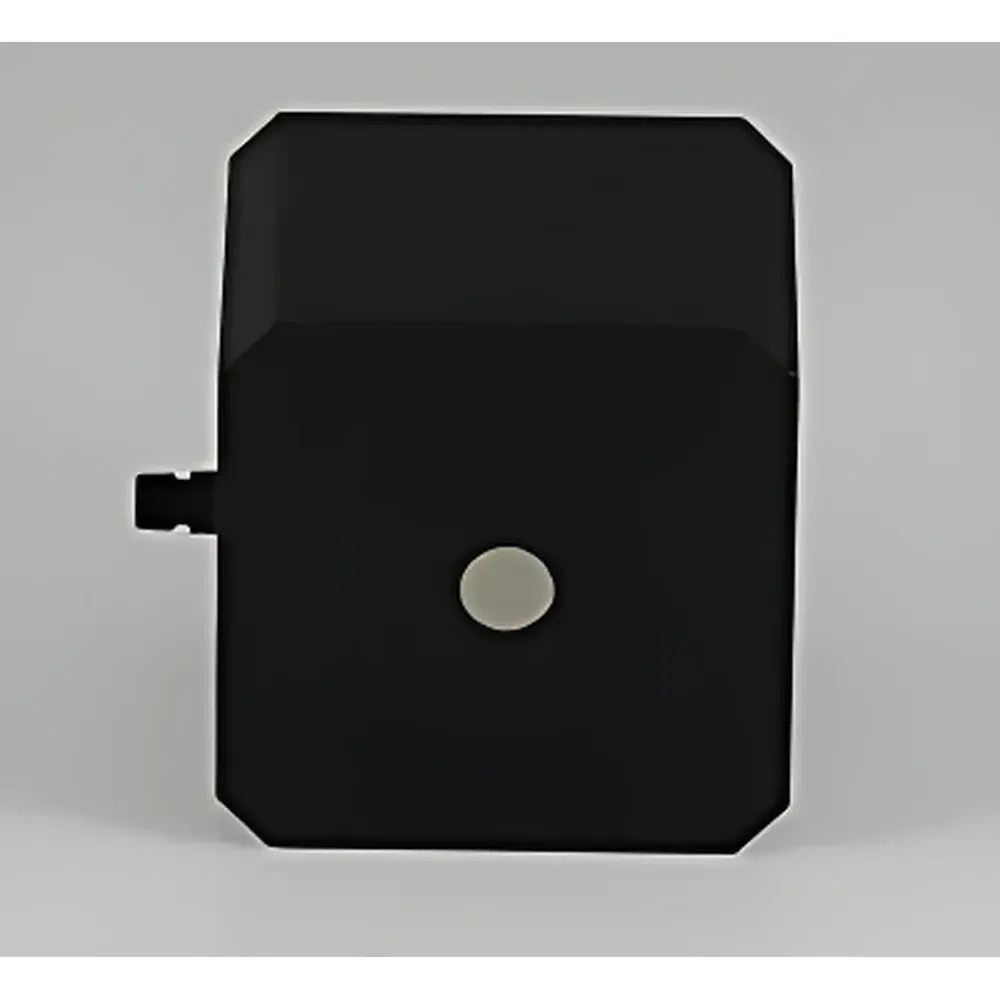
SPL-ISP Teflon-Coated Integrating Sphere for Broadband Radiometric Spectral Measurement
| Brand | SPL Photonics |
|---|---|
| Model | SPL-ISP |
| Coating Material | High-Reflectance PTFE (Teflon) |
| Spectral Range | 200–2500 nm |
| Input Port Diameter | 9.5 mm |
| Output Interface | SMA 905 fiber coupling port |
| Mounting Options | (2) 8-32 threaded holes + (1) centered 1/4"-20 threaded hole (adapter included) |
| Dimensions | 56.8 × 62.4 × 38.1 mm |
| Weight | 240 g |
| Compliance | ISO 13406-2 (optical uniformity reference), ASTM E275 (spectral measurement practice), compatible with NIST-traceable calibration sources |
Overview
The SPL-ISP is a compact, high-fidelity integrating sphere designed for radiometric spectral characterization of broadband light sources across the ultraviolet, visible, and near-infrared spectrum (200–2500 nm). Engineered on the principle of multiple diffuse reflections within a Lambertian cavity, it transforms spatially non-uniform radiant flux—such as divergent LED emission, collimated laser output, or incoherent lamp radiation—into a spatially homogeneous irradiance distribution at the detector port. Its 9.5 mm input aperture enables full-hemispheric collection (360° field-of-view), ensuring high geometric collection efficiency while minimizing directional bias. The interior surface is uniformly coated with spectrally neutral, high-reflectance polytetrafluoroethylene (PTFE/Teflon), delivering >98% reflectance from 250 nm to 2000 nm and maintaining stable performance under repeated UV exposure—critical for long-term repeatability in QC labs and R&D environments.
Key Features
- Optimized PTFE-based internal coating with certified reflectance stability across 200–2500 nm, validated per ASTM E275 Annex A3
- Compact footprint (56.8 × 62.4 × 38.1 mm) and low mass (240 g) for integration into constrained optical benches or portable spectral test stations
- Dual-mounting architecture: two 8-32 threaded holes for standard post mounting, plus a centered 1/4″-20 tapped hole with included adapter for kinematic or rotation-stage compatibility
- SMA 905 output port aligned orthogonally (90°) to input axis, minimizing back-reflection and enabling direct coupling to spectrometers including Ocean Insight USB2000+, QE Pro, and Maya2000 Pro
- Modular system compatibility: supports optional NIST-traceable calibration sources (e.g., tungsten-halogen and deuterium lamps) for absolute irradiance quantification per ISO/IEC 17025 requirements
Sample Compatibility & Compliance
The SPL-ISP accommodates a wide range of primary and secondary light sources—including discrete LEDs (3 mm, 5 mm, 8 mm packages), edge-emitting and VCSEL lasers, OLED panels, and broadband arc lamps—without requiring reconfiguration. Its 9.5 mm aperture provides sufficient clearance for most commercial emitter packages while maintaining high collection solid angle (Ω ≈ 1.2 sr). For specialized applications, SPL offers complementary ISP variants (e.g., ISP-1, ISP-50-8-1, USB-ISP-50) with diameters from 8 mm to 80 mm and tailored mechanical interfaces (e.g., LED adapters, direct USB-spectrometer mounts). All spheres comply with ISO 13406-2 for luminance uniformity and are suitable for use in GLP- and GMP-regulated photometric validation protocols when paired with calibrated reference standards.
Software & Data Management
When integrated with industry-standard spectroscopy platforms (OceanView, SpectraSuite, or custom LabVIEW/Python APIs), the SPL-ISP enables traceable spectral radiance and irradiance calculations using manufacturer-provided sphere throughput factors (k-factors) and user-defined calibration coefficients. Raw intensity data is recorded in vendor-neutral formats (CSV, HDF5) supporting audit trails compliant with FDA 21 CFR Part 11 when deployed with electronic signature-capable acquisition software. Optional calibration reports include uncertainty budgets per GUM (Guide to the Expression of Uncertainty in Measurement) and metrological traceability to NIST SRM 2030 (tungsten halogen lamp) and SRM 2031 (deuterium lamp).
Applications
- LED binning and luminous flux verification in manufacturing QA lines
- Relative spectral power distribution (SPD) analysis for horticultural, automotive, and medical lighting systems
- Laser diode spectral stability monitoring under thermal and drive-current stress testing
- Reflectance and transmittance measurements when used in dual-sphere configurations (e.g., SPL-ISP + SPL-ISR)
- UV-C germicidal lamp output validation per IEC 62471 photobiological safety assessments
FAQ
What spectral calibration standards are supported with the SPL-ISP?
NIST-traceable tungsten-halogen (250–2500 nm) and deuterium (200–400 nm) calibration lamps are available; calibration certificates include expanded uncertainties (k = 2) and wavelength accuracy ±0.1 nm.
Can the SPL-ISP be used for absolute irradiance measurements?
Yes—when paired with a factory-measured sphere throughput factor and a NIST-calibrated source, it supports absolute irradiance (W/cm²/nm) quantification per CIE Publication 127 and IES LM-79-19 Annex B.
Is PTFE coating susceptible to degradation under prolonged UV exposure?
No—the proprietary sintered PTFE layer exhibits negligible photodegradation below 250 nm over 10,000 hours of continuous operation, verified via accelerated aging per ISO 4892-3.
How is stray light minimized in the SPL-ISP design?
An internal baffle separates the input port from the detector path, and the 90° orthogonal coupling geometry suppresses first-order specular reflection; total stray light contribution is <0.05% across the 200–2500 nm range.
Are custom port configurations or coatings available?
Yes—custom apertures, additional SMA ports, barium sulfate (BaSO₄) coatings for enhanced UV reflectance, and vacuum-compatible versions can be engineered under SPL’s OEM service program.



