
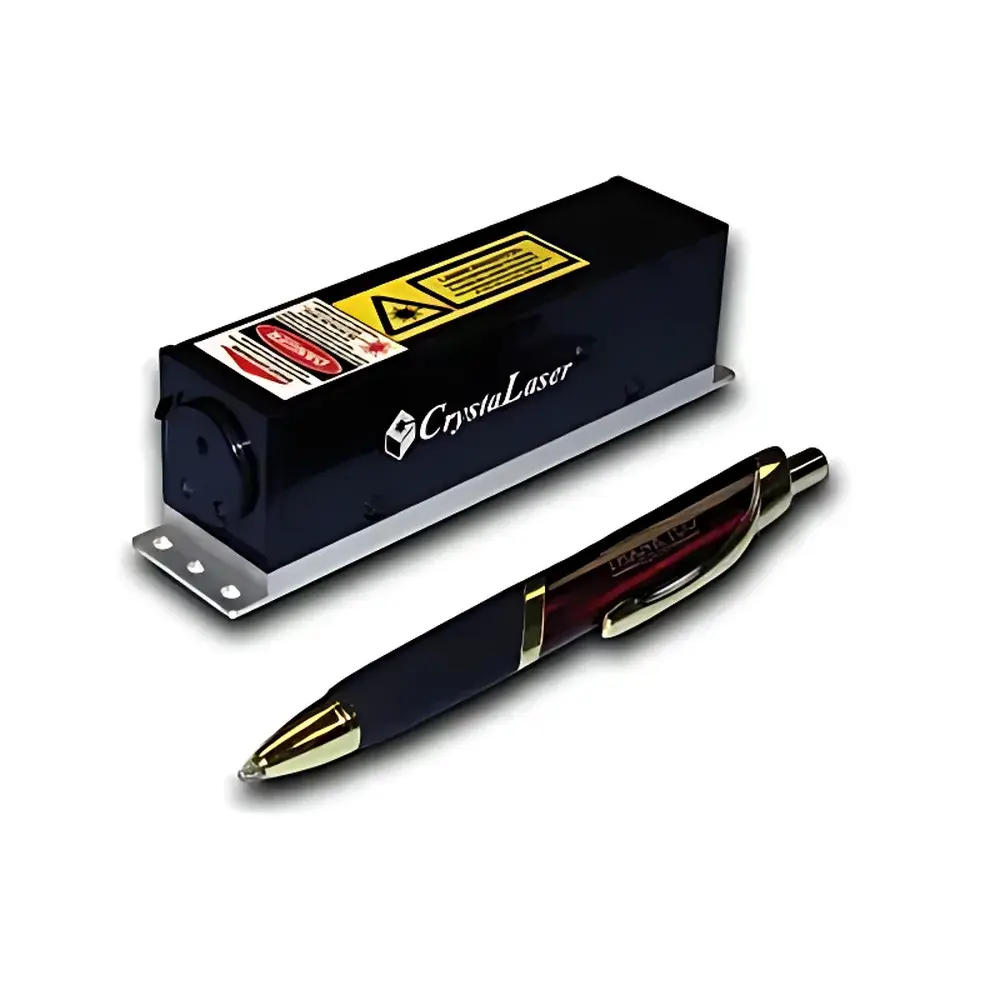
CrystaLaser QL Series Q-Switched Green Lasers
| Brand | CrystaLaser |
|---|---|
| Wavelengths | 532 nm, 527 nm, 523 nm, 555 nm, 561 nm |
| Max. Avg. Power (at optimal rep rate) | 1000 mW |
| Max. Pulse Energy (at 1 kHz) | 0.20–0.35 mJ |
| Avg. Power Options | 1 W, 500 mW, 200 mW, 100 mW, 50 mW |
| Pulse Width | 7–100 ns (typ. 10–25 ns) |
| Repetition Rate | 1–100 kHz (internal), 0–400 kHz (external trigger) |
| Beam Diameter (1/e²) | 0.3 mm |
| Beam Divergence (full angle) | 3–4 mrad |
| Transverse Mode | TEM₀₀, M² < 1.2 (typ. < 1.1) |
| Longitudinal Mode | Single longitudinal mode (coherence length option available) |
| Power Stability (rms) | ≤3% after warm-up |
| Beam Pointing Stability | < 0.02 mrad (constant temperature) |
| Polarization | Linear, extinction ratio ≥100:1 |
Overview
The CrystaLaser QL Series comprises a family of diode-pumped, actively Q-switched solid-state lasers engineered for high-peak-power pulsed green output across multiple discrete wavelengths—532 nm, 527 nm, 523 nm, 555 nm, and 561 nm. Unlike continuous-wave or gain-switched sources, these lasers utilize electro-optic or acousto-optic Q-switching to generate nanosecond-duration pulses with excellent temporal and spatial coherence. The architecture integrates a Nd:YAG or Nd:YVO₄ gain medium with intracavity frequency-doubling crystals (e.g., KTP or LBO), enabling stable, low-noise operation in TEM₀₀ mode. Designed for integration into precision optical systems, the QL lasers deliver consistent pulse-to-pulse energy stability and minimal beam pointing drift—critical for time-resolved fluorescence lifetime imaging (FLIM), laser-induced breakdown spectroscopy (LIBS), time-of-flight mass spectrometry (TOF-MS), and nonlinear optical pumping applications.
Key Features
- Five standard emission wavelengths optimized for biological fluorophore excitation (e.g., 532 nm for FITC, 561 nm for mCherry, 527 nm for GFP variants)
- Actively Q-switched design ensuring deterministic pulse timing, jitter < 1 ns (RMS), and full external triggering capability up to 400 kHz
- TEM₀₀ transverse mode with M² < 1.2 (typically < 1.1), supporting diffraction-limited focusing for high-resolution ablation and confocal excitation
- Single longitudinal mode (SLM) configuration available with coherence lengths exceeding 10 m—enabling interferometric applications and coherent Raman excitation
- Thermally stabilized cavity and low-drift mechanical design ensure beam pointing stability < 0.02 mrad over 8-hour operation at constant ambient temperature
- Integrated analog modulation input (0–5 V) for real-time pulse energy control without altering repetition rate or pulse width
Sample Compatibility & Compliance
The QL Series is compatible with standard OEM optical mounts (e.g., SM1-threaded housings) and supports direct fiber coupling via optional FC/PC or SMA adapters. All models comply with IEC 60825-1:2014 Class 4 laser safety requirements when operated above 500 mW average power; lower-power variants meet Class 3B specifications. Laser housing conforms to RoHS 2011/65/EU and REACH (EC) No. 1907/2006 directives. Electrical interface meets CE EMC Directive 2014/30/EU (EN 61326-1) for laboratory equipment. Optional FDA-compliant documentation packages—including Device Master Record (DMR) excerpts and laser safety interlock schematics—are available for regulated environments requiring ISO 13485 or 21 CFR Part 820 traceability.
Software & Data Management
Each QL laser ships with CrystaLaser’s QControl™ GUI (Windows/Linux/macOS), providing real-time monitoring of diode current, crystal temperature, pulse energy (via integrated photodiode), and repetition rate synchronization status. The software supports SCPI command set over USB 2.0 or RS-232, enabling seamless integration with LabVIEW, MATLAB, or Python-based automation frameworks. Audit-trail logging (timestamped parameter changes, error events, and thermal history) complies with GLP/GMP data integrity requirements per ALCOA+ principles. Optional firmware upgrade path supports future integration with Ethernet-based industrial control networks (Modbus TCP, EtherCAT).
Applications
- Laser Microdissection & Cell Ablation: Nanosecond pulses at 532 nm enable precise sub-micron tissue sectioning with minimal thermal damage due to high peak power (>10 MW) and short interaction time
- Time-Resolved Fluorescence Spectroscopy: Synchronized 1–100 kHz pulsing allows TCSPC acquisition with picosecond timing resolution using hybrid PMTs or SPAD arrays
- Optical Pump-Probe Experiments: Dual-wavelength variants (e.g., QL532 + QL808) support broadband transient absorption measurements in ultrafast photophysics labs
- Calibration of Scientific CCD/CMOS Sensors: Uniform spatial profile and stable pulse energy make QL lasers ideal for quantum efficiency and linearity mapping of scientific imaging sensors
- Seed Sources for Optical Parametric Oscillators (OPOs): High spectral purity and narrow linewidth (< 0.05 nm) enable efficient pumping of tunable mid-IR OPOs in spectroscopic applications
FAQ
What cooling method is used in the QL Series lasers?
All QL models employ thermoelectric (TE) cooling with closed-loop temperature control (±0.1 °C stability) for both pump diodes and nonlinear crystals—no water cooling required.
Can the pulse width be adjusted independently of repetition rate?
Pulse width is primarily determined by cavity design and Q-switch driver settings; fixed-width options (7 ns, 15 ns, 25 ns, 100 ns) are selected at time of order—dynamic adjustment during operation is not supported.
Is remote interlock functionality available for integration into safety-rated systems?
Yes—each unit includes a 24 V DC safety interlock loop compliant with EN 61508 SIL 2 requirements, configurable for fail-safe shutdown upon door opening or emergency stop activation.
Do QL lasers support OEM integration with custom form factors?
CrystaLaser offers mechanical and electrical OEM kits—including compact chassis variants, custom pinouts, and bare-board driver modules—for embedded integration in analytical instrumentation platforms.
What is the typical warm-up time to achieve specified power stability?
Full thermal equilibrium and RMS power stability ≤3% are achieved within 30 minutes of cold start under nominal operating conditions (23 ±2 °C ambient).





