
Thorlabs SPL-OSW MEMS Optical Switch Kit
| Brand | Thorlabs |
|---|---|
| Origin | USA |
| Model | SPL-OSW |
| Switch Configurations | 1×2, 2×2, 1×4, 1×8 |
| Operating Wavelength Ranges | 480–650 nm, 600–800 nm, 750–950 nm, 800–1000 nm, 970–1170 nm, 1240–1625 nm |
| Insertion Loss | Typ. 0.7 dB / Max 2.6 dB |
| Crosstalk | Typ. 75 dB / Min –60 dB |
| Polarization Dependent Loss | Typ. 0.02 dB / Max 0.2 dB |
| Switching Speed | Typ. 0.5 ms / Max 1 ms |
| Max Optical Power | 30–300 mW (wavelength-dependent) |
| Fiber Type | Single-mode (SM450 to SMF-28E) |
| Mode Field Diameter | 3.3–10.4 µm |
| Lifetime | ≥10⁹ switching cycles |
| Control Interface | USB 2.0, TTL, front-panel toggle |
| Power Supply | 4.75–5.25 VDC (USB) or 6–15 VDC (external), included PMPS9 wall adapter |
| Dimensions (kit) | 170 × 100 × 20 mm |
| Compliance | RoHS, CE, FCC Class B |
Overview
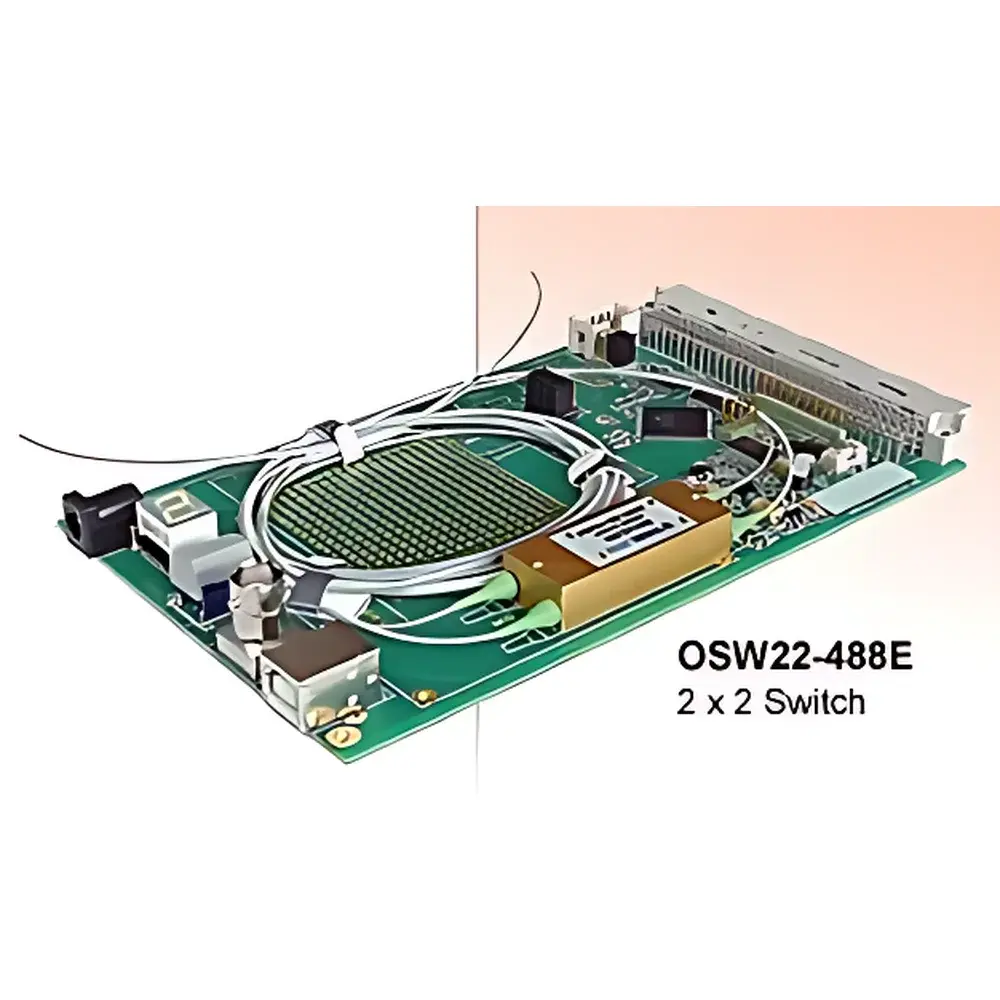
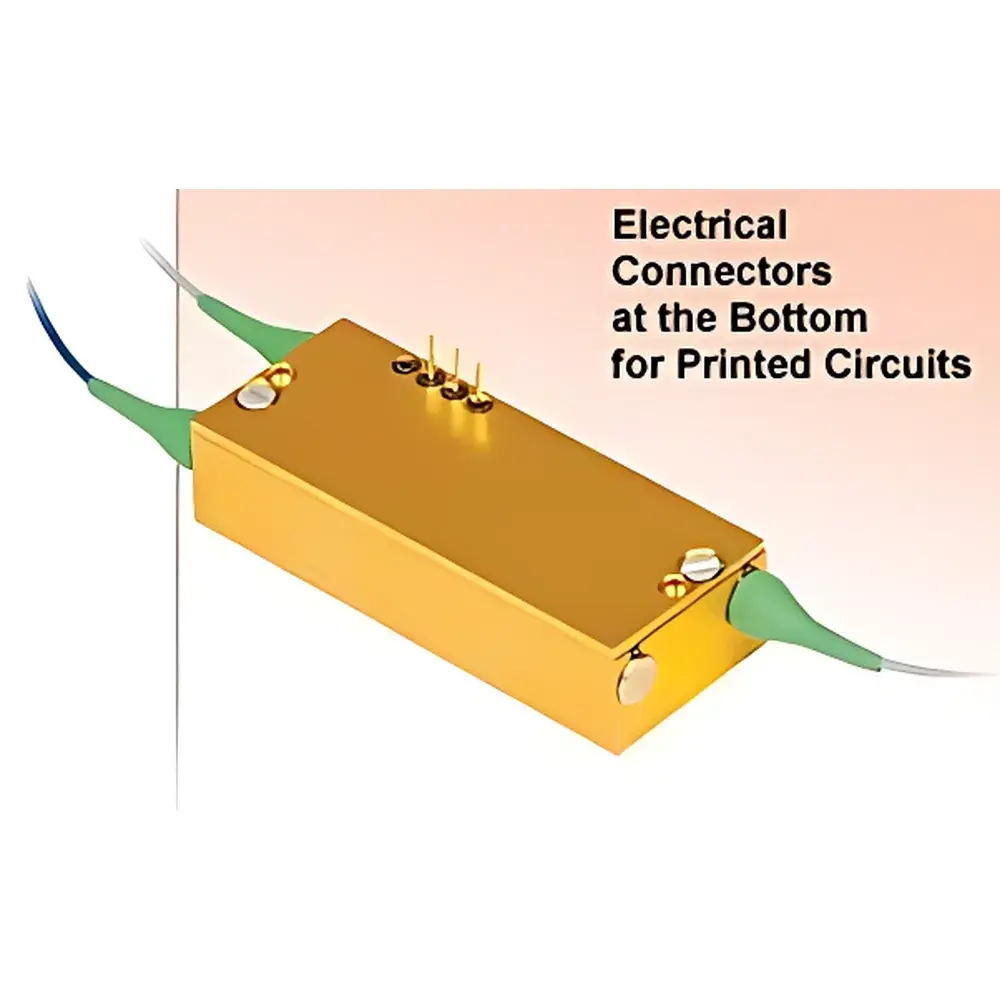
The Thorlabs SPL-OSW MEMS Optical Switch Kit is a modular, high-reliability fiber-optic switching platform engineered for precision optical path control in automated test systems, quantum optics setups, spectroscopic instrumentation, and telecom R&D environments. Built upon silicon-based microelectromechanical systems (MEMS) actuation, the device operates via electrostatically driven micromirrors that physically redirect light between input and output ports—enabling true all-optical, non-latching switching without intermediate electrical-to-optical conversion. This architecture delivers sub-millisecond switching (<1 ms max), exceptional repeatability (±0.01 dB), and inherently low polarization-dependent loss (PDL < 0.2 dB), making it suitable for polarization-sensitive applications such as interferometry and coherent detection. Unlike thermally or piezoelectrically actuated switches, MEMS-based designs eliminate thermal drift and hysteresis, ensuring stable long-term performance across environmental fluctuations. The SPL-OSW supports multiple configurations—including 1×2, 2×2, 1×4, and 1×8 topologies—each optimized for bidirectional signal routing in both linear and cross-connect modes. Its wavelength coverage spans six discrete bands from 480 nm to 1625 nm, aligning with common laser sources (e.g., 488 nm Ar⁺, 633 nm HeNe, 780 nm diode, 1310/1550 nm telecom bands), and is compatible with standard single-mode fibers including SM450, SM600, SM780, SM800, SM980, and Corning SMF-28E.
Key Features
- MEMS mirror-based switching mechanism ensures >10⁹ operational cycles with no mechanical wear-out
- Non-latching operation: maintains state only while voltage is applied; zero power consumption in static configuration
- Triple control interface: front-panel tactile switch, 5 V TTL trigger (compatible with arbitrary waveform generators and DAQ systems), and USB 2.0 host communication (with native LabVIEW™ and LabWindows/CVI drivers)
- Integrated DIN41612-compatible Eurocard form factor (100 mm × 160 mm) for seamless integration into 19-inch rack-mounted optical benches and OEM instrumentation chassis
- Onboard seven-segment LED channel indicator and TTL status output for real-time monitoring and system-level synchronization
- Low insertion loss (typ. 0.7 dB, max 2.6 dB depending on configuration and wavelength band) and high isolation (crosstalk ≤ –60 dB for 1×4/1×8, ≤ –50 dB for 1×2/2×2)
- RoHS-compliant construction with CE and FCC Class B certification for laboratory and industrial deployment
Sample Compatibility & Compliance
The SPL-OSW is designed exclusively for single-mode fiber (SMF) interfacing and ships without pre-installed connectors—allowing end-users to specify FC/PC, FC/APC, SC/APC, or custom terminations per application requirements. Its optical design accommodates mode-field diameters ranging from 3.3 µm (SM450 at 488 nm) to 10.4 µm (SMF-28E at 1550 nm), minimizing coupling loss across the full operational bandwidth. All variants meet IEC 61300-2-36 (fiber optic connector durability), IEC 61300-2-17 (vibration), and IEC 60068-2-14 (thermal shock) standards. For regulated environments, the kit’s deterministic switching behavior, traceable calibration history (available upon request), and support for audit-ready logging via USB enable compliance with GLP/GMP workflows and FDA 21 CFR Part 11 electronic record requirements when paired with validated software platforms.
Software & Data Management
Thorlabs provides fully documented, royalty-free drivers for LabVIEW™ 2015+ and LabWindows/CVI 2013+, enabling direct integration into automated test sequences and custom GUIs. The USB interface exposes a HID-class virtual COM port, supporting ASCII command sets for channel selection, status polling, and firmware version interrogation. All switching events are timestamped with microsecond resolution, and internal registers log cumulative cycle counts for predictive maintenance. When deployed in PRO8 modular systems, SPL-OSW modules interoperate with Thorlabs’ Kinesis® software suite, allowing synchronized multi-axis control alongside motorized stages, filter wheels, and power meters. Data export supports CSV and TDMS formats, facilitating post-acquisition analysis in MATLAB®, Python (via PyVISA), or Excel-based QA reporting frameworks.
Applications
- Automated optical component testing: dynamic routing of DUTs in production test beds for isolators, circulators, and WDM filters
- Quantum key distribution (QKD) systems: fast, low-loss path selection for basis encoding and measurement basis switching
- Laser cavity dumping and pulse picking in ultrafast oscillator-amplifier chains
- Multiplexed sensor networks: time-division multiplexing of FBG or interferometric sensors in structural health monitoring
- Confocal and multiphoton microscopy: synchronized illumination path switching between excitation lasers and detection channels
- DWDM/CWDM system validation: channel-by-channel insertion loss and crosstalk characterization across C- and L-bands
FAQ
What is the maximum optical power handling capability?
Maximum continuous-wave optical power ranges from 30 mW (at 488 nm) to 300 mW (at 1310/1550 nm), depending on the selected wavelength variant. Pulsed operation up to 10 kW peak power is feasible with appropriate duty-cycle management.
Can the switch be used in vacuum or elevated temperature environments?
The specified operating temperature range is 0–40 °C. Extended-range versions (–20 to +60 °C) are available under custom order; vacuum-compatible variants require hermetic packaging and must be requested at quotation stage.
Is fiber alignment performed at the factory?
No. All units ship with bare fiber ends (no connectors). Active alignment and epoxy curing are required during final integration to achieve optimal coupling efficiency—Thorlabs offers alignment fixtures (e.g., ADAL1) and passive alignment sleeves (e.g., ADAF1) for this purpose.
How is calibration traceability maintained?
Each unit undergoes factory verification against NIST-traceable reference photodiodes and power meters. Calibration reports—including insertion loss, PDL, and crosstalk measurements per channel—are provided digitally with serial-number-matched metadata.
Does the SPL-OSW support analog modulation or variable attenuation?
No. It is a binary on/off path selector. For continuously tunable attenuation, Thorlabs recommends pairing the SPL-OSW with an inline VOA (e.g., VOAS101) or using the SOA1013SXS semiconductor optical amplifier-based shutter for nanosecond-scale analog control.





