
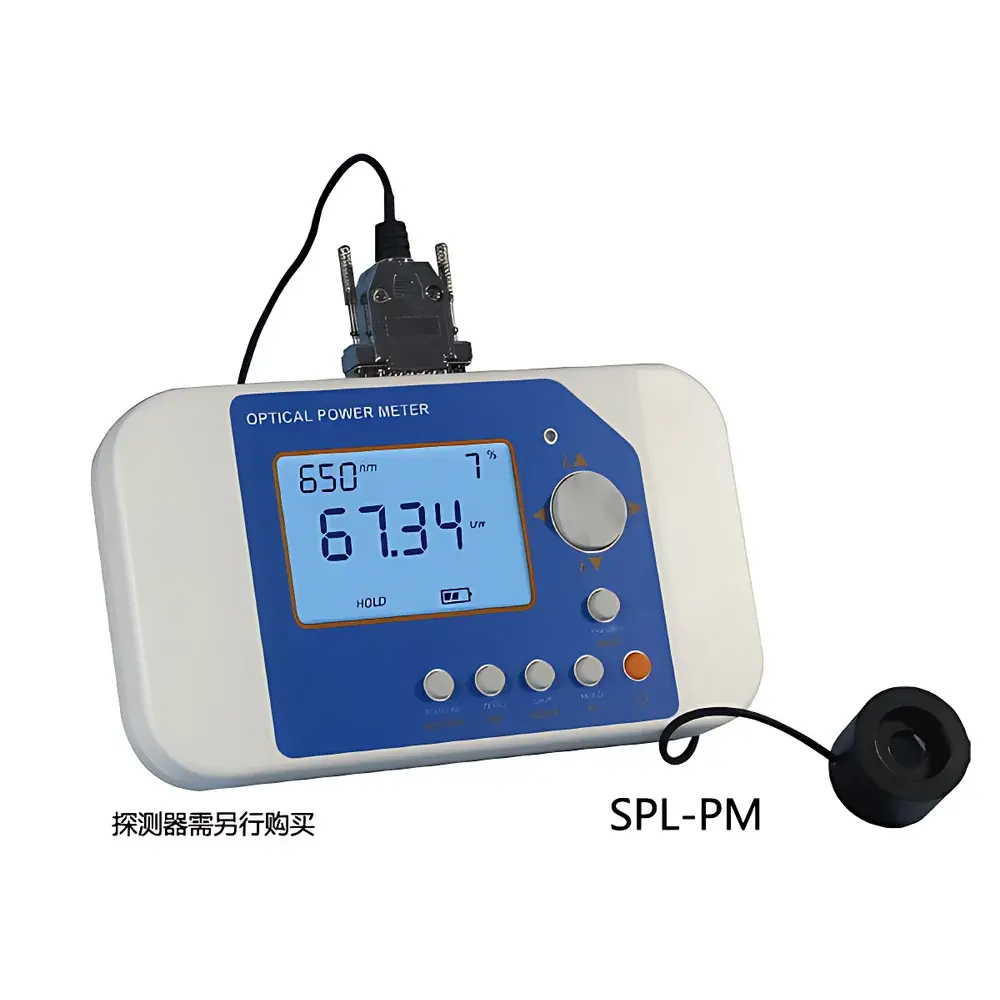
SPL SPL-PM Handheld Optical Power and Energy Meter
| Brand | SPL |
|---|---|
| Model | SPL-PM |
| Measurement Range | 1 pW to 20 kW |
| Detector Compatibility | UV-enhanced Si, Si, InGaAs |
| Display | 4-digit LCD with intelligent backlight |
| Units | W, dBm, dB |
| Power | Rechargeable battery or AC adapter |
| Compliance | CE-marked for laboratory use |
| Software Features | Real-time data logging, tabular export (CSV), audit-ready timestamped records |
Overview
The SPL SPL-PM Handheld Optical Power and Energy Meter is a precision-calibrated, portable instrumentation platform engineered for quantitative radiometric measurement across an exceptionally broad dynamic range—from single-photon-level optical power (1 pW) to high-energy pulsed or continuous-wave laser outputs (up to 20 kW). Designed around a digital communication architecture between the meter head and SPL-PM-IR series photodetectors, it eliminates analog signal degradation and ensures traceable, repeatable measurements under variable environmental conditions. Its operational principle relies on calibrated photodiode responsivity curves (NIST-traceable calibration certificates available per detector), enabling accurate conversion of photocurrent into absolute optical power or pulse energy values. The device is intended for use in laser safety verification, optical system alignment, laser source characterization, and quality control in photonics R&D labs and manufacturing environments where compliance with ISO/IEC 17025–aligned measurement practices is required.
Key Features
- Digital detector interface ensuring immunity to electromagnetic interference and eliminating gain drift associated with analog amplification stages
- Four-digit segmented LCD display with adaptive backlight—optimized for readability in both darkroom and ambient-lit laboratory settings
- Simultaneous support for three standardized radiometric units: watts (W), decibel-milliwatts (dBm), and relative decibels (dB)
- Auto-ranging functionality spanning 16 decades without manual intervention—critical for characterizing ultra-low-power alignment beams and high-power industrial lasers
- Configurable auto-shutdown (3–30 min timeout) to preserve battery life during extended benchtop operation
- Over-range warning with visual and audible alerting to prevent detector saturation and measurement artifacts
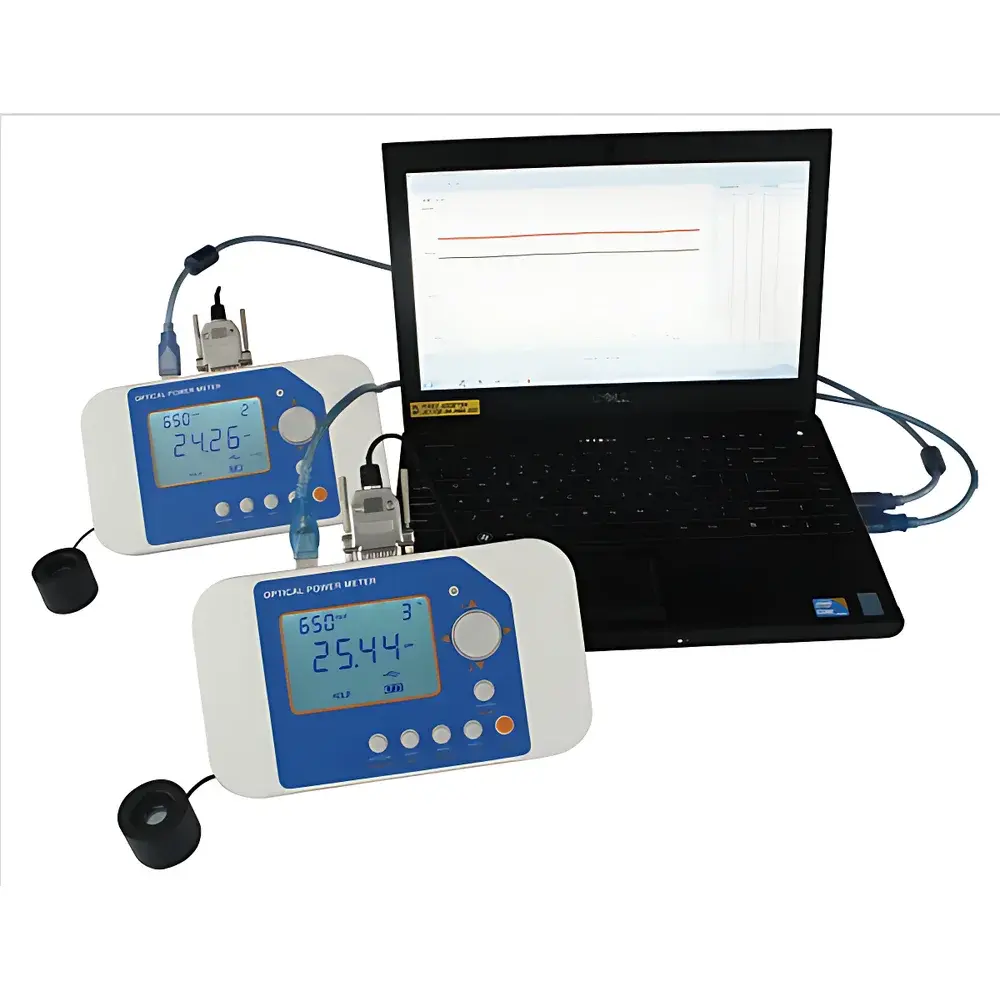
- USB 2.0 host interface enabling real-time streaming, synchronized multi-channel acquisition (up to four detectors via software), and firmware updates
- Dual power architecture: integrated rechargeable Li-ion battery (8+ hours typical runtime) and universal AC adapter input (100–240 VAC, 50/60 Hz)
Sample Compatibility & Compliance
The SPL-PM meter is compatible with SPL’s modular detector portfolio—including UV-enhanced silicon (190–1100 nm), standard silicon (400–1100 nm), and indium gallium arsenide (InGaAs; 800–1700 nm) sensors—each supplied with individual NIST-traceable calibration data. Detectors are housed in thermally stabilized mounts to minimize temperature-induced responsivity drift (< ±0.05 %/°C typical). The system conforms to IEC 61326-1:2013 for electromagnetic compatibility and meets CE marking requirements for laboratory instrumentation. While not certified for medical device use under IEC 62304 or FDA 21 CFR Part 11 out-of-the-box, its data logging software supports optional audit trail configuration (user login, timestamped parameter changes, immutable CSV export) to facilitate GLP/GMP-aligned workflows in regulated environments.
Software & Data Management
The included Windows-based SPL-PowerLog software provides full instrument control and metrological data handling. It enables real-time dual-channel monitoring, configurable sampling rates (1–100 Hz), and time-stamped data capture with metadata tagging (operator ID, detector SN, wavelength setting, measurement mode). All acquired datasets are stored in open CSV format with header rows specifying units, calibration coefficients, and uncertainty budgets. Exported files retain full traceability for integration into LIMS or statistical process control platforms. Software update history and configuration logs are retained locally for internal QA review. No cloud connectivity or telemetry is enabled by default—ensuring data sovereignty and network isolation per ITAR and institutional cybersecurity policies.
Applications
- Laser diode threshold and slope efficiency characterization in semiconductor optoelectronics labs
- Optical fiber coupling loss validation in telecom component testing
- Pulsed laser energy stability assessment (e.g., Q-switched Nd:YAG, Ti:sapphire oscillators)
- Calibration transfer between primary standards and field-deployable detectors
- UV-curing lamp irradiance mapping for photopolymerization process development
- Photovoltaic cell spectral response verification using monochromated sources
- Educational laboratories requiring robust, entry-level radiometry tools compliant with undergraduate physics curriculum standards (e.g., AAPT recommended equipment lists)
FAQ
What calibration standards are used for SPL-PM detectors?
All SPL-PM-IR series detectors are calibrated against NIST-traceable reference standards at accredited third-party laboratories. Calibration reports include spectral responsivity curves, uncertainty budgets (k=2), and temperature coefficients.
Can the SPL-PM measure both CW and pulsed laser sources?
Yes—when paired with appropriate thermal or photodiode-based detectors from the SPL-PM-IR family. Pulse energy measurement requires selection of a joule-rated sensor and configuration of integration gate width in software.
Is the USB interface compatible with Linux or macOS systems?
The native SPL-PowerLog software is Windows-only; however, raw HID-compliant USB data packets can be parsed via custom Python or LabVIEW drivers using provided protocol documentation.
How often should recalibration be performed?
Annual recalibration is recommended for ISO/IEC 17025 compliance. Frequency may increase based on usage intensity, mechanical shock exposure, or regulatory requirements in pharmaceutical or aerospace applications.
Does the SPL-PM support external triggering for synchronized measurements?
No—external trigger input is not implemented. Synchronization across multiple channels is achieved via software-timed acquisition with sub-millisecond inter-channel jitter.



