
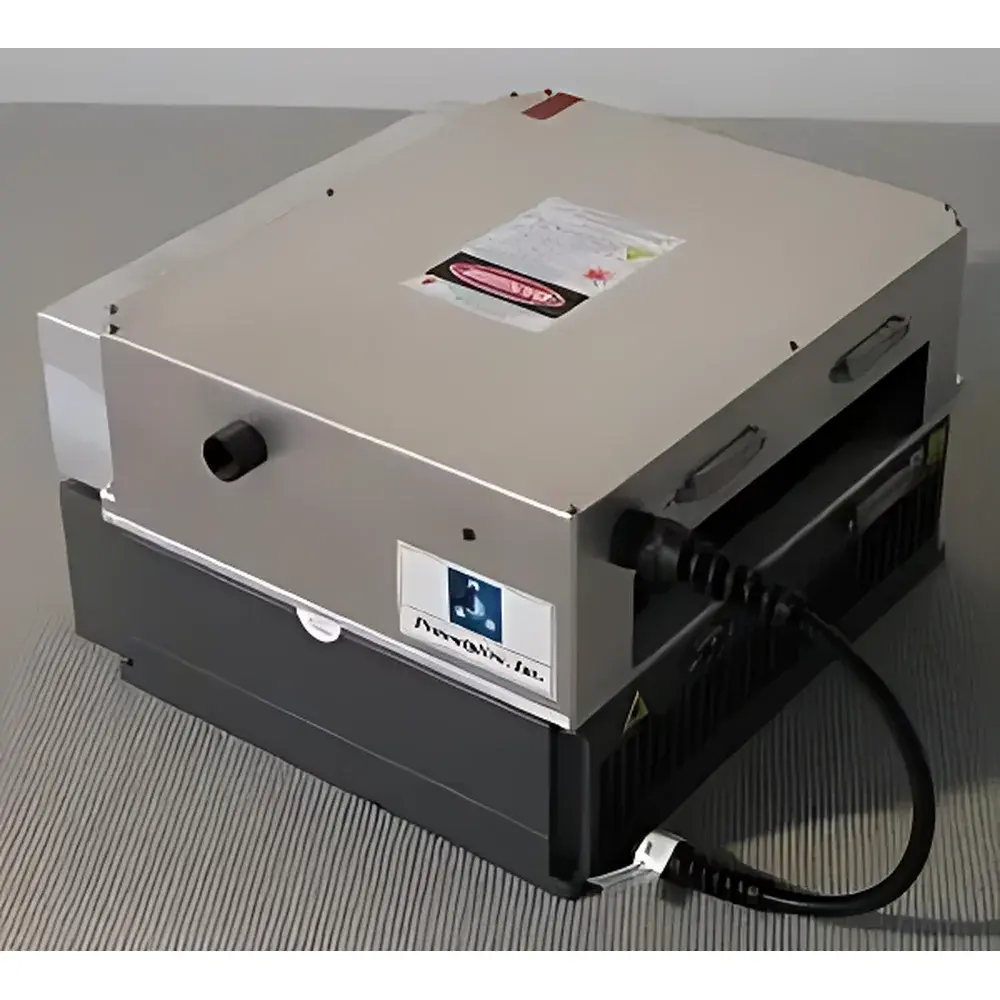
Pranalytica MultiLux™-20-XX-YY-CW-SYST High-Power Multi-Wavelength Quantum Cascade Laser System
| Brand | Pranalytica |
|---|---|
| Origin | USA |
| Model | MultiLux™-20-XX-YY-CW-SYST |
| Output Configuration | SWIR @ ~2.1 µm (≥3.0 W), MWIR @ ~4.0 µm (≥1.5 W), MWIR @ ~4.6 µm (≥2.0 W) |
| Beam Collinearity | < 1 mrad |
| Beam Quality (M²) | < 1.5 for all channels |
| Cooling | Air-cooled |
| Dimensions (L×W×H) | 10" × 10" × 6.5" |
| Weight | 20 lbs (laser head), 30 lbs (controller) |
| Control Interface | RS232/RS422/RS485 |
| Pulse Modulation Bandwidth | MWIR ≤100 kHz (3 dB), SWIR ≤5 kHz (3 dB) |
| Power Input | 110/220 VAC 50/60 Hz or 28 VDC |
Overview
The Pranalytica MultiLux™-20-XX-YY-CW-SYST is a turnkey, air-cooled, high-power multi-wavelength laser system engineered for demanding mid-infrared (MWIR) and short-wave infrared (SWIR) applications requiring simultaneous, co-aligned emission across spectrally distinct bands. At its core, the system integrates three independently controlled, continuous-wave (CW) semiconductor lasers: a fiber-based SWIR source at ~2.1 µm, and two thermoelectrically stabilized quantum cascade lasers (QCLs) operating at ~4.0 µm and ~4.6 µm. Unlike conventional interband diode lasers, QCLs rely on intersubband transitions within engineered quantum-well heterostructures—enabling precise wavelength definition, high wall-plug efficiency, and robust operation at near-room temperature. This architecture supports fundamental molecular absorption spectroscopy in atmospheric transmission windows (e.g., 3–5 µm and 8–12 µm), where critical analytes—including CO, NO, CH₄, NH₃, HCN, and volatile organic compounds—exhibit strong fundamental vibrational-rotational transitions. The system’s co-linear beam geometry (<1 mrad divergence mismatch) and diffraction-limited output (M² < 1.5 per channel) ensure spatial coherence over extended propagation paths, making it suitable for long-range standoff detection, active illumination, and heterodyne sensing configurations.
Key Features
- Triple-wavelength CW emission: SWIR (~2.1 µm, ≥3.0 W), MWIR #1 (~4.0 µm, ≥1.5 W), MWIR #2 (~4.6 µm, ≥2.0 W)
- Sub-milliradian beam collinearity and matched beam diameters (±10%) enabling seamless spectral multiplexing
- Hermetically sealed, thermoelectrically cooled QCL modules with integrated collimating optics for long-term stability
- Independent current and temperature control for each laser channel via precision QCL drivers and TEC controllers
- Flexible modulation capability: internal/external TTL-triggered pulse sequencing up to 100 kHz (MWIR) and 5 kHz (SWIR)
- Ruggedized 10″ × 10″ × 6.5″ laser head with air-cooling architecture compliant with MIL-STD-810G environmental specifications
- Full-system rack-mount controller with RS232/RS422/RS485 interfaces and comprehensive safety interlocks (over-temperature, over-current, beam path fault monitoring)
Sample Compatibility & Compliance
The MultiLux™-20-XX-YY-CW-SYST is designed for integration into analytical platforms requiring trace-gas quantification, industrial process monitoring, or defense-grade countermeasure systems. Its spectral coverage aligns with ASTM E1444 (standard practice for infrared gas analysis), ISO 14001-compliant emissions verification protocols, and EPA Method 320 for stack gas monitoring. All QCL modules undergo burn-in and lifetime qualification per Telcordia GR-468-CORE, ensuring >10,000 hours of operational reliability under continuous duty. The system meets IEC 60825-1:2014 Class 4 laser safety requirements, with embedded hardware interlocks, key-switch enablement, and shutter control. For regulated environments, optional audit-trail logging and user-access-level management support FDA 21 CFR Part 11 compliance when paired with validated third-party data acquisition software.
Software & Data Management
The system ships with Pranalytica’s MultiLux Control Suite—a Windows-based application providing real-time parameter visualization, waveform programming, and synchronized multi-channel triggering. It supports SCPI command syntax for integration into LabVIEW, MATLAB, or Python-based automation frameworks. All operational logs—including laser current, TEC setpoint, case temperature, and output power history—are timestamped and exportable in CSV or HDF5 format. Optional firmware upgrades enable advanced features such as closed-loop power stabilization using integrated photodiode feedback and dynamic wavelength calibration against NIST-traceable reference cells. Remote diagnostics and firmware updates are supported via secure SSH tunneling, facilitating maintenance in field-deployed or classified installations.
Applications
- Defense & Security: Infrared countermeasures (IRCM), laser target designation, standoff explosive residue detection (e.g., TNT, RDX), chemical warfare agent identification (e.g., sarin, VX), and container screening via photoacoustic or cavity-enhanced absorption spectroscopy
- Medical Diagnostics: Non-invasive breath analysis for biomarkers including NH₃ (renal dysfunction), acetone (diabetes), isoprene (cholesterol metabolism), and NO (asthma inflammation), compatible with ISO 16900 respiratory sampling standards
- Environmental Monitoring: Mobile and fixed-site networks for urban air quality (O₃, CO, NO₂), agricultural methane flux quantification, maritime emissions verification (SO₂, NOₓ), and industrial stack compliance reporting per EU Directive 2010/75/EU
- Industrial Process Control: Real-time monitoring of natural gas composition (CH₄/C₂H₆ ratio), pipeline leak detection (ppb-level ethylene sensitivity), pharmaceutical solvent residual analysis (e.g., dichloromethane in lyophilized products), and semiconductor fab ambient purity assurance (HF, Cl₂, SiH₄)
- Research: Time-resolved pump-probe spectroscopy, dual-comb spectroscopy seed sources, quantum cascade detector characterization, and calibration of Fourier-transform infrared (FTIR) spectrometers
FAQ
What wavelengths are available in standard MultiLux™ configurations?
Standard models include SWIR at ~2.1 µm, MWIR at ~4.0 µm, and MWIR at ~4.6 µm. Custom combinations spanning 2.0–12.0 µm are available upon request, subject to QCL chip availability and thermal management constraints.
Is the system compatible with external lock-in amplifiers or data acquisition systems?
Yes—each laser channel provides analog modulation input (0–5 V) and TTL sync outputs. Digital control via RS422 ensures deterministic timing synchronization across multiple instruments in multi-sensor arrays.
Can the system operate unattended for extended periods?
The system is rated for continuous 24/7 operation under ambient temperatures of 15–30 °C and relative humidity <70% non-condensing. Built-in thermal derating algorithms automatically reduce output power if cooling capacity is compromised.
Does Pranalytica provide OEM integration support?
Yes—full mechanical, electrical, and firmware documentation is supplied under NDA. Engineering support includes custom mounting interface design, thermal interface optimization, and subsystem-level qualification testing per customer-defined MIL-STD or IEC specifications.
How is wavelength accuracy maintained over time and temperature?
Each QCL incorporates an integrated thermistor and calibrated lookup table; factory wavelength verification is traceable to NIST SRM 2034 (HeNe laser standard). Optional external wavelength meters (e.g., Bristol 721A) can be integrated for real-time drift correction in metrology-critical applications.






