
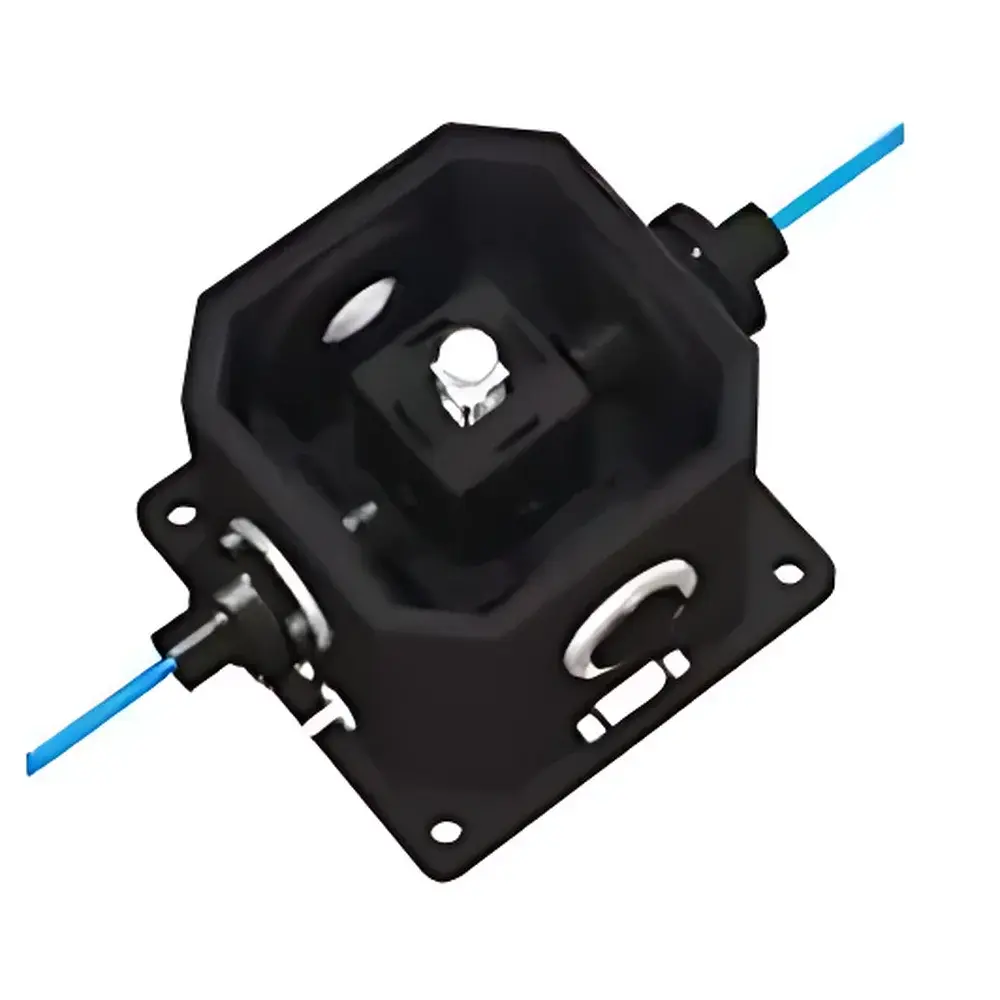
Quantum Northwest qpod™ Precision Temperature-Controlled Cuvette Holder
| Brand | Quantum Northwest |
|---|---|
| Origin | South Korea |
| Model | qpod™ Cuvette Holder |
| Temperature Range | −40.0 °C to +105.0 °C (standard), extendable to −55.0 °C to +150.0 °C |
| Temperature Stability | ±0.02 °C (standard cuvette mode), ±0.05 °C (fiber-optic spectrometer mode) |
| Control Method | Peltier-based thermoelectric control with PID feedback |
| Temperature Sensor | Integrated Pt100 or thermistor probe |
| Stirring | Magnetic stirrer with variable speed |
| Optical Interface | SMA905 connector, fused silica focusing lens, UV-enhanced front-surface mirror, adjustable slit, optional 12.5 mm filter holder and polarizer |
| Configurations | CUV-qpod-ABSKIT (absorption/transmission), CUV-qpod-FLKIT (right-angle fluorescence), CUV-qpod-MPKIT (dual-mode absorption & fluorescence) |
| Compliance | Designed for GLP-compliant spectroscopic workflows |
Overview
The Quantum Northwest qpod™ Precision Temperature-Controlled Cuvette Holder is an engineered optical component designed for high-fidelity thermal regulation of liquid or solid samples during spectroscopic measurements. Based on thermoelectric (Peltier) actuation with closed-loop PID control and high-resolution thermal sensing, the qpod™ delivers rapid, stable, and reproducible temperature conditioning across a broad operational range—from −40.0 °C to +105.0 °C in standard configuration, with custom variants supporting −55.0 °C to +150.0 °C. Its architecture integrates thermal management, optical coupling, and sample homogenization into a single compact platform suitable for integration with benchtop UV-Vis, fluorescence, CD, Raman, transient absorption, NIR, and fiber-coupled spectrometers—including Ocean Insight (formerly Ocean Optics) systems via SMA905 interface. The device is not a standalone instrument but a precision subsystem intended for use within validated analytical workflows requiring traceable, auditable, and repeatable thermal conditions.
Key Features
- Peltier-driven temperature control with ±0.02 °C stability (cuvette mode) and ±0.05 °C stability (fiber-optic mode), verified using calibrated thermistor or Pt100 internal sensors
- Programmable ramp rates and isothermal hold profiles—fully scriptable via RS-232 or USB interface for integration into automated acquisition sequences
- Integrated magnetic stirring with continuously variable speed to ensure thermal uniformity and minimize convection gradients across the sample volume
- Optomechanically adjustable components: fused silica focusing lens, UV-enhanced front-surface mirror, linear slit aperture (for beam definition), and optional 12.5 mm filter holder and linear polarizer
- Three application-optimized configurations: ABSKIT (collimated beam path for absorbance/transmittance), FLKIT (90° excitation/emission geometry for fluorescence), and MPKIT (modular dual-path design supporting both modalities)
- Rugged aluminum housing with low-thermal-mass design enabling <60-second stabilization after step-change commands
Sample Compatibility & Compliance
The qpod™ accommodates standard 10 mm square cuvettes (1 mL–3.5 mL volume), as well as custom cell geometries upon request. Its open optical path supports transmission, reflection, and fluorescence sampling without mechanical obstruction. All optical surfaces are specified for UV-VIS-NIR performance (190–2500 nm), with fused silica lenses and dielectric-coated mirrors ensuring minimal wavefront distortion and high throughput. From a regulatory standpoint, the qpod™ is engineered to support GLP and GMP environments: temperature logs include timestamped sensor readings with audit-trail-capable firmware (optional), and thermal calibration procedures align with ASTM E2877 guidance for spectrophotometric thermal validation. When deployed in FDA-regulated laboratories, it may be included in instrument qualification protocols (IQ/OQ/PQ) as a critical auxiliary subsystem affecting measurement uncertainty.
Software & Data Management
Control is managed through Quantum Northwest’s proprietary qpod™ Control Software (Windows-based), which provides real-time temperature monitoring, profile scripting, and data export in CSV format. The software supports third-party integration via ASCII command protocol over serial or virtual COM port, enabling synchronization with spectrometer acquisition engines (e.g., OceanView, SpectraSuite, or custom LabVIEW/Python scripts). All temperature setpoints, actual readings, stir speed, and timestamps are logged with millisecond resolution. For regulated environments, optional 21 CFR Part 11 compliance packages include electronic signature capability, user access levels, and immutable audit trails—configurable per laboratory SOPs.
Applications
The qpod™ serves as a foundational thermal interface in multiple advanced spectroscopic techniques: temperature-dependent UV-Vis absorbance studies of protein denaturation or polymer phase transitions; fluorescence quantum yield determination across thermal gradients; circular dichroism analysis of chiral biomolecules; time-resolved transient absorption kinetics under controlled thermal initiation; fiber-optic Raman probing of catalytic surfaces; and NIR moisture mapping in pharmaceutical granules. Its compatibility with Ocean Insight spectrometers makes it especially valuable in field-deployable or OEM-integrated systems where size, power efficiency, and thermal responsiveness are constrained.
FAQ
What is the minimum temperature ramp rate achievable?
Ramp rates are user-defined; typical operation achieves 0.1 °C/min to 5 °C/min with full stability maintained at endpoint.
Can the qpod™ be used under vacuum or inert gas purge?
Yes—the baseplate includes dedicated ports for gas inlet/outlet; custom vacuum-rated versions are available upon request.
Is NIST-traceable calibration documentation provided?
Calibration certificates with uncertainty budgets (k=2) are available as an add-on service, aligned with ISO/IEC 17025-accredited reference standards.
Does the magnetic stirrer interfere with sensitive magnetic measurements?
The stir motor is shielded and operates at frequencies outside typical SQUID or VSM bandwidths; however, direct placement adjacent to magnetometers requires evaluation of local field perturbation.
Are replacement lenses or mirrors available as spare parts?
Yes—fused silica lenses, UV-enhanced mirrors, and slit assemblies are stocked and sold individually with full optical specifications and coating certifications.




