
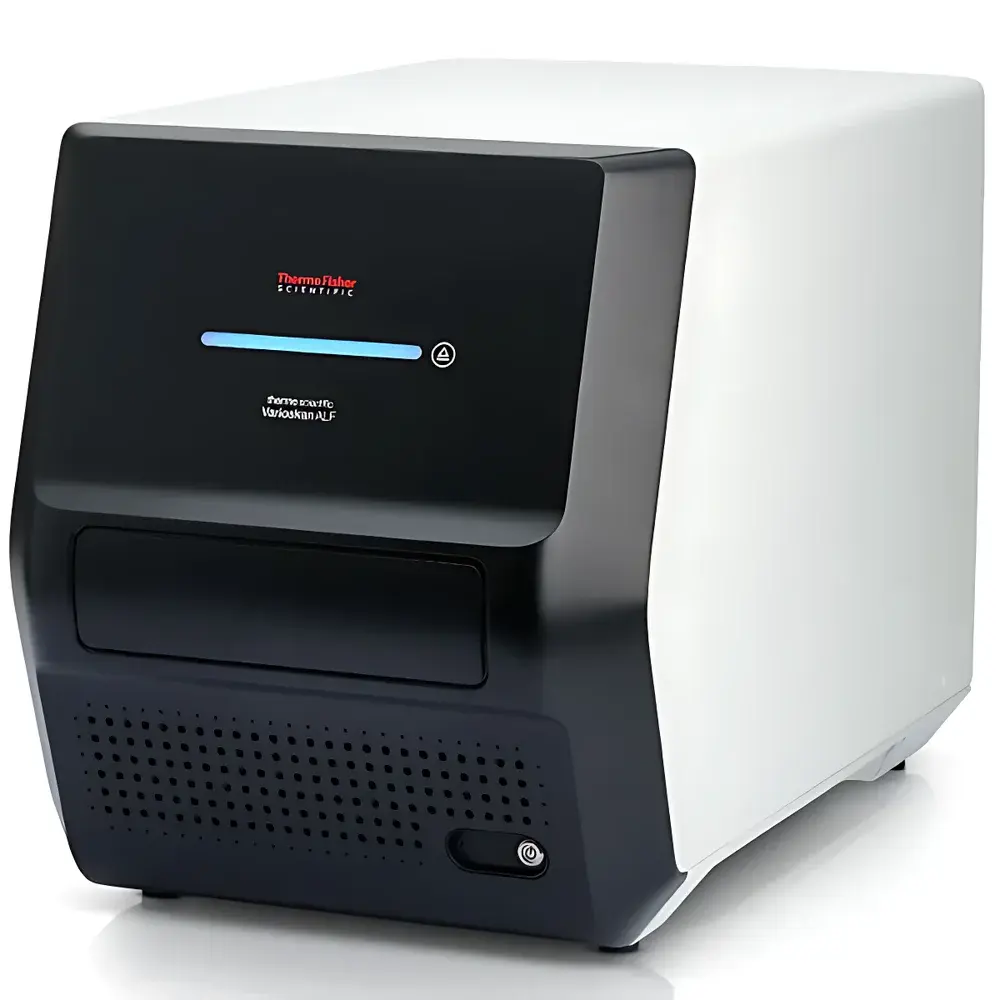
Thermo Fisher Varioskan ALF Multimode Microplate Reader
| Brand | Thermo Fisher |
|---|---|
| Origin | Guangdong, China |
| Manufacturer Type | Original Equipment Manufacturer (OEM) |
| Product Origin | Domestic (China) |
| Model | Varioskan ALF |
| Detection Methods | Absorbance, Turbidimetry, Fluorescence, Luminescence |
| Automation Level | Fully Automated |
| Assay Modes | Endpoint, Kinetic, Spectral Scan, Kinetic Spectral Scan |
| Detector Types | Photomultiplier Tube (PMT) for fluorescence/luminescence |
| Wavelength Range | 200–1000 nm (monochromator-based) |
| Absorbance Range | 0.000–4.000 OD |
| Sample Formats | 6–384-well microplates, cuvettes, and proprietary ultra-low-volume plates (e.g., NanoDrop-compatible microvolume strips) |
Overview
The Thermo Fisher Varioskan ALF Multimode Microplate Reader is a fully automated, high-performance benchtop instrument engineered for quantitative and qualitative analysis across life science research, drug discovery, and quality control laboratories. It employs a dual-optical architecture: a high-stability xenon flash lamp coupled with a precision monochromator for continuous, stepless wavelength selection from 200 to 1000 nm in absorbance and turbidimetric measurements; and independent filter-based optical paths optimized for fluorescence intensity (including FRET), time-resolved fluorescence (TRF), and luminescence (including bioluminescence and chemiluminescence). This hybrid design ensures broad spectral coverage without sacrificing sensitivity or signal-to-noise ratio—particularly critical for low-abundance targets in cell-based assays or nucleic acid quantification. The instrument complies with core performance expectations defined in ISO/IEC 17025 for testing laboratories and supports audit-ready operation under GLP and GMP environments when integrated with validated software workflows.
Key Features
- Dual optical system: Monochromator-based UV-Vis-NIR (200–1000 nm) for flexible, high-resolution spectral scanning and endpoint/kinetic absorbance assays; dedicated filter wheels for fluorescence and luminescence detection to maximize photon collection efficiency.
- Fully automated operation: Integrated plate handling, programmable incubation (ambient to 45 °C ±0.5 °C), orbital shaking (200–1200 rpm, variable amplitude), and auto-zeroing routines reduce manual intervention and improve inter-assay reproducibility.
- Ultra-low volume compatibility: Supports microvolume measurements using proprietary capillary-based strips or 2–5 µL sample volumes in standard microplates—enabling accurate nucleic acid and protein quantitation without dilution.
- LED status bar: Real-time visual feedback for instrument readiness, measurement progress, error conditions, and maintenance alerts—enhancing lab workflow transparency and reducing operator training burden.
- Self-diagnostic system: Built-in hardware diagnostics perform daily calibration verification, lamp energy monitoring, and optical path integrity checks; logs are timestamped and exportable for regulatory review.
- Modular expandability: Optional barcode reader, stacker modules, and third-party liquid handler integration enable seamless incorporation into automated screening platforms compliant with ANSI/SLAS standards.
Sample Compatibility & Compliance
The Varioskan ALF accommodates standard microplate formats (6–384-well), opaque and clear-bottom plates, cuvettes (10 mm pathlength), and ultra-low-volume microvolume plates with or without lids. It meets mechanical and electromagnetic compatibility requirements per IEC 61326-1 and safety standards per IEC 61010-1. For regulated applications, the system supports 21 CFR Part 11-compliant user access control, electronic signatures, and immutable audit trails when operated with Thermo Fisher’s SkanIt Software v5.2 or later. All assay protocols—including DNA/RNA quantitation (A260/A280), BCA/Lowry protein assays, ELISA kinetics, and ATP-based cell viability—can be preconfigured to align with ASTM E2552 (microplate reader performance verification) and ISO 15197 (in vitro diagnostic accuracy criteria).
Software & Data Management
SkanIt Software provides intuitive method setup, real-time data visualization, and comprehensive post-acquisition analysis—including kinetic curve fitting (linear, exponential, sigmoidal), spectral deconvolution, well-mapping, and multi-parameter normalization (e.g., Z’-factor, % inhibition, EC50). Raw data files (.skf) are structured XML-based archives containing full metadata: instrument ID, operator, timestamps, environmental logs (temperature/humidity), and complete optical configuration history. Export options include CSV, Excel, PDF reports, and direct LIMS integration via ODBC or RESTful API. Audit trail functionality records all user actions—including parameter edits, result deletions, and report generation—with IP address, workstation ID, and digital signature linkage.
Applications
- Nucleic acid and protein quantification (UV absorbance at 260/280 nm; fluorescence with SYBR Gold, Qubit dyes)
- Enzyme-linked immunosorbent assays (ELISA) with kinetic monitoring of colorimetric, fluorescent, or chemiluminescent substrates
- Cell proliferation, cytotoxicity, and apoptosis assays (MTT, Resazurin, Caspase-Glo)
- Bacterial growth kinetics and antimicrobial susceptibility testing (OD600 turbidimetry)
- Calcium flux and membrane potential assays (fluorescence ratiometric imaging with dual excitation/emission filters)
- Reporter gene assays (luciferase, GFP) requiring high dynamic range and low background luminescence detection
FAQ
Does the Varioskan ALF support temperature-controlled kinetic assays?
Yes—integrated Peltier-based incubation maintains setpoints from ambient to 45 °C with ±0.5 °C stability and ramp rates up to 1.5 °C/min.
Can it perform spectral scans in fluorescence mode?
No—fluorescence excitation and emission wavelengths are selected via discrete filters; spectral scanning is available only in absorbance and luminescence modes.
Is validation documentation provided for GMP environments?
Thermo Fisher supplies IQ/OQ documentation templates, DQ checklists, and a traceable calibration certificate (NIST-traceable photometric standards) upon request.
What microplate barcoding standards are supported?
GS1-128, Code 128, and DataMatrix ECC200 via optional USB barcode reader module.
How is carryover minimized during sequential plate reads?
Optical path purging cycles and configurable wash protocols between wells prevent cross-contamination; no fluidic lines are used in optical detection.




