
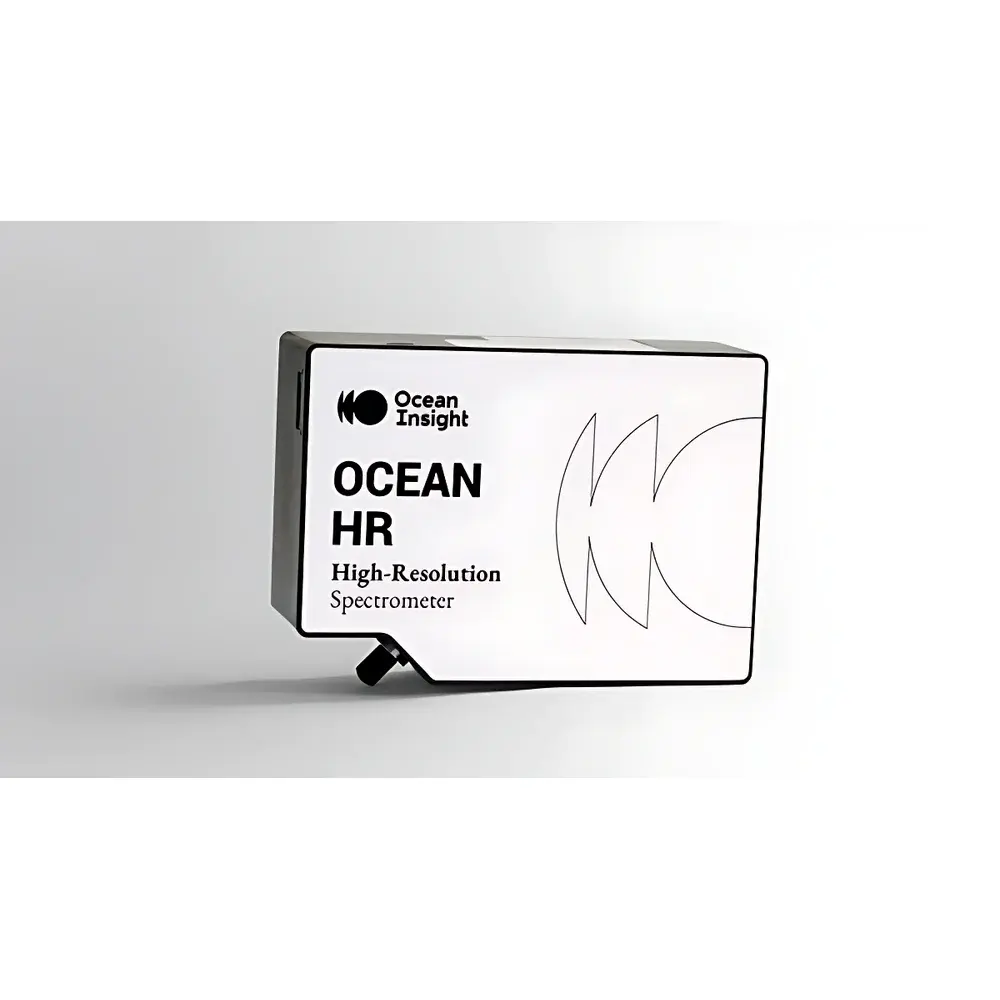
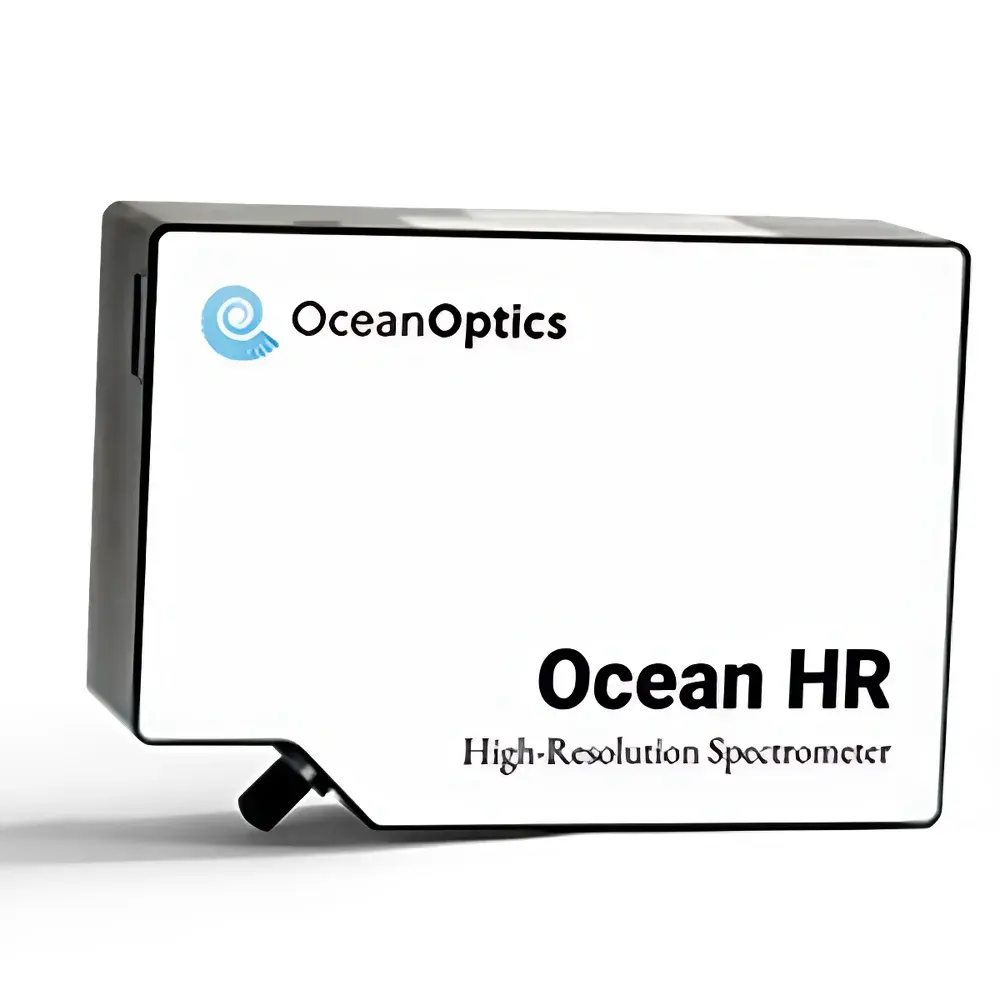
Ocean Optics HR2/HR4/HR6 High-Resolution Fiber-Optic Spectrometers
| Brand | Ocean Optics |
|---|---|
| Origin | USA |
| Model Series | HR2, HR4, HR6 |
| Wavelength Range (configurable) | 185–1100 nm |
| Optical Resolution (FWHM) | 0.06–7.24 nm |
| Integration Time | 1 µs–10 s |
| Dynamic Range | 3400:1 to 12000:1 |
| Signal-to-Noise Ratio | 380:1 to 3000:1 |
| Interface | USB Type-C, SMA, 16-pin Samtec TFM, RS-232 |
| Dimensions | 148.8 × 106.4 × 48.2 mm³ |
| Weight | 930.6 g |
| Operating Temperature | 0–55 °C |
| Storage Temperature | −30–70 °C |
| Software | OceanDirect SDK (cross-platform API) |
Overview
The Ocean Optics HR2, HR4, and HR6 series are high-resolution, compact fiber-optic spectrometers engineered for precision spectral analysis across the ultraviolet, visible, and near-infrared (UV-VIS-NIR) regions (185–1100 nm). Based on Czerny-Turner optical architecture with optimized gratings and back-thinned CCD or CMOS detectors, these instruments deliver sub-nanometer full-width-at-half-maximum (FWHM) resolution—enabling accurate discrimination of closely spaced spectral features such as atomic emission lines, protein absorbance peaks, and DNA/RNA absorption bands. Unlike conventional benchtop spectrophotometers, the HR series leverages modular fiber-coupled design to support in-line, at-line, and field-deployable configurations—making them suitable for integration into OEM analytical platforms, process monitoring systems, and portable laboratory instrumentation. Each model is factory-calibrated traceable to NIST standards and designed for long-term wavelength stability under variable thermal conditions.
Key Features
- Sub-nanometer optical resolution (FWHM down to 0.06 nm with appropriate grating/slit configuration)
- Ultrafast acquisition: minimum integration time of 1 µs (HR2), enabling transient event capture and plasma diagnostics
- Thermal wavelength stability ≤ 0.06 pixels/°C (HR2), ensuring measurement repeatability without active temperature control
- Hardware-accelerated signal averaging mode (available on HR4 and HR6), improving effective SNR by up to 3× without increasing total acquisition time
- Configurable optical path: interchangeable slits (10–200 µm), multiple grating options, and selectable detector types (CCD/CMOS) to balance resolution, sensitivity, and speed
- Multi-interface connectivity: USB Type-C for plug-and-play operation, RS-232 for legacy industrial control, and 16-pin Samtec TFM for synchronized triggering and external hardware integration
- Robust mechanical housing (aluminum alloy chassis) rated for continuous operation in ambient laboratory and controlled industrial environments
Sample Compatibility & Compliance
The HR series supports a broad range of sample presentation methods—including cuvette holders, integrating spheres, reflection probes, collimating optics, and gas cells—via standard SMA 905 fiber coupling. This flexibility accommodates transmission, reflectance, fluorescence, and emission measurements per ASTM E308 (computing colorimetric values), ISO 13406-2 (display characterization), and USP (spectrophotometric system suitability). All models comply with IEC 61326-1 for electromagnetic compatibility in laboratory and industrial settings. Data integrity and audit readiness are supported through OceanDirect’s built-in metadata logging (timestamp, integration time, calibration ID, temperature), which satisfies GLP/GMP documentation requirements and aligns with FDA 21 CFR Part 11 principles when deployed with validated software workflows.
Software & Data Management
OceanDirect is a vendor-provided, cross-platform SDK (Windows, macOS, Linux) offering low-level instrument control via C/C++, Python, MATLAB, and LabVIEW APIs. It enables real-time spectral acquisition, dark/baseline correction, nonlinearity compensation, and user-defined ROI extraction. The SDK includes native support for hardware-triggered acquisition, external clock synchronization, and streaming buffer management—critical for time-resolved spectroscopy and closed-loop process control. Raw spectral data is exported in HDF5 or CSV formats with embedded calibration coefficients, facilitating traceable post-processing in third-party tools such as Origin, Igor Pro, or Python-based SciPy pipelines. Optional OceanInsight software provides GUI-driven method development, compliance reporting templates, and multi-instrument fleet management capabilities.
Applications
- Pharmaceutical QA/QC: Quantitative UV-Vis absorbance of small-molecule APIs and biologics (e.g., protein concentration via A280), dissolution testing, and excipient identification
- Molecular biology: dsDNA/ssDNA quantification (260 nm), RNA purity assessment (260/280 ratio), and oligonucleotide characterization
- Plasma & combustion diagnostics: Time-resolved atomic line monitoring (e.g., Hα, O I, N II) in reactive plasma sources and flame emission spectroscopy
- Materials science: Thin-film interference analysis, LED phosphor emission profiling, and semiconductor photoluminescence mapping
- Environmental monitoring: In-situ water quality assessment (nitrate, nitrite, chlorophyll-a) using flow-through cuvettes or immersed probes
- OEM integration: Embedded spectral engines for handheld analyzers, medical devices (e.g., pulse oximetry R&D), and industrial sorting systems
FAQ
What distinguishes the HR2, HR4, and HR6 models beyond resolution specifications?
The HR2 prioritizes speed and thermal robustness for dynamic applications (e.g., plasma monitoring); the HR4 emphasizes low stray light and enhanced electronics for high-fidelity UV-NIR broadband measurements; the HR6 delivers highest SNR and sensitivity for weak-emission or low-concentration samples (e.g., protein assays, gas-phase atomic lines).
Can HR spectrometers operate in GMP-regulated environments?
Yes—when used with validated OceanDirect scripts and documented calibration procedures, HR instruments meet foundational data integrity requirements for regulated labs. Full 21 CFR Part 11 compliance requires supplementary controls (e.g., electronic signatures, audit trail configuration) implemented at the system level.
Is external triggering supported across all HR models?
Yes—all HR series units feature TTL-compatible trigger input/output pins via the 16-pin Samtec TFM connector, enabling synchronization with lasers, shutters, or motion stages.
How is wavelength calibration maintained over temperature fluctuations?
Each unit undergoes multi-point thermal calibration during manufacturing. Real-time pixel-to-wavelength mapping remains stable within ±0.2 nm over the full operating range (0–55 °C), verified per ISO/IEC 17025-compliant test protocols.
Are custom firmware modifications available for OEM integrators?
Ocean Optics provides OEM partners with access to bootloader-level firmware tools and hardware reference designs under NDA, supporting deep integration into proprietary analytical platforms.
Related Products





