
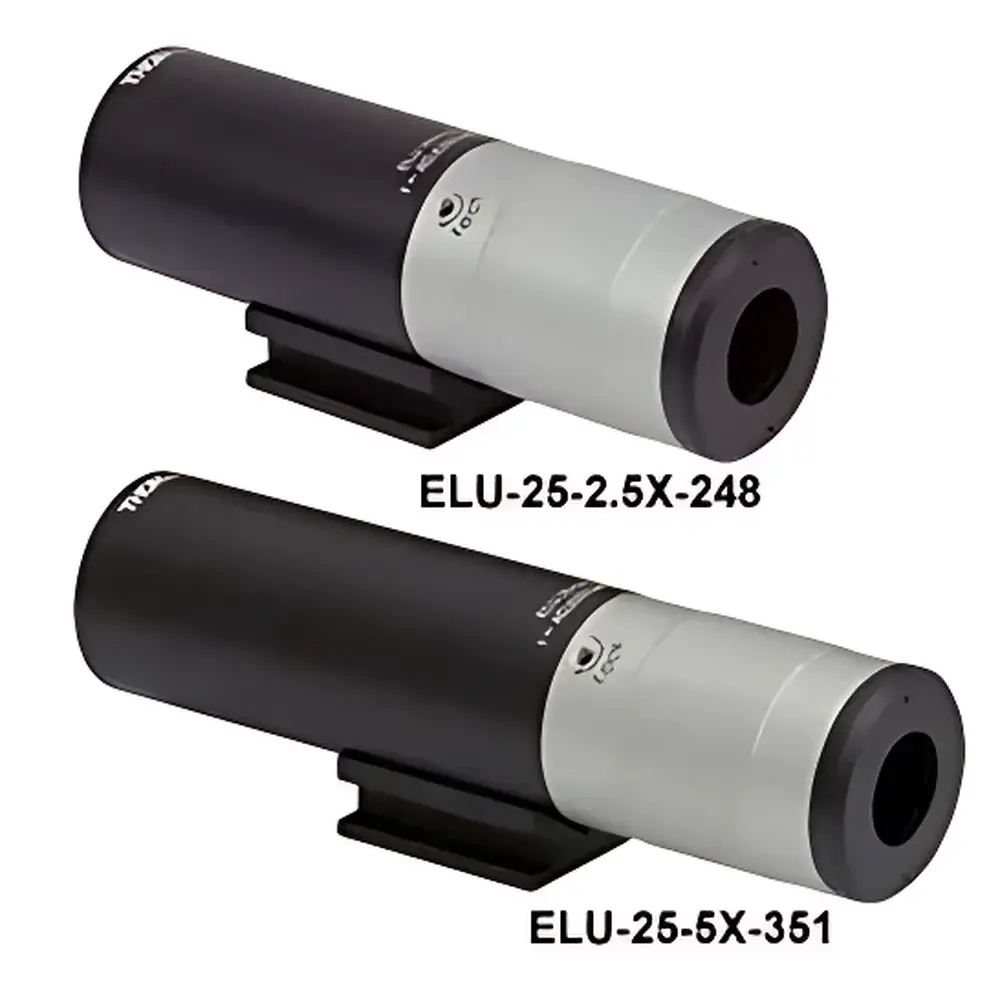
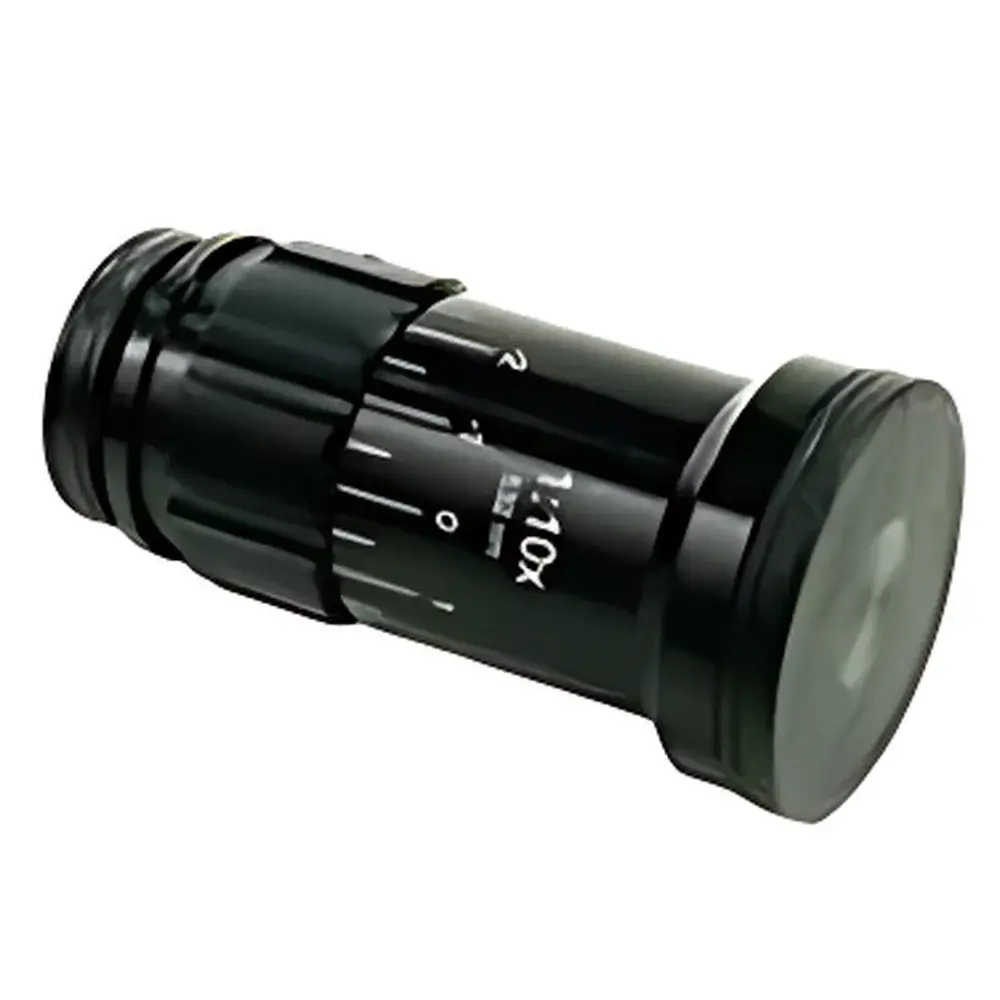
Thorlabs SOPL-M UV Galilean Beam Expander/Reducer
| Brand | Thorlabs |
|---|---|
| Origin | USA |
| Manufacturer Type | Authorized Distributor |
| Origin Category | Imported |
| Model | SOPL-M |
| Pricing | Upon Request |
Overview
The Thorlabs SOPL-M UV Galilean Beam Expander/Reducer is a precision-engineered optical component designed for controlled expansion or reduction of collimated laser beams in the ultraviolet spectral range. Based on the Galilean telescope configuration—comprising two aspheric lenses with no internal focus—it delivers diffraction-limited performance with wavefront error < λ/4 across its operational bandwidth. Unlike Keplerian designs, the Galilean architecture avoids internal beam waist formation, eliminating risk of air breakdown or optical damage in high-peak-power UV applications. The SOPL-M is optimized for 2.5×, 5×, 10×, or 20× magnification ratios and features custom-shaped Lithosil® (fused silica) optics, selected for superior UV transmission, low thermal expansion, and high homogeneity. Its narrowband anti-reflection coating—centered at specified UV wavelengths—achieves reflectivity < 0.25% per surface, ensuring maximal throughput and minimal ghosting. With a laser-induced damage threshold (LIDT) of 500 MW/cm² (measured at 355 nm, 10 ns, 20 Hz), the SOPL-M supports demanding pulsed UV applications including ultrafast spectroscopy, photoelectron emission microscopy, and deep-UV lithography alignment.
Key Features
- Galilean design: Zero internal focus, enabling safe use with high-peak-power UV lasers
- Aspheric Lithosil® optics: Minimized spherical and chromatic aberrations; optimized for UV transmission (190–400 nm)
- Narrowband UV AR coating: High-efficiency transmission with < 0.25% surface reflectance per interface
- Sliding lens mechanism: Precision-ground translation sleeve allows continuous collimation adjustment while suppressing beam walk-off
- C-Mount threaded input aperture: Facilitates inline integration with filters, apertures, or additional UV-grade optics
- Mechanical mounting options: 1/4″-20 and M6 tapped holes on base; compatible with CL6 clamps and standard optical tables
- Interchangeable end caps: Removable C-mount caps protect threads during handling and storage
Sample Compatibility & Compliance
The SOPL-M is intended for use with collimated, spatially coherent light sources—including excimer lasers (e.g., ArF at 193 nm, KrF at 248 nm), frequency-tripled Nd:YAG (355 nm), and UV diode lasers. It maintains beam quality (M² < 1.1) when used within its specified input beam diameter range (Ø ≤ 3 mm, 1/e²). All optical surfaces comply with ISO 10110-7 scratch-dig specifications (20–10), and mechanical housing meets RoHS Directive 2011/65/EU requirements. While not certified to a specific medical or industrial standard, the device’s construction and coating durability support compliance with laboratory quality systems adhering to ISO/IEC 17025 calibration traceability protocols. No FDA 21 CFR Part 11 or GLP/GMP validation documentation is provided, as the unit functions as a passive optical component without embedded software or data logging capability.
Software & Data Management
The SOPL-M operates as a fully passive optical element and contains no electronic components, firmware, or onboard software. Consequently, it does not require driver installation, firmware updates, or digital configuration. Performance characterization—including theoretical magnification, effective focal length, and wavefront error—is documented in Thorlabs’ publicly available technical drawings (DWG/PDF) and Zemax-compatible .ZAR files, which may be imported into optical design platforms for system-level modeling. Users are advised to reference the manufacturer’s published LIDT test reports and coating spectral transmission curves when integrating the SOPL-M into regulated environments requiring traceable optical performance data.
Applications
- UV beam conditioning for scanning Fabry–Pérot interferometers (e.g., SA200 series), where reduced beam diameter enables optimal coupling into narrow-aperture etalons
- Deep-UV photolithography alignment systems requiring stable, low-aberration beam scaling
- Time-resolved photoemission experiments requiring diffraction-limited spot size control at sub-200 nm wavelengths
- UV Raman spectroscopy setups requiring precise matching of excitation beam diameter to sample chamber apertures
- Integration into multi-wavelength optical benches where chromatic stability across UV–visible bands is critical
- Beam delivery systems for UV laser micromachining, where high LIDT and minimal wavefront distortion ensure process repeatability
FAQ
Can the SOPL-M be used with femtosecond UV pulses?
Yes—provided pulse energy and peak intensity remain below the specified LIDT (500 MW/cm² at 355 nm, 10 ns). For ultrashort pulses (< 1 ps), users must perform empirical LIDT verification due to nonlinear absorption effects.
Is the SOPL-M vacuum-compatible?
The housing is machined from 6061-T6 aluminum with no adhesives or outgassing elastomers; however, standard anodization is not ultra-high-vacuum rated. Optional black hard-anodized or bare aluminum finishes are available upon request for UHV integration.
Does Thorlabs provide Zemax models for the SOPL-M?
Yes—Zemax .ZAR files, including surface prescriptions and coating dispersion data, are available for download from the product webpage under “Resources.”
Can I mount the SOPL-M directly to a motorized translation stage?
Yes—the base plate includes 1/4″-20 and M6 threaded holes compatible with standard kinematic mounts and motorized stages equipped with matching screws.
What is the maximum input beam divergence acceptable for diffraction-limited operation?
For wavefront error < λ/4, input divergence should not exceed ±0.5 mrad (full angle) when operating at design wavelength and specified magnification.



