
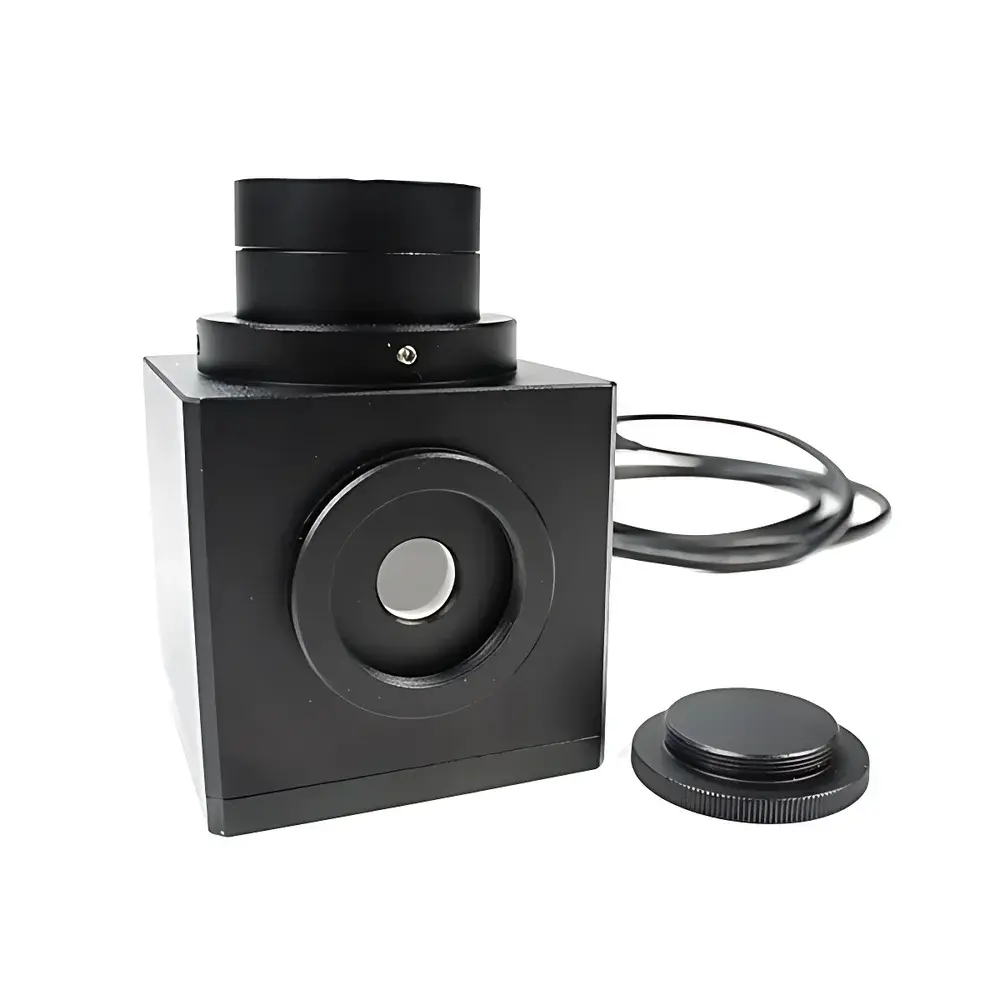
SPL SPL-8205-04 Integrating Sphere Power Detector with Silicon Photodiode (350–1100 nm)
| Brand | SPL |
|---|---|
| Origin | Zhejiang, China |
| Manufacturer Type | Authorized Distributor |
| Country of Origin | China |
| Model | SPL-8205-04 |
| Interface Options | DB15 (for SPL-8201 Power Meter) or USB 2.0 |
| Detector Material | Silicon (Si) |
| Spectral Range | 350–1100 nm |
| Power Range | 1 µW – 3 W |
| Max Avg. Power Density | 5 mW/cm² |
| Integrating Sphere Diameter | 2 in |
| Sphere Coating | PTFE |
| Input Port | SMA905 |
| Mounting Threads | M4/M6 |
| Cable Length | 1.5 m |
| Dimensions (D×H) | 62 × 62 × 85 mm |
| Weight | 500 g |
Overview
The SPL SPL-8205-04 Integrating Sphere Power Detector is a precision optical power measurement instrument engineered for high-fidelity radiometric quantification of broadband light sources across the visible and near-infrared spectrum (350–1100 nm). It employs a calibrated silicon photodiode coupled with a 2-inch PTFE-coated integrating sphere to ensure uniform spatial response, minimal angular dependence, and excellent linearity over six orders of magnitude (1 µW to 3 W). The detector operates on the principle of diffuse reflectance integration: incident light—whether from free-space beams or fiber-coupled outputs—is homogenized within the sphere cavity, enabling accurate total power measurement independent of beam profile, divergence, or polarization state. Designed for laboratory, R&D, and production environments, the SPL-8205-04 complies with fundamental radiometric traceability requirements and supports calibration traceable to NIM (National Institute of Metrology, China) standards. Its dual-interface architecture—DB15 for standalone operation with the SPL-8201 handheld power meter, or native USB 2.0 for direct PC connectivity—ensures flexibility in system integration without compromising measurement integrity.
Key Features
- High-stability silicon photodiode with spectral responsivity optimized for 350–1100 nm, including strong UV-VIS-NIR coverage
- 2-inch integrating sphere with >99% reflective PTFE coating, ensuring low spatial non-uniformity (<±0.5%) and long-term reflectance stability
- Dual interface options: DB15 analog/digital hybrid output compatible with SPL-8201 power meter (with local display, data logging, and real-time monitoring), or USB 2.0 digital interface for direct PC communication
- Built-in EEPROM stores factory calibration coefficients per wavelength (at 10 nm intervals), enabling automatic spectral correction in OPM software
- Integrated SMA905 input port accommodates both free-space collimated beams and fiber-optic inputs via optional FC/SMA adapters
- Robust mechanical design: aluminum housing with M4/M6 threaded mounting holes, IP50-rated enclosure, and 1.5 m shielded cable with ferrite core for EMI suppression
- Supports multi-channel synchronization: up to 16 SPL-8205-04-U units can be daisy-chained via USB hub with timestamp-aligned acquisition in OPM software
- Full SDK (C/C++, Python, LabVIEW, MATLAB) provided for custom automation, OEM integration, and compliance with internal QA workflows
Sample Compatibility & Compliance
The SPL-8205-04 is validated for use with continuous-wave (CW) and quasi-CW light sources including LEDs, laser diodes, superluminescent diodes (SLDs), halogen lamps, and broadband plasma sources. It is unsuitable for pulsed lasers with peak powers exceeding 10 kW or pulse widths below 10 ns without external attenuation. The detector meets IEC 61000-6-3 (EMC emission limits) and IEC 61000-6-2 (immunity to electrostatic discharge and RF fields). While not certified to ISO/IEC 17025 as a standalone calibration lab, each unit ships with an individual NIST-traceable calibration certificate (valid for 12 months) covering 350–1100 nm at 10 nm increments. The OPM software supports audit trails, user access control, and electronic signatures compliant with FDA 21 CFR Part 11 when deployed in regulated environments under documented SOPs.
Software & Data Management
The OPM (Optical Power Measurement) software is a Windows-based application supporting real-time acquisition, statistical analysis (min/max/avg/std dev), time-series trending, and batch export to CSV, TXT, or HDF5. It implements linear interpolation between stored calibration points and applies temperature-compensated responsivity correction using onboard thermistor data. All measurements are timestamped with microsecond resolution and support configurable trigger modes (software, TTL, or auto-start). Data files include embedded metadata: serial number, calibration date, operator ID, integration time, and spectral weighting function. For GLP/GMP environments, the software logs all parameter changes, user logins, and file exports in a tamper-evident SQLite database. Raw binary data streams are accessible via SDK for integration into LIMS or MES platforms.
Applications
- Laser diode and VCSEL output power validation during wafer-level testing and packaging
- LED luminous flux and radiant power characterization per CIE S 025/E:2015
- Optical amplifier (EDFA, SOA) gain and noise figure verification
- Calibration transfer between primary standards and field instruments
- Fiber optic component insertion loss testing (e.g., isolators, couplers, WDM filters)
- Photobiomodulation and medical light source dosimetry (in conjunction with irradiance calculations)
- Environmental chamber-based aging studies requiring long-term power stability monitoring
FAQ
Is the SPL-8205-04 suitable for measuring pulsed laser energy?
No—it is designed exclusively for average power measurement of CW or high-repetition-rate (>10 kHz) quasi-CW sources. For pulsed energy measurement, a thermal sensor or joulemeter is required.
Can the USB version operate without installing drivers on modern Windows systems?
Yes—the SPL-8205-04-U uses CDC ACM class-compliant USB communication and requires no proprietary drivers on Windows 10/11, macOS 12+, or Linux kernel ≥5.4.
Does the integrating sphere support vacuum or inert-gas purging?
No—the sphere is sealed at the factory and not rated for pressure differentials or gas compatibility. Ambient air operation only.
How often should recalibration be performed?
Annual recalibration is recommended for ISO/IEC 17025-aligned quality systems; biannual recalibration suffices for general R&D use under stable environmental conditions.
Can the detector be used with third-party DAQ systems?
Yes—via the provided SDK and ASCII command protocol over USB or RS-232 (when used with SPL-8201), enabling integration with National Instruments, Keysight, or custom FPGA-based controllers.





