
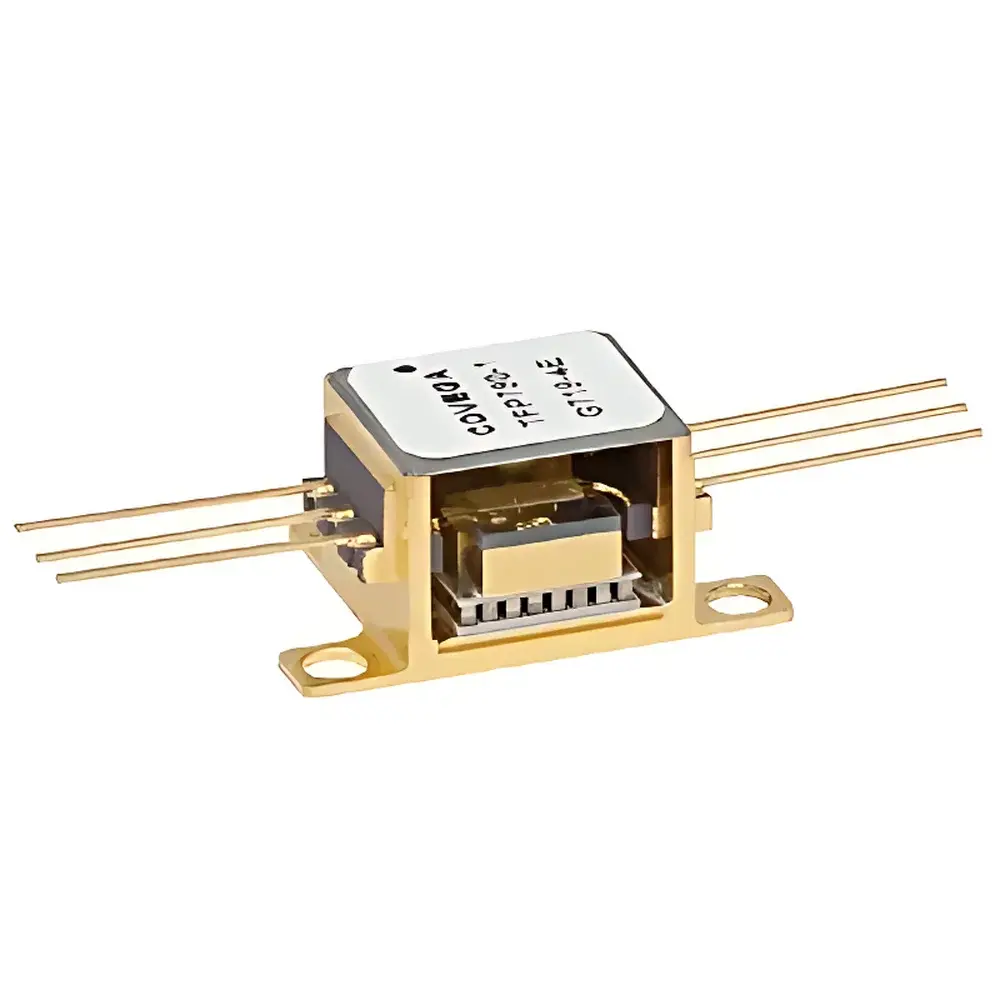
Thorlabs BOA Series Semiconductor Optical Amplifier (SOA) – Broadband Booster Optical Amplifier
| Brand | Thorlabs |
|---|---|
| Origin | USA |
| Model | BOA |
| Component Category | Optical Instrument Component |
| Wavelength Options | λc = 1220 nm, 1320 nm, 1450 nm, 1550/1590 nm, 1650 nm |
| Fiber Output | 1.5 m SMF or PMF with FC/APC connector |
| Center Wavelength Tolerance | ±0.5 nm |
| Compliance | RoHS, CE, ISO 9001-certified manufacturing |
Overview
The Thorlabs BOA Series Semiconductor Optical Amplifier is a polarization-dependent, broadband booster optical amplifier engineered for high-gain, low-noise amplification in fiber-optic communication systems, metrology setups, and seed-source conditioning applications. Based on InP-based quantum-well semiconductor gain media, the BOA operates on the principle of stimulated emission within a traveling-wave waveguide structure, delivering superior small-signal gain and saturation power compared to polarization-insensitive semiconductor optical amplifiers (SOAs). Its design prioritizes stability under controlled current and temperature conditions—enabled by integrated thermoelectric coolers (TECs) and precision thermal sensing—making it suitable for integration into laboratory-grade test benches and OEM photonic subsystems requiring deterministic gain behavior.
Key Features
- Polarization-dependent architecture optimized for known-input-state applications, achieving up to 30 dB small-signal gain and higher saturation output power than equivalent SOA devices
- Multiple center wavelength options: 1220 nm, 1320 nm, 1450 nm, dual-band 1550/1590 nm, and 1650 nm—each specified with ±0.5 nm center wavelength tolerance
- Integrated optical isolator minimizes back-reflection-induced instabilities, enabling robust operation with external cavity lasers or interferometric systems
- Factory-characterized performance data included with each unit, including gain vs. current, noise figure vs. wavelength, and saturation power curves
- Standard 1.5 m single-mode (SMF-28) or polarization-maintaining (PM980) fiber pigtail terminated with FC/APC connectors for low-return-loss interfacing
- Compatible with Thorlabs’ LM14S2 14-pin butterfly mount and industry-standard laser diode drivers (e.g., ITC4001, LDC1300B) for seamless thermal and current control
Sample Compatibility & Compliance
The BOA is designed for use with narrow-linewidth seed sources such as DFB lasers, DBR lasers, and external-cavity diode lasers (ECDLs), particularly where polarization alignment can be maintained upstream. It supports input powers from −30 dBm to +3 dBm and is rated for continuous-wave (CW) operation only. All units are manufactured in Thorlabs’ ISO 9001-certified U.S. facilities and comply with RoHS Directive 2011/65/EU and CE marking requirements for electromagnetic compatibility (EMC) and low-voltage directives. While not explicitly certified to Telcordia GR-468-CORE or ITU-T G.663, its gain uniformity, thermal stability, and spectral flatness meet typical qualification thresholds for lab-scale deployment in R&D environments subject to GLP-aligned documentation practices.
Software & Data Management
No proprietary firmware or embedded software resides on the BOA device itself; operation is fully analog and hardware-defined. However, Thorlabs provides comprehensive characterization datasets—including spectral gain profiles, polarization extinction ratio (PER) maps, and thermal drift coefficients—for each shipped unit. These datasets are delivered in CSV and PDF formats and are compatible with common data analysis platforms (MATLAB, Python SciPy, LabVIEW). When paired with Thorlabs’ Kinesis or APT software suites via external controllers (e.g., TEC and current drivers), users can implement automated sweep routines for gain calibration, wavelength-dependent noise figure mapping, and long-term stability monitoring—all traceable through timestamped log files supporting audit-ready workflows per FDA 21 CFR Part 11 principles when configured with appropriate system-level access controls.
Applications
- Boosting low-power seed lasers in fiber laser pumping architectures (e.g., Yb-doped or Er-doped pre-amplifier stages)
- Pre-amplification before coherent detection in optical time-domain reflectometry (OTDR) and distributed acoustic sensing (DAS) systems
- Gain medium in master-oscillator power-amplifier (MOPA) configurations for LIDAR transmitters operating at 1550 nm or 1650 nm
- Wavelength-flexible amplification in tunable laser source development, especially where polarization control is maintained via inline waveplates or polarization controllers
- Nonlinear frequency conversion seeding, including optical parametric oscillation (OPO) and difference-frequency generation (DFG), requiring stable, narrowband, amplified inputs
FAQ
Is the BOA polarization-insensitive?
No—the BOA is intentionally polarization-dependent. For applications with undefined or fluctuating input polarization states, Thorlabs recommends the SOA series instead.
Can the BOA be used in pulsed operation?
The BOA is rated for CW operation only. Pulsed drive schemes may induce nonlinear transient effects, thermal overshoot, and accelerated degradation; they are not supported or characterized.
What thermal management is required?
The device must be mounted on an actively temperature-stabilized platform (e.g., Thorlabs TED200C or ITC4001) maintaining the submount at 25 °C ± 0.1 °C for optimal gain reproducibility and wavelength stability.
Does the BOA include built-in monitoring photodiodes?
No—output power monitoring requires external tap couplers and calibrated photodetectors. No internal monitor PD or bias-tee functionality is integrated.
Are custom center wavelengths available?
Standard offerings cover discrete bands from 1220–1650 nm. Custom λc between 1550–1620 nm are available upon technical consultation and minimum order volume agreement.



