
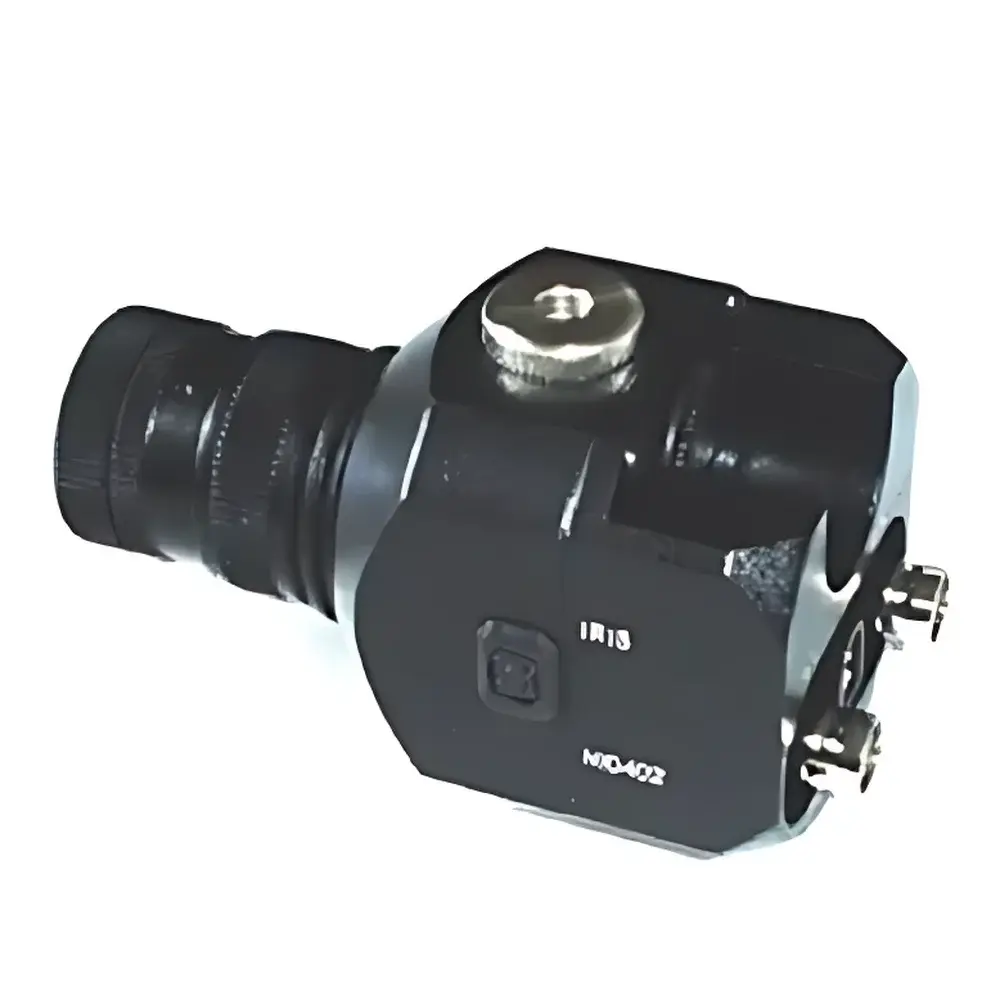
ElectroOptic CONTOUR-IR Near-Infrared CCD Camera
| Brand | ElectroOptic |
|---|---|
| Origin | Russia |
| Model | CONTOUR-IR |
| Sensor Type | Silicon-based CCD |
| Spectral Range | 700–1100 nm |
| Interface | USB 2.0 or GigE (configurable) |
| Pixel Resolution | 1392 × 1040 (standard) |
| Pixel Size | 6.45 µm × 6.45 µm |
| Read Noise | <15 e⁻ (rms, typical) |
| Dark Current | <0.001 e⁻/pixel/s @ 25°C |
| Cooling | Thermoelectric (Peltier), ΔT ≤ −20°C below ambient |
| Dynamic Range | >60 dB |
| Compliance | CE, RoHS |
Overview
The ElectroOptic CONTOUR-IR Near-Infrared CCD Camera is a high-sensitivity imaging instrument engineered for quantitative detection and visualization of radiation in the 700–1100 nm spectral band. It operates on the principle of photon-to-electron conversion within a front-illuminated, thermoelectrically cooled silicon CCD sensor—optimized via anti-reflection coating and low-noise clocking architecture to maximize quantum efficiency above 800 nm. Unlike standard visible-light CCDs, the CONTOUR-IR features enhanced near-infrared (NIR) responsivity through proprietary pixel design and optimized charge transfer protocols, enabling reliable imaging of weak NIR emitters such as GaAs LEDs, diode-pumped solid-state (DPSS) lasers, and fiber-coupled laser diodes. Its optical architecture supports direct coupling to C-mount lenses, infrared microscopes, and collimated beam paths—making it suitable for both laboratory-based alignment verification and long-duration passive monitoring applications.
Key Features
- High quantum efficiency (>45% at 900 nm) enabled by back-thinned or AR-coated front-illuminated silicon CCD variants (model-dependent)
- Thermoelectric cooling system achieving stable sensor temperatures up to 20°C below ambient, reducing dark current by two orders of magnitude compared to uncooled operation
- Low read noise performance (25,000 e⁻), supporting high-dynamic-range acquisition without saturation artifacts
- Flexible digital interface options: USB 2.0 for rapid prototyping and integration into compact setups; Gigabit Ethernet for synchronized multi-camera deployments and deterministic latency control
- Onboard 12-bit or 16-bit ADC with programmable gain and offset, allowing optimization for either photon-starved or high-flux conditions
- Robust mechanical housing rated IP52, compatible with vibration-damped optical tables and cleanroom environments (ISO Class 7 compliant when operated with filtered air purge)
Sample Compatibility & Compliance
The CONTOUR-IR accommodates diverse NIR-emitting sources and sample configurations—including free-space beams, fiber outputs, microscope epi-illumination paths, and macro-scale artwork surfaces. Its spectral response aligns with common NIR excitation wavelengths used in fluorescence lifetime imaging (FLIM), laser-induced breakdown spectroscopy (LIBS) plasma diagnostics, and cultural heritage analysis. The camera complies with EU Directive 2014/30/EU (EMC), 2011/65/EU (RoHS), and carries CE marking for use in non-medical research instrumentation. While not certified for IEC 61000-4-x immunity testing out-of-box, it meets functional immunity requirements under typical laboratory electromagnetic conditions (e.g., adjacent to laser drivers or RF generators operating below 500 MHz). Firmware supports timestamped image acquisition traceable to UTC via NTP synchronization when connected to a networked host.
Software & Data Management
The CONTOUR-IR is delivered with cross-platform SDKs (C/C++, Python, MATLAB) and a native GUI application supporting real-time preview, histogram analysis, region-of-interest (ROI) extraction, and non-uniformity correction (NUC) calibration. All acquired frames include embedded metadata: exposure time, sensor temperature, gain setting, timestamp (µs resolution), and lens focal length (if entered manually). Raw image data are saved in FITS or TIFF formats—both supporting BITPIX=16 and IEEE 754 floating-point scaling for quantitative radiometric analysis. Audit trail functionality logs all user-initiated parameter changes, satisfying GLP documentation requirements for regulated R&D workflows. Integration with LabVIEW and EPICS IOC environments is validated for synchrotron beamline and industrial process monitoring deployments.
Applications
- Laser beam profiling and mode analysis of NIR diode and DPSS lasers (e.g., 808 nm, 940 nm, 1064 nm sources)
- Infrared microscopy for semiconductor wafer inspection, thermal defect mapping, and biological tissue contrast enhancement
- Non-destructive evaluation (NDE) of historical pigments and underdrawings in paintings using reflectography techniques per ISO 18239:2017
- Alignment and focus verification in free-space quantum optics experiments involving entangled photon pairs generated via SPDC
- Real-time monitoring of NIR LED array uniformity in horticultural lighting systems and automotive LiDAR emitter validation
- Time-resolved imaging in pump-probe configurations where gating is implemented externally via mechanical chopper or electro-optic modulator
FAQ
What is the maximum frame rate achievable at full resolution?
At 1392 × 1040 pixels and 12-bit depth, the USB 2.0 interface supports up to 15 fps; GigE enables sustained 22 fps with lossless compression disabled.
Does the camera support hardware triggering?
Yes—TTL-compatible input/output triggers are provided for external synchronization with pulsed lasers or motion stages.
Is calibration data provided with the unit?
Each unit ships with factory-measured dark frame, flat-field, and pixel response non-uniformity (PRNU) maps, traceable to NIST-traceable irradiance standards.
Can the CONTOUR-IR be used in vacuum environments?
No—the Peltier cooler requires convective heat dissipation; operation is limited to atmospheric pressure with ambient temperature between 15–30°C.
Is FDA 21 CFR Part 11 compliance supported?
Electronic signature and audit trail features meet baseline requirements; full Part 11 validation packages are available upon request for GxP-regulated installations.



