
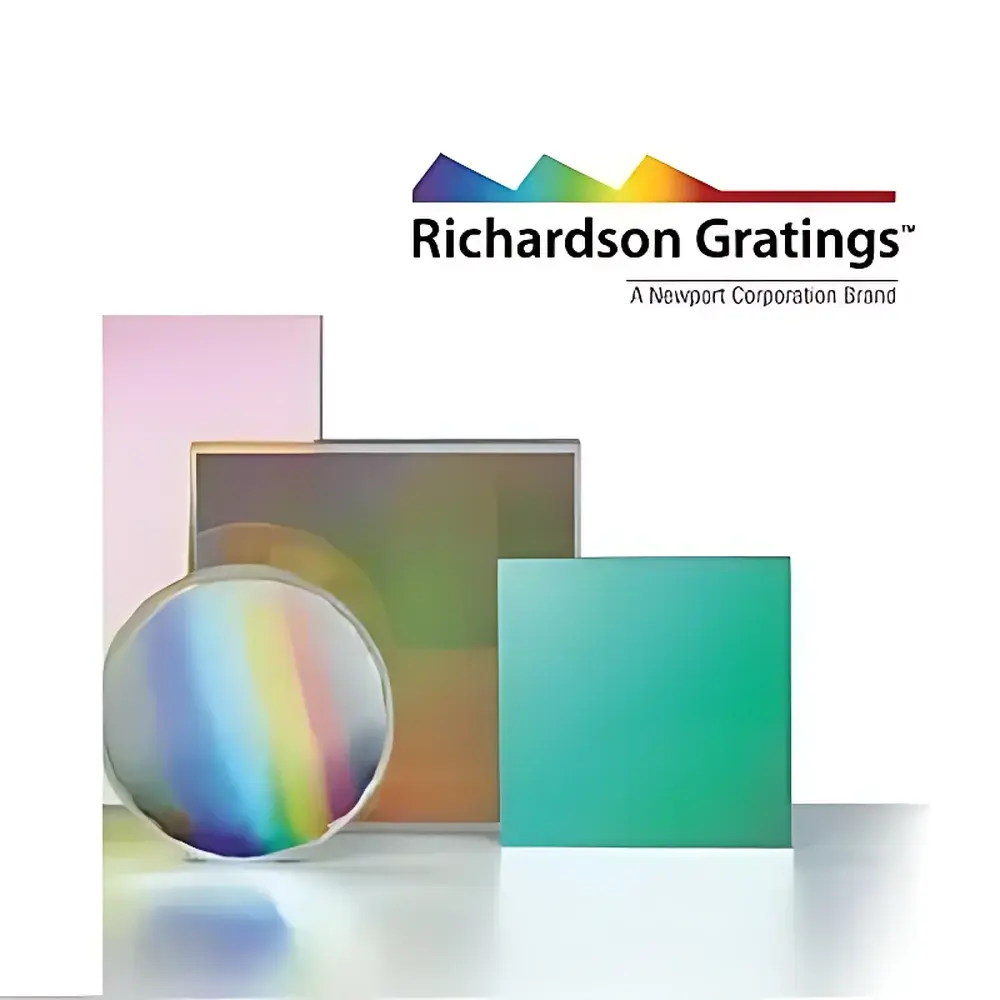
Newport Richardson Gratings SPL Series Holographic & Ruled Diffraction Gratings
| Brand | Newport |
|---|---|
| Manufacturer | Richardson Gratings (a Newport Corporation subsidiary) |
| Origin | USA |
| Product Type | Optical Instrument Component |
| Category | Diffraction Grating |
| Model | SPL Series |
| Grating Fabrication | Holographic or Ruled |
| Substrate Material | Fused Silica or BK7 (standard) |
| Coating | Protected Aluminum (standard), optional UV-enhanced, Au, or dielectric coatings |
| Line Density Range | 750–4320 lines/mm |
| Spectral Range | 130 nm – 2.3 µm |
| Maximum Clear Aperture | up to 130 mm × 160 mm |
| Efficiency Optimization | Blazed or High-Modulation Design |
| Compliance | ISO 10110 optical surface specifications, MIL-PRF-13830B scratch-dig standards |
Overview
Newport Richardson Gratings SPL Series diffraction gratings are precision-engineered optical components designed for high-fidelity spectral dispersion in research-grade spectroscopy, laser pulse compression, monochromator and spectrometer integration, and telecom wavelength management systems. As a division of Newport Corporation, Richardson Gratings leverages over six decades of expertise in grating physics, holographic master fabrication, and ion-beam etching to deliver industry-leading groove uniformity, wavefront fidelity, and long-term environmental stability. These gratings operate on the principle of constructive interference of light scattered from periodic microstructures—either photochemically recorded (holographic) or mechanically ruled—enabling precise control over dispersion, resolution, and polarization-dependent efficiency across ultraviolet (UV), visible (VIS), and near-infrared (NIR) spectral bands. Each SPL grating is manufactured under cleanroom conditions and individually tested for groove density accuracy, efficiency curve profile, and surface flatness per ISO 10110-5, ensuring traceable performance for applications requiring metrological rigor.
Key Features
- Holographic & Ruled Options: SPL series includes both holographically recorded gratings (low stray light, excellent wavefront preservation) and mechanically ruled gratings (optimized blaze profiles for maximum efficiency at specific wavelengths).
- Wide Line Density Selection: Available from 750 to 4320 grooves/mm, supporting resolutions from coarse spectral separation to high-resolution Fourier-transform and echelle-based systems.
- Multi-Band Spectral Coverage: Engineered for operation from deep UV (130 nm) through visible (400–700 nm) to near-IR (up to 2.3 µm), with optimized efficiency peaks aligned to common laser lines and atomic emission features.
- High-Efficiency Modulation Designs: “High-modulation” gratings minimize higher-order diffraction and suppress ghosting; “blazed” variants provide >85% peak diffraction efficiency in Littrow or off-Littrow configurations.
- Large-Aperture Capability: Standard clear apertures up to 130 mm × 160 mm enable integration into large-format imaging spectrometers and high-energy laser beam expanders without vignetting.
- Custom Coating & Substrate Options: Standard protected aluminum coating; optional UV-enhanced Al, gold (for IR), or broadband dielectric stacks available upon request for polarization-sensitive or high-power applications.
Sample Compatibility & Compliance
SPL gratings are compatible with standard optical mounts (e.g., Kinematic kinematic grating holders, vacuum-compatible flanges) and integrate seamlessly into OEM instruments including Czerny-Turner monochromators, Echelle spectrographs, pulse compressors (e.g., Treacy-type), and tunable laser cavities. All gratings comply with ISO 10110-5 for surface quality (scratch-dig per MIL-PRF-13830B), and substrate flatness ≤λ/10 @ 633 nm (verified interferometrically). For regulated environments—including pharmaceutical QC labs and defense-contracted R&D—the gratings support full traceability documentation (calibration certificates, coating deposition logs, and groove density verification reports), aligning with GLP/GMP documentation practices and facilitating FDA 21 CFR Part 11-compliant instrument qualification when integrated into validated analytical systems.
Software & Data Management
While SPL gratings are passive optical components, Newport provides comprehensive technical data packages for system-level modeling: measured efficiency curves (TE/TM polarization), groove density maps, and phase error profiles are delivered in ASCII and CSV formats compatible with Zemax OpticStudio, CODE V, and MATLAB-based diffraction simulations. Grating selection tools—including the Newport Grating Calculator web application—allow users to compute resolving power (R = mN), angular dispersion (dθ/dλ), and optimal incidence angles for target wavelength ranges and focal lengths. For OEM integrators, Newport offers NDA-protected design support, including custom groove profile optimization and finite-element thermal-mechanical modeling for high-power or cryogenic deployments.
Applications
- High-resolution astronomical spectroscopy (e.g., echelle cross-dispersers for radial velocity measurements)
- Laser pulse compression and chirped pulse amplification (CPA) systems operating at 800 nm, 1030 nm, or 1550 nm
- UV-VIS-NIR benchtop and portable spectrometers for environmental monitoring and material analysis
- Wavelength-division multiplexing (WDM) modules and optical coherence tomography (OCT) light sources
- Plasma diagnostics and LIBS (Laser-Induced Breakdown Spectroscopy) systems requiring low-stray-light dispersion
- Teaching laboratories for undergraduate optics courses—demonstrating Bragg’s law, Rayleigh criterion, and polarization-dependent diffraction effects
FAQ
What is the difference between holographic and ruled gratings in the SPL series?
Holographic gratings are fabricated via interference lithography and offer superior groove regularity, lower scatter, and negligible periodic errors—ideal for high-resolution spectroscopy. Ruled gratings use diamond-tipped ruling engines to produce blazed grooves, delivering higher peak efficiency at specific wavelengths but with higher stray light levels.
Can SPL gratings be used in vacuum or high-humidity environments?
Yes—standard fused silica substrates and protected aluminum coatings are rated for UHV compatibility (<10⁻⁹ Torr) and stable under 95% RH. Optional ion-assisted deposition (IAD) coatings further enhance environmental durability.
Is groove density uniformity guaranteed across the entire aperture?
Yes. Each SPL grating undergoes full-aperture groove density mapping using a calibrated HeNe interferometer. Uniformity is specified as ±0.02% across the clear aperture, supporting diffraction-limited performance in imaging spectrometers.
Do you provide efficiency data for both s- and p-polarized light?
Yes—full polarization-resolved efficiency curves (0°–90° angle of incidence, TE/TM) are included in the delivery package for all catalog and custom orders.
Are custom line densities or non-standard sizes available?
Yes. Newport Richardson Gratings supports bespoke designs—including asymmetric groove profiles, dual-band coatings, and elliptical or toroidal substrates—subject to minimum order quantities and lead-time agreement.







