
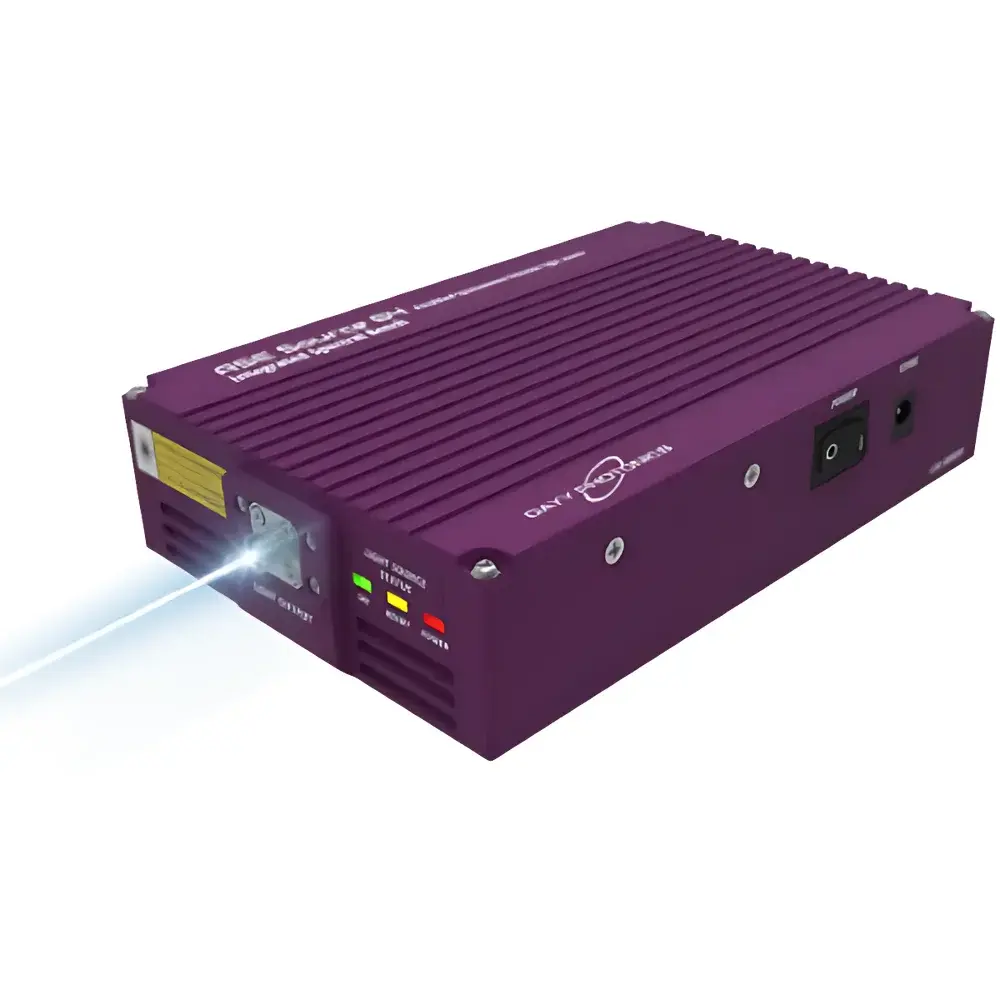
DAYY Photonics ASE Integrated Spectral Bench (ISB4)
| Brand | DAYY Photonics |
|---|---|
| Origin | Canada |
| Manufacturer Type | Authorized Distributor |
| Origin Category | Imported |
| Model | ASE ISB4 |
| Pricing | Upon Request |
| Center Wavelength Options | 770–1680 nm (12 discrete options) |
| Spectral Bandwidth (FWHM) | 15–70 nm |
| Output Power | 20–200 mW |
| Polarization Degree | Low / Medium / High (configurable per fiber type) |
| Output Connector | FC/APC (standard), FC/PC or SMA (optional) |
| Control Interfaces | USB, RS-232 |
| Drive Control | 0–100% adjustable via GUI or API |
Overview
The DAYY Photonics ASE Integrated Spectral Bench (ISB4) is a turnkey, benchtop broadband light source engineered for high-stability, high-power operation in the near-infrared (NIR) spectral region. Based on amplified spontaneous emission (ASE) physics, the ISB4 leverages a proprietary Optical Spectral Engine (OSE4) coupled with a high-gain optical amplifier stage to generate spectrally broad, spatially coherent, and temporally incoherent output—ideal for applications requiring low temporal coherence and high brightness. Unlike superluminescent diodes (SLEDs), the ISB4 delivers significantly higher output power (up to 200 mW) across customizable center wavelengths from 770 nm to 1680 nm, with spectral bandwidths tunable between 15 nm and 70 nm (FWHM). Its monolithic integration of driver electronics, thermal stabilization, and spectral shaping optics ensures exceptional long-term power stability (<±0.5% over 8 h) and wavelength repeatability—critical for metrology-grade instrumentation and production-line testing.
Key Features
- Compact, rack-mountable 19″ chassis (2U height) with integrated heat-sink and active temperature control for ambient operation from 15–30 °C
- Twelve factory-configurable center wavelength options spanning 770 nm to 1680 nm, each with defined spectral range and FWHM per model variant (e.g., ASM003522 @ 1550 nm: 1520–1580 nm, 60 nm FWHM)
- Adjustable output power from 0% to 100% of maximum rated level, digitally controlled with <0.1% resolution via embedded microcontroller
- Three polarization performance grades available: low-depolarized (DoP 95%)
- Standard FC/APC output connector; optional FC/PC or SMA-905 interfaces supplied with calibrated coupling efficiency documentation
- Dual communication protocols: USB 2.0 (CDC class, no driver required) and RS-232 (TTL-level, 115.2 kbps), both supporting full parameter readback and remote triggering
- Embedded real-time monitoring of diode current, TEC temperature, photodiode feedback, and output power drift compensation
Sample Compatibility & Compliance
The ISB4 is compatible with standard single-mode (SMF-28, HI1060, SM1950), polarization-maintaining (PANDA, Bow-tie), and low-birefringence fibers. All variants comply with IEC 60825-1:2014 Class 3B laser safety requirements when operated within specified power limits. Device firmware implements hardware-enforced interlock logic and automatic shutdown upon temperature excursion (>±2 °C from setpoint) or optical feedback anomaly. For regulated environments, the system supports audit-ready operation under GLP and GMP frameworks: all configuration changes, power adjustments, and calibration events are timestamped and logged internally with non-volatile memory retention (≥10,000 entries). While not FDA-cleared as a medical device, the ISB4 meets essential electromagnetic compatibility (EMC) requirements per CISPR 11 Group 1, Class B and operates within FCC Part 15 Subpart B limits.
Software & Data Management
The ISB4 ships with DAYY’s SpectraControl™ GUI—a cross-platform application (Windows/macOS/Linux) providing real-time spectral preview (via optional external spectrometer integration), power trending, and multi-unit synchronization. The GUI includes built-in scripting support (Python-compatible JSON-RPC API) enabling seamless integration into automated test sequences (e.g., LIV characterization, OCT system alignment, or fiber Bragg grating interrogation). All configuration parameters—including center wavelength selection, power setpoint, TEC target, and safety thresholds—are stored in encrypted EEPROM and can be exported/imported as .json profiles. Audit logs are exportable in CSV format with ISO 8601 timestamps and SHA-256 hash integrity verification. Remote firmware updates are performed via signed binary packages validated against embedded public-key certificates.
Applications
- Optical component characterization: insertion loss, polarization-dependent loss (PDL), and return loss measurement of isolators, circulators, and WDM filters
- Fiber-optic sensing: interferometric strain/temperature monitoring in structural health systems using low-coherence interferometry (LCI)
- Optical coherence tomography (OCT): swept-source and spectral-domain OCT engine calibration and reference arm illumination
- Inertial navigation: bias stability testing and scale factor calibration of fiber optic gyroscopes (FOGs) requiring broadband, low-coherence seed sources
- Telecom R&D: dispersion measurement, chromatic dispersion mapping, and nonlinear coefficient validation in specialty fibers
- Biophotonics: fluorescence excitation source multiplexing and tissue scattering spectroscopy where high NIR photon flux improves signal-to-noise ratio
- Industrial metrology: white-light interferometry and surface profilometry requiring stable, broadband illumination with minimal speckle noise
FAQ
What distinguishes the ISB4 from conventional SLED-based sources?
The ISB4 employs an ASE amplifier architecture—not semiconductor gain alone—enabling 2× to 4× higher output power than equivalent SLEDs at comparable wavelengths, with broader spectral coverage and superior power stability over temperature and time.
Can the ISB4 be synchronized with external trigger signals?
Yes. A dedicated TTL-compatible sync input accepts external gate pulses (5 V CMOS, ≤10 MHz repetition rate) to enable pulsed operation or master-slave timing with oscilloscopes, cameras, or data acquisition systems.
Is spectral calibration traceable to NIST standards?
Each unit includes a factory spectral calibration report referenced to NIST-traceable tungsten-halogen and laser line standards; optional annual recalibration services are available with ISO/IEC 17025-accredited certificates.
Does the ISB4 support OEM integration into custom enclosures?
Yes. Mechanical drawings, thermal dissipation profiles, pinout schematics, and API documentation are provided under NDA for system integrators designing embedded platforms or multi-source test benches.
How is output power calibrated and maintained over lifetime?
Internal photodiode feedback is continuously compensated against thermally induced responsivity drift using a dual-wavelength reference algorithm; factory calibration is valid for 12 months or 2,000 operating hours—whichever occurs first.




