
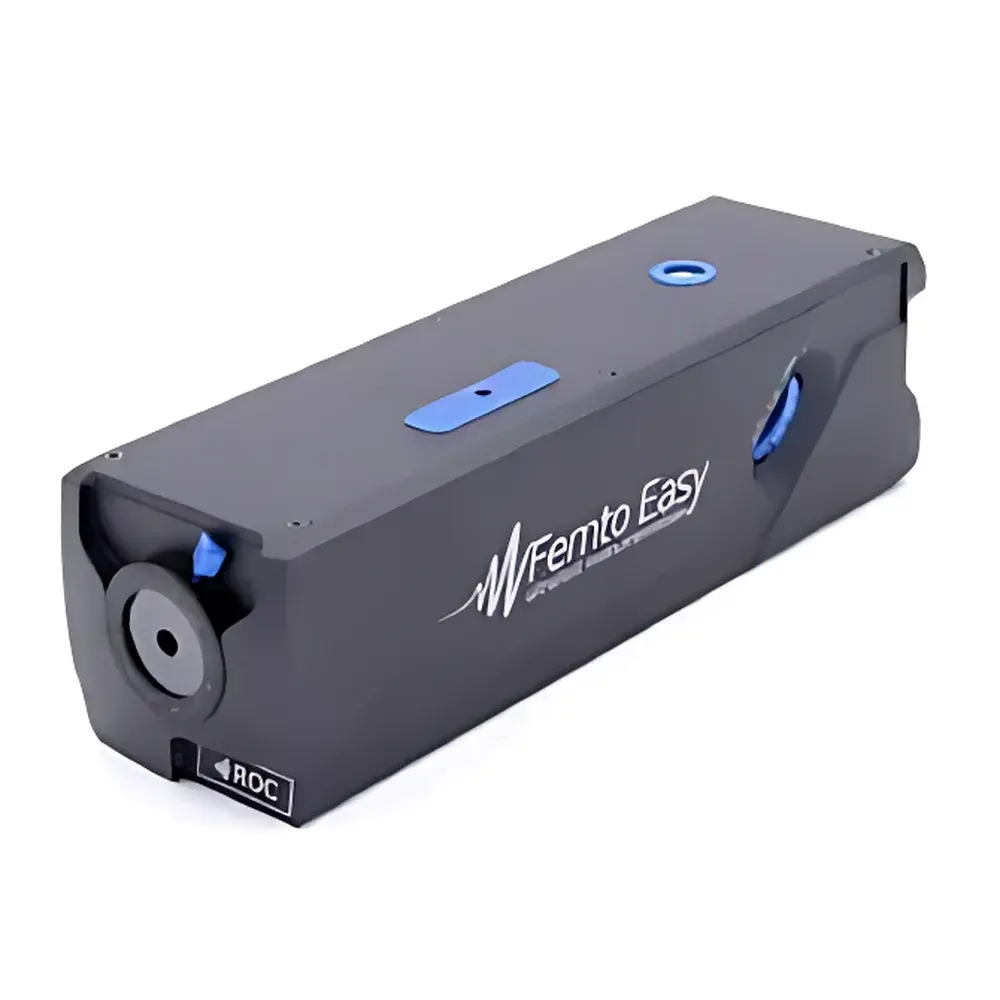
Femto Easy ROC Compact Single-Shot & Multi-Shot Autocorrelator
| Brand | FEMTOEASY |
|---|---|
| Origin | France |
| Model Series | FC, FS, PS1, PS3, PS5, PS10, µ-ROC, MS-ROC, MS-ROC-LP, MS-ROC-SP, MS-ROC-SLP |
| Wavelength Range | 480–2200 nm |
| Pulse Duration Coverage | 4 fs – 80 ps |
| Input Repetition Rate | Single-shot to GHz |
| Detection | CMOS, 12-bit, 3 Mpx, 72 dB dynamic range |
| Interface | USB 3.1 (GigE optional) |
| Beam Height Adjustment | 30 mm (standard), up to 148 mm (MS-series) |
| Integrated ND Filter Wheel | Yes |
| Polarization Requirement | Linear (horizontal or vertical) |
| Trigger Support | External TTL sync up to 125 kHz (with Enhanced Detection option) |
Overview
The Femto Easy ROC (Row-Optimized Correlator) series represents a class of fully integrated, alignment-free autocorrelators engineered for precise, real-time characterization of ultrashort laser pulses. Based on second-harmonic generation (SHG) in nonlinear crystals within a collinear interferometric configuration, the ROC family implements intensity autocorrelation to retrieve pulse duration without phase retrieval ambiguity. Unlike traditional scanning autocorrelators requiring mechanical delay lines and manual alignment, the ROC architecture eliminates moving parts and optical drift—enabling robust, turnkey operation in both laboratory and industrial environments. The system operates across an exceptionally broad spectral window (480–2200 nm), supporting Ti:sapphire, Yb-, Er-, and Cr:ZnSe-based ultrafast oscillators and amplifiers. Its design adheres to fundamental principles of ultrafast metrology: high temporal fidelity, shot-to-shot reproducibility, and immunity to environmental perturbations such as vibration and thermal drift.
Key Features
- True single-shot capability: Measures full autocorrelation trace from one laser pulse—critical for low-repetition-rate or unstable sources.
- No alignment or calibration required: Factory-optimized collinear path ensures long-term stability; zero maintenance over extended deployment cycles.
- Integrated motorized ND filter wheel: Provides automatic attenuation matching across input pulse energies ranging from sub-yJ (single-shot, 30 fs) to µJ-level (300 fs), eliminating manual filter swaps and signal saturation risks.
- Multi-mode acquisition: Supports single-pulse, burst-mode, and high-repetition-rate (up to 125 kHz with Enhanced Detection option) measurement protocols.
- High spatial resolution beam profiling: µ-ROC variant enables simultaneous spatial beam profile and temporal width mapping along one axis—valuable for cavity diagnostics and beam delivery validation.
- Modular upgrade path: Optional features—including Phase Matching tuning, Enhanced Detection (higher QE, lower noise floor), High Dynamic Range (16-bit software-enhanced digitization), and external TTL triggering—allow performance tailoring per application constraints.
Sample Compatibility & Compliance
The ROC platform accommodates free-space and fiber-coupled inputs (via optional FC/PC or SMA fiber adapter kits). It accepts linearly polarized beams oriented horizontally or vertically, with standardized kinematic mounting interfaces (M4/M6 tapped holes). All models comply with CE marking requirements and meet IEC 61000-6-3 (EMC emission) and IEC 61000-6-2 (immunity) standards. Data integrity and audit readiness are supported through timestamped metadata embedding (UTC synchronization via PC), consistent with GLP/GMP-aligned ultrafast lab workflows. While not FDA-cleared as a medical device, the ROC series is routinely deployed in ISO 13485-certified laser manufacturing facilities for QC of femtosecond ophthalmic and dermatological systems.
Software & Data Management
Femto Easy’s proprietary RocControl software (Windows/macOS/Linux) provides intuitive GUI-driven operation, real-time trace visualization, and automated pulse width fitting using Gaussian, sech², or user-defined intensity profiles. Raw 12-bit image data (3 Mpx) is saved in HDF5 format with embedded metadata (wavelength, crystal type, ND position, trigger status, timestamp). Software supports batch processing, statistical trending (e.g., pulse duration drift over 24+ hours), and export to CSV, MATLAB .mat, or Python-compatible NumPy arrays. For regulated environments, optional 21 CFR Part 11-compliant audit trail logging (user actions, parameter changes, calibration events) is available upon request. Remote operation via TCP/IP API enables integration into automated test benches and laser production lines.
Applications
- Ultrafast oscillator/amplifier commissioning and daily stability monitoring
- Chirped-pulse amplification (CPA) system optimization—stretcher-compressor alignment verification
- Industrial laser source qualification for micromachining, thin-film ablation, and LIBS
- Biomedical laser development (e.g., multiphoton microscopy excitation source validation)
- Academic research in strong-field physics, attosecond science, and nonlinear spectroscopy
- In-line pulse diagnostics in vacuum or cleanroom-integrated laser workstations
FAQ
What pulse durations can the ROC series measure?
The ROC family covers 4 fs (MS-ROC-SLP) to 80 ps (MS-ROC-LP), with model-specific ranges: FC (5–150 fs), PS10 (300 fs–10 ps), µ-ROC (40–1200 fs depending on configuration), and MS-ROC variants offering fine-scan resolution down to 50 as.
Is phase retrieval possible with ROC instruments?
No—the ROC measures intensity autocorrelation only. For complete electric field reconstruction (amplitude + phase), complementary tools such as FROG or SPIDER are recommended.
Can ROC operate with amplified laser systems delivering µJ–mJ pulses?
Yes—integrated ND filtering and optional high-damage-threshold crystals (e.g., BBO, BiBO, LBO) enable safe operation with pulse energies up to several µJ at 1 kHz repetition rates.
How is synchronization handled for low-repetition-rate lasers (e.g., 10 Hz Ti:sapphire amplifier)?
The MS-ROC supports external TTL triggering and Low Repetition Rate mode, allowing stable acquisition even below 200 Hz without signal averaging artifacts.
Are calibration certificates provided with each unit?
Each ROC ships with factory-measured SHG crystal phase-matching curve and traceable pulse width verification report (NIST-traceable reference sources used during final QA). On-site recalibration services are available globally.




