
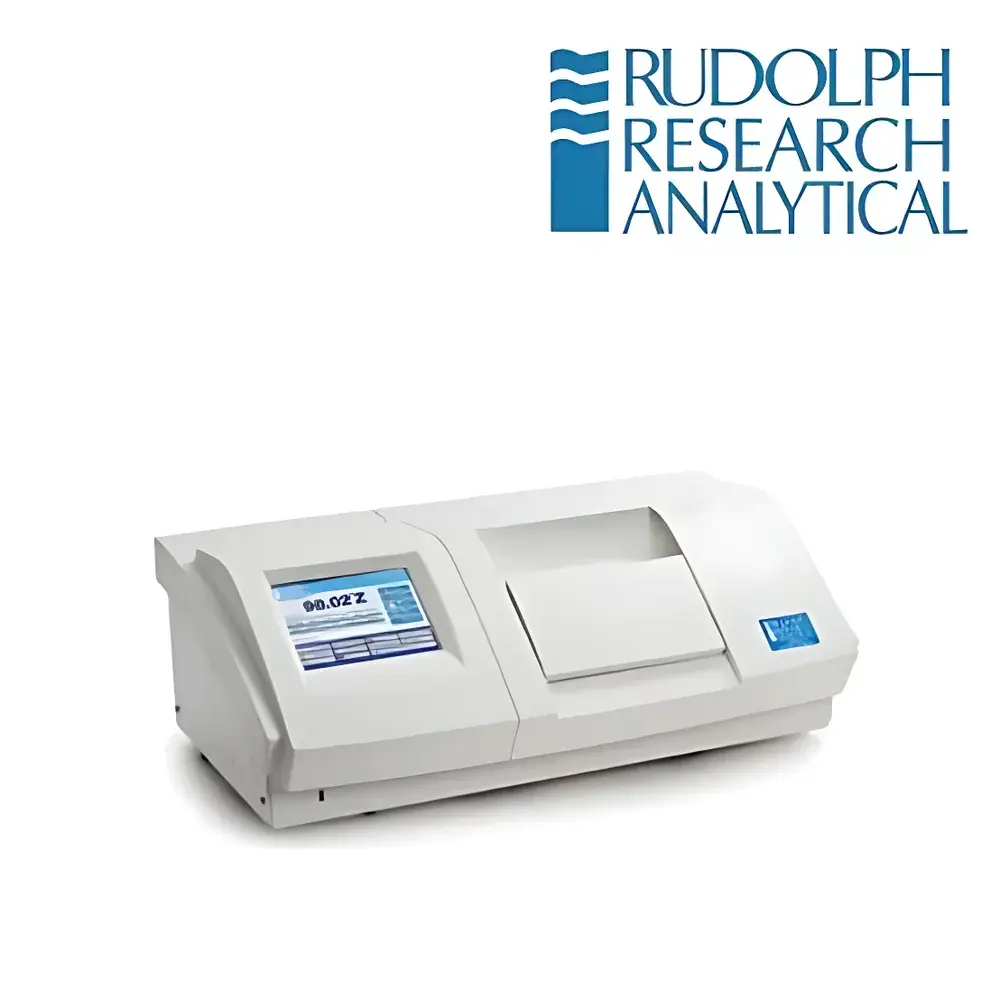
Rudolph AUTOPOL 589 Digital Polarimeter
| Brand | Rudolph |
|---|---|
| Origin | USA |
| Model | AUTOPOL 589 |
| Measurement Wavelength | 589 nm |
| Wavelength Switching | Manual or Optional Motorized |
| Measurement Range | ±225°Z |
| Resolution | 0.01°Z |
| Optical Element | Calcite Prism |
| Temperature Control Accuracy | ±0.1°C |
| Calibration | One-Touch Auto-Calibration |
| Measurement Modes | Sucrose Concentration (°Z), Optical Rotation (°), Purity, User-Defined Units |
| Compliance | SPRI Certified |
Overview
The Rudolph AUTOPOL 589 Digital Polarimeter is a precision optical instrument engineered for accurate, traceable, and repeatable measurement of optical rotation in optically active substances—primarily sucrose solutions in the sugar industry. Based on the fundamental principle of polarimetry, the instrument quantifies the angular rotation of plane-polarized light as it passes through a chiral sample, enabling direct determination of sucrose concentration expressed in the Z-scale (°Z), as defined by the International Commission for Uniform Methods of Sugar Analysis (ICUMSA). Designed and manufactured in the United States, the AUTOPOL 589 integrates high-stability optics, thermally regulated sample cells, and microprocessor-controlled signal processing to deliver metrological reliability required for trade settlement, quality control, and R&D applications across cane sugar, beet sugar, molasses, syrups, and refined intermediates.
Key Features
- Fixed-wavelength sodium D-line source at 589 nm—optimized for sucrose analysis per ICUMSA Method GS4/3-10 and AOAC Official Method 932.12
- Calcite prism-based optical system ensuring long-term stability, minimal drift, and high polarization extinction ratio
- Integrated Peltier-controlled cell holder with ±0.1°C temperature regulation—critical for compliance with ICUMSA temperature correction protocols (e.g., 20°C reference)
- One-touch automatic calibration using built-in quartz control plates traceable to NIST standards
- Multi-mode operation: direct readout in °Z (Z-scale), degrees of optical rotation (°), % purity (based on theoretical specific rotation), or user-defined units
- Motorized wavelength selection option available for extended method flexibility (e.g., 546 nm or 436 nm for specialty applications)
- Non-destructive, solution-phase analysis requiring only 1–2 mL sample volume per measurement
Sample Compatibility & Compliance
The AUTOPOL 589 accommodates standard 100 mm, 200 mm, and custom-length sample cells—including jacketed cells for external temperature control—and supports viscous, colored, or turbid solutions common in raw sugar liquors and refinery intermediates. It meets the stringent performance criteria established by the Sugar Processing Research Institute (SPRI), making it the only polarimeter formally recognized for official sugar trade arbitration and regulatory reporting in North America and the EU. Instrument validation aligns with ISO/IEC 17025 requirements for testing laboratories, and operational records support GLP and GMP audit readiness when paired with optional 21 CFR Part 11-compliant software modules.
Software & Data Management
Equipped with Rudolph’s PolaWin™ software (Windows-based), the AUTOPOL 589 enables comprehensive data acquisition, real-time trending, statistical process control (SPC) charting, and automated report generation compliant with ICUMSA reporting templates. All measurements include embedded metadata: date/time stamp, operator ID, cell pathlength, temperature, calibration status, and instrument serial number. Audit trail functionality logs every parameter change, calibration event, and result export—fully satisfying FDA 21 CFR Part 11 electronic record and signature requirements when configured with user authentication and electronic signatures.
Applications
- Trade-grade sucrose assay for import/export documentation and contractual settlement
- In-process monitoring of carbonatation, sulfitation, and crystallization stages in sugar refineries
- Quality assurance of liquid sweeteners (invert syrup, HFCS blends) and functional carbohydrates
- Research into chiral impurities, hydrolysis kinetics, and enzymatic inversion in carbohydrate chemistry
- Validation of HPLC and enzymatic methods via orthogonal polarimetric reference measurement
- Teaching and method development in food science, analytical chemistry, and pharmaceutical curricula
FAQ
What does “°Z” represent, and how is it different from standard optical rotation units?
The Z-scale (°Z) is a sucrose-specific unit defined by ICUMSA, where 1°Z equals the optical rotation produced by a 1% w/w aqueous sucrose solution at 20°C using sodium D-light (589 nm) in a 100 mm cell. It eliminates dependency on pathlength and temperature assumptions inherent in generic degree (°) reporting.
Is the AUTOPOL 589 suitable for measuring non-sucrose chiral compounds?
Yes—the instrument reports raw optical rotation (°) and supports user-defined specific rotation calculations. However, ICUMSA-certified °Z mode is optimized exclusively for sucrose and related cane/beet sugar matrices.
How often must the instrument be recalibrated?
Daily verification with quartz control plates is recommended before critical measurements; full recalibration is required only after maintenance, relocation, or if verification fails per internal SOPs.
Can the AUTOPOL 589 interface with LIMS or MES systems?
Yes—via RS-232, USB, or Ethernet, supporting ASTM E1384 and ASTM E1467-compliant data transfer protocols for seamless integration into laboratory and manufacturing execution systems.



