
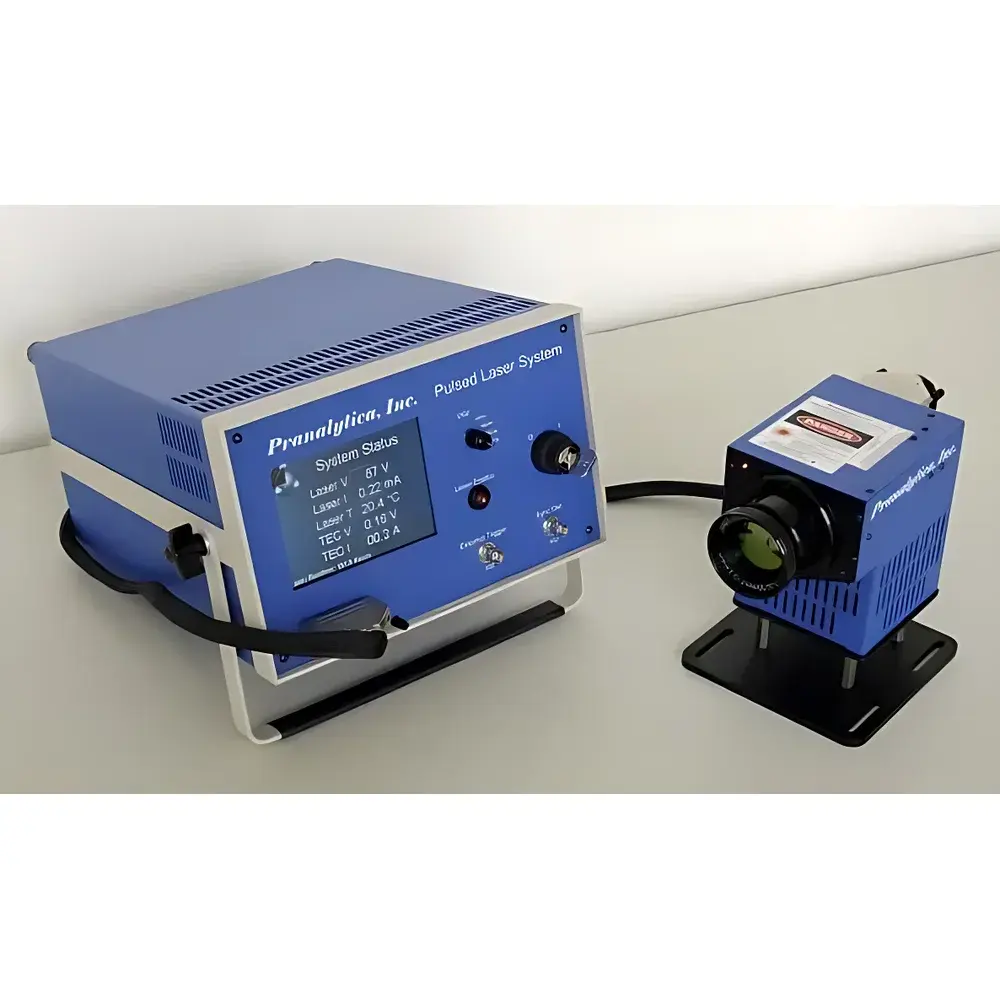
Pranalytica 1101-XX-HP-XXXX High-Power Pulsed Quantum Cascade Laser (QCL) System
| Brand | Pranalytica |
|---|---|
| Origin | USA |
| Model | 1101-XX-HP-XXXX |
| Output Wavelength Range | 3.8–12+ µm |
| Peak Pulse Power | Up to 4 W (model-dependent) |
| Pulse Width | 50–500 ns |
| Rise/Fall Time | <5 ns |
| Max Repetition Rate | 1 MHz |
| Beam Diameter | ~4 mm (collimated) |
| Spectral Bandwidth | ~150 nm (centered at 4.6 µm, configurable) |
| Operating Temperature | Ambient (no cryogenic cooling required) |
| Dimensions (Laser Head) | 13 × 17 × 15 cm |
| Weight (Laser Head) | 1.9 kg |
| Power Supply Input | 110/220 V AC, 3 A max |
| Modulation Bandwidth | DC–100 kHz (standard), up to 1 GHz (with optional driver) |
Overview
The Pranalytica 1101-XX-HP-XXXX is a turnkey high-power pulsed quantum cascade laser (QCL) system engineered for demanding mid-infrared (MIR) applications requiring robust, field-deployable performance. Unlike conventional diode lasers that rely on interband electron-hole recombination, QCLs operate on intersubband transitions within the conduction band of engineered semiconductor heterostructures—typically comprising >500 periods of coupled quantum wells. This unipolar architecture enables precise wavelength design across the 3.8–12+ µm spectral range, covering key atmospheric transmission windows (3–5 µm and 8–12 µm) and enabling high-sensitivity molecular absorption spectroscopy. The 1101-XX-HP-XXXX integrates a thermally stabilized QCL chip, collimating optics, precision pulse electronics, and a hardened power supply into a single compact subsystem. It delivers near-diffraction-limited, quasi-collimated output with sub-5 ns rise/fall times and fixed pulse widths selectable between 50 ns and 500 ns—making it suitable for time-resolved detection, lidar-based standoff sensing, and high-speed modulation protocols.
Key Features
- Peak pulsed output power up to 4 W at room temperature—among the highest commercially available for MIR QCL systems
- Wavelength tunability across 3.8–12+ µm via discrete device selection; standard configuration centered at 4.6 µm with ~150 nm spectral bandwidth
- Industrial-grade thermal management and hermetic packaging ensuring >3,000 hours of stable operation under full-power cycling and ambient temperature fluctuations (<45 °C)
- Integrated collimation optics producing a ~4 mm diameter beam; optional bayonet-mount expansion lens assembly supports kilometer-range beam projection (e.g., Janos ASIO 50 mm F/2.3 objective)
- Flexible triggering architecture supporting internal clocking, external TTL synchronization, and programmable pulse sequencing up to 1 MHz repetition rate
- Comprehensive electrical protection suite including overvoltage, overcurrent, and thermal shutdown; 5-second soft-start delay prevents current surge during activation
- OEM-ready mechanical and electrical interfaces—including front-panel modulation input (DC–100 kHz, TTL-compatible), RS-232/USB control, and analog monitor outputs
Sample Compatibility & Compliance
The 1101-XX-HP-XXXX is designed for integration into analytical platforms requiring trace-gas detection, industrial process monitoring, or defense-related countermeasure systems. Its emission spectrum overlaps strongly with fundamental vibrational-rotational absorption lines of critical analytes—including CO, NO, NO₂, NH₃, CH₄, H₂S, HF, and volatile organic compounds (VOCs). The system complies with IEC 61000-6-3 (EMI emissions) and IEC 61000-6-2 (immunity), and its enclosure meets IP54-rated environmental protection standards for dust and water resistance. While not inherently certified for medical or pharmaceutical use, its optical stability and reproducibility support GLP-compliant method development in regulated environments. When integrated with NIST-traceable gas cells or calibrated photodetectors, the system supports ASTM E2884-13 (standard guide for infrared spectroscopic measurements) and ISO 14001-aligned emissions monitoring workflows.
Software & Data Management
The system ships with Pranalytica’s QCL Control Suite—a cross-platform application (Windows/macOS/Linux) providing real-time parameter adjustment, pulse diagnostics, and data logging. Key functionalities include waveform preview, jitter analysis, pulse-to-pulse energy stability tracking (±0.5% RMS over 1 hr), and automated calibration sequence execution. All operational parameters—including trigger mode, pulse width, repetition rate, and bias voltage—are stored with timestamped metadata in HDF5 format, facilitating audit-ready documentation per FDA 21 CFR Part 11 requirements when deployed in GxP environments. Optional SDKs (C/C++, Python, LabVIEW) enable seamless integration with third-party DAQ systems (e.g., National Instruments PXI), spectrometers (e.g., FTIR or grating-based MIR detectors), or embedded controllers used in unmanned aerial vehicle (UAV) payloads or mobile environmental stations.
Applications
- Defense & Security: Infrared countermeasures (IRCM), long-range explosive vapor detection, container screening, and chemical warfare agent identification using tunable absorption spectroscopy
- Medical Diagnostics: Non-invasive breath analysis for ammonia (liver/kidney dysfunction), acetone (diabetes monitoring), and isoflurane/sevoflurane (anesthetic gas quantification)
- Environmental Monitoring: Real-time stack emission compliance testing (EPA Method 320), marine vessel exhaust profiling, agricultural methane flux measurement, and urban air quality networks
- Industrial Process Control: In-line natural gas composition analysis (CH₄/C₂H₆ ratio), refinery leak detection (H₂S, SO₂), and pharmaceutical reactor headspace monitoring (residual solvents, moisture)
- Semiconductor Manufacturing: In-situ chamber cleaning verification (NF₃, ClF₃), wafer transfer ambient purity assessment, and plasma etch byproduct detection (SiF₄, CF₄)
FAQ
What is the typical spectral linewidth of the 1101-XX-HP-XXXX system?
The standard broadband configuration exhibits a full-width-at-half-maximum (FWHM) of approximately 150 nm centered at 4.6 µm. Narrower linewidth options (<1 cm⁻¹) are available through external cavity integration or DFB-QCL variants upon request.
Does the system require liquid nitrogen or thermoelectric cooling?
No. The laser head operates continuously at ambient temperature without cryogenic support. Active thermoelectric stabilization maintains junction temperature within ±0.1 °C during extended operation.
Can the pulse width be adjusted dynamically during operation?
Pulse width is configured at factory level per model variant (e.g., 100 ns, 200 ns, 500 ns). Real-time dynamic adjustment is not supported in the base configuration but can be implemented via custom firmware and external arbitrary waveform generators.
Is remote operation supported over Ethernet or fiber?
Standard communication uses USB 2.0 and RS-232. Ethernet and fiber-optic isolation modules are available as OEM add-ons for EMI-hardened installations in industrial or military settings.
What safety certifications does the laser head carry?
The system is classified as Class IV laser product per IEC 60825-1:2014 and includes interlocked housing, beam shutter, and visible alignment LED per ANSI Z136.1-2022 requirements. Laser Safety Officer (LSO) documentation packages are provided with each unit.




