
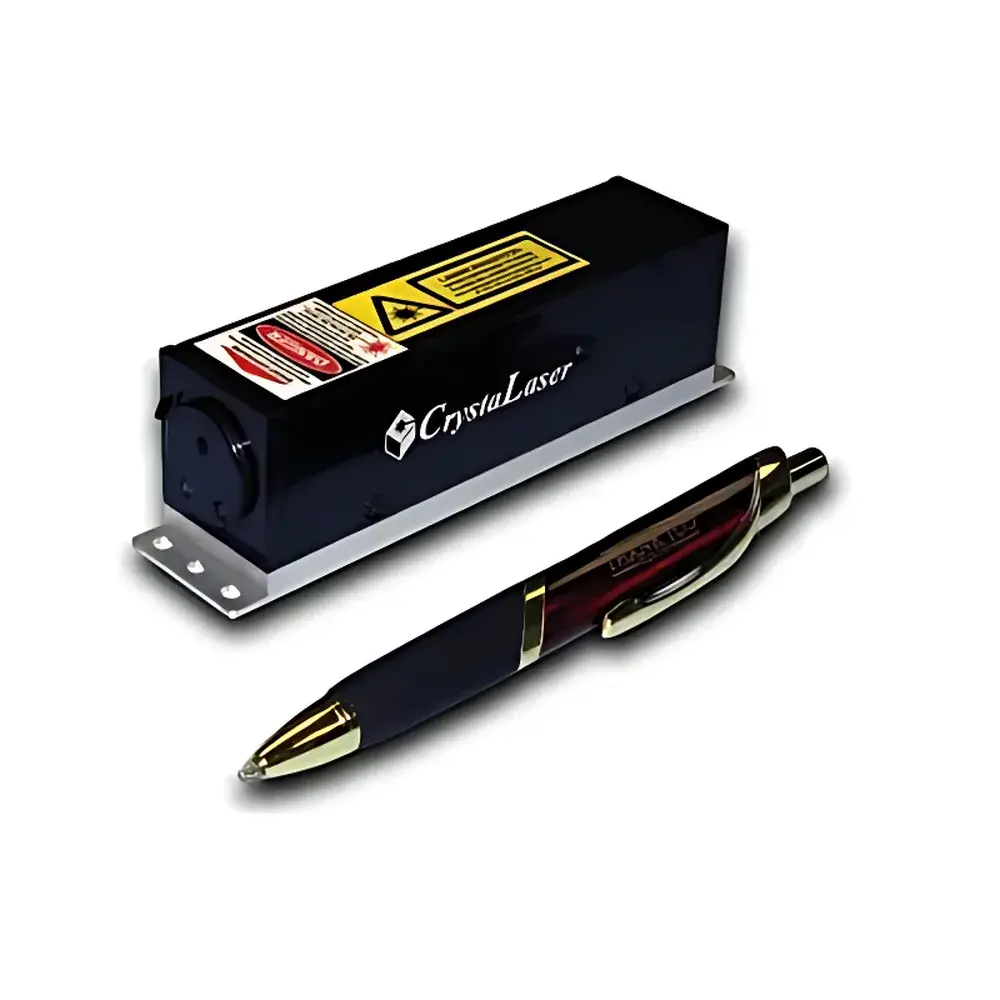
CrystaLaser DL375/DL405/DL445 Continuous-Wave Violet-Blue Diode Lasers
| Brand | CrystaLaser |
|---|---|
| Origin | USA |
| Model Series | DL375, DL405, DL445 |
| Wavelengths | 375 nm (±5 nm), 405 nm (±5 nm), 445 nm (±5 nm) |
| Output Power Options | 375 nm — up to 30 mW |
| Beam Diameter (1/e²) | 1.2 mm (DL375/DL405), 1.2–2.5 mm (DL445) |
| Full-Angle Beam Divergence | 0.6 mrad (DL375/DL405), 0.7–1.2 mrad (DL445) |
| Transverse Mode | TEM₀₀ (M² ≈ 1.2, DL375) |
| Longitudinal Mode | Single Longitudinal Mode (SLM, DL375) |
| Spectral Linewidth | < 10⁻⁵ nm (DL375 SLM), 0.8 nm (DL405), ~1 nm (DL445) |
| Coherence Length | > 50 m (DL375 SLM), not specified (DL405/DL445) |
| Intensity Noise (RMS, 10 Hz–50 MHz) | < 1% (DL375/DL445), < 0.5% (DL405 low-noise variant) |
| Power Stability (RMS) | 1% over 8 h |
| optional ultra-stable versions | 0.5% or 0.25% over 24 h |
| Beam Pointing Stability | < 0.02 mrad (temperature-stabilized environment) |
| Polarization | Linear, extinction ratio ≥ 100:1, vertical orientation |
Overview
The CrystaLaser DL375, DL405, and DL445 series are continuous-wave (CW) semiconductor diode lasers engineered for precision applications in violet-to-blue spectral regions. Operating at center wavelengths of 375 nm, 405 nm, and 445 nm (each with ±5 nm tolerance), these lasers leverage high-efficiency gallium nitride (GaN)-based diode technology to deliver stable, collimated output across three distinct performance tiers: single longitudinal mode (SLM) for interferometry and holography, low-noise TEM₀₀ for fluorescence excitation and confocal microscopy, and multi-mode variants optimized for high-power photopolymerization and industrial alignment. Unlike gas-based UV sources, these solid-state lasers offer compact footprint, rapid turn-on response (<1 s), and inherent wavelength stability without warm-up drift—making them suitable for integration into OEM instrumentation, automated inspection platforms, and regulated laboratory environments.
Key Features
- Three discrete wavelength families (375 nm, 405 nm, 445 nm) with factory-calibrated spectral accuracy and minimal batch-to-batch variation
- Configurable output power ranges: up to 30 mW (375 nm), 1000 mW (405 nm), and 1000 mW (445 nm), supporting both low-flux spectroscopic probing and high-intensity material processing
- Beam quality control: diffraction-limited TEM₀₀ operation (M² < 1.2) on DL375 and DL405 variants; multi-mode DL445 maintains M² < 3 while enabling higher power density
- Thermally stabilized housing with integrated TEC and PID feedback loop ensures beam pointing stability < 0.02 mrad under constant ambient conditions
- Linear polarization with ≥100:1 extinction ratio, vertically oriented by default—compatible with standard polarizing optics and Pockels cells
- Ultra-low intensity noise options (<0.5% RMS, 10 Hz–50 MHz) available for DL405 models used in photon correlation spectroscopy (PCS) and time-resolved fluorescence lifetime measurements
- Optional ultra-stable power regulation (0.25% RMS over 24 h) meets requirements for quantitative optical density calibration and long-duration photobleaching studies
Sample Compatibility & Compliance
These lasers are designed for use with standard optical components rated for UV–blue spectral transmission, including fused silica lenses, MgF₂-coated mirrors, and quartz cuvettes. The 375 nm and 405 nm variants are compatible with common fluorophores (e.g., DAPI, Hoechst 33342, Alexa Fluor 405) and photoresists (e.g., SU-8, IP-L) used in microfabrication. All units comply with IEC 60825-1:2014 Class 3B laser safety standards and include integrated key-switch interlock, emission indicator LED, and shutter-compatible TTL modulation input. Firmware supports configurable safety lockout protocols aligned with ISO 13857 and ANSI Z136.1 institutional laser safety programs. No hazardous substances are employed per RoHS Directive 2011/65/EU.
Software & Data Management
Each laser integrates a digital control interface via RS-232 or USB 2.0, enabling remote power setpoint adjustment, modulation triggering, and real-time status monitoring (temperature, current, fault flags). Optional CrystaLaser Control Suite (v3.2+) provides GUI-based logging of power stability traces, thermal history, and cumulative operating hours—exportable in CSV and HDF5 formats for auditability. Data logs include timestamped metadata compliant with FDA 21 CFR Part 11 requirements when paired with validated user authentication and electronic signature modules. Instrument drivers support LabVIEW™, MATLAB® Instrument Control Toolbox, and Python (PySerial/PyVISA), facilitating integration into automated QC workflows governed by ISO/IEC 17025 or GLP frameworks.
Applications
- Life Sciences: Confocal and super-resolution microscopy excitation (375/405 nm), flow cytometry scatter calibration, optogenetic actuation (ChR2 variants)
- Materials Science: Photopolymerization of acrylate resins, UV-curable adhesive curing, nanoimprint lithography alignment beams
- Instrumentation: Calibration sources for spectroradiometers (NIST-traceable irradiance validation), reference emitters in optical coherence tomography (OCT) systems
- Industrial Metrology: High-contrast machine vision illumination for PCB trace inspection, semiconductor wafer defect mapping, and micro-optic alignment verification
- Research: Pump-probe spectroscopy (with synchronized femtosecond systems), Raman excitation enhancement, quantum dot photoluminescence characterization
FAQ
Are these lasers air-cooled or water-cooled?
All DL-series lasers are conduction-cooled via integrated thermoelectric coolers (TECs) and aluminum alloy housings—no external water chiller required. Ambient air convection is sufficient for continuous operation within 15–30 °C environmental range.
Can the DL405 be configured for analog modulation?
Yes—standard models accept 0–5 V analog input for linear power control (bandwidth: DC to 10 kHz). Optional high-bandwidth modulation (up to 500 kHz) is available with external driver upgrade.
Is wavelength tuning possible across the 375–445 nm range?
No—each model is fixed-wavelength. Tuning requires discrete replacement of the diode chip; CrystaLaser does not offer broadband tunable variants in this product line.
What is the expected lifetime under continuous operation?
Rated mean time to failure (MTTF) exceeds 10,000 hours at rated power and nominal temperature, per Telcordia GR-468-CORE reliability testing protocols.
Do you provide NIST-traceable calibration certificates?
Yes—optional factory calibration includes spectral centroid verification (±0.5 nm), power output certification (±3% uncertainty), and beam parameter measurement (per ISO 11146-1), issued with NIST-traceable reference standards.





