
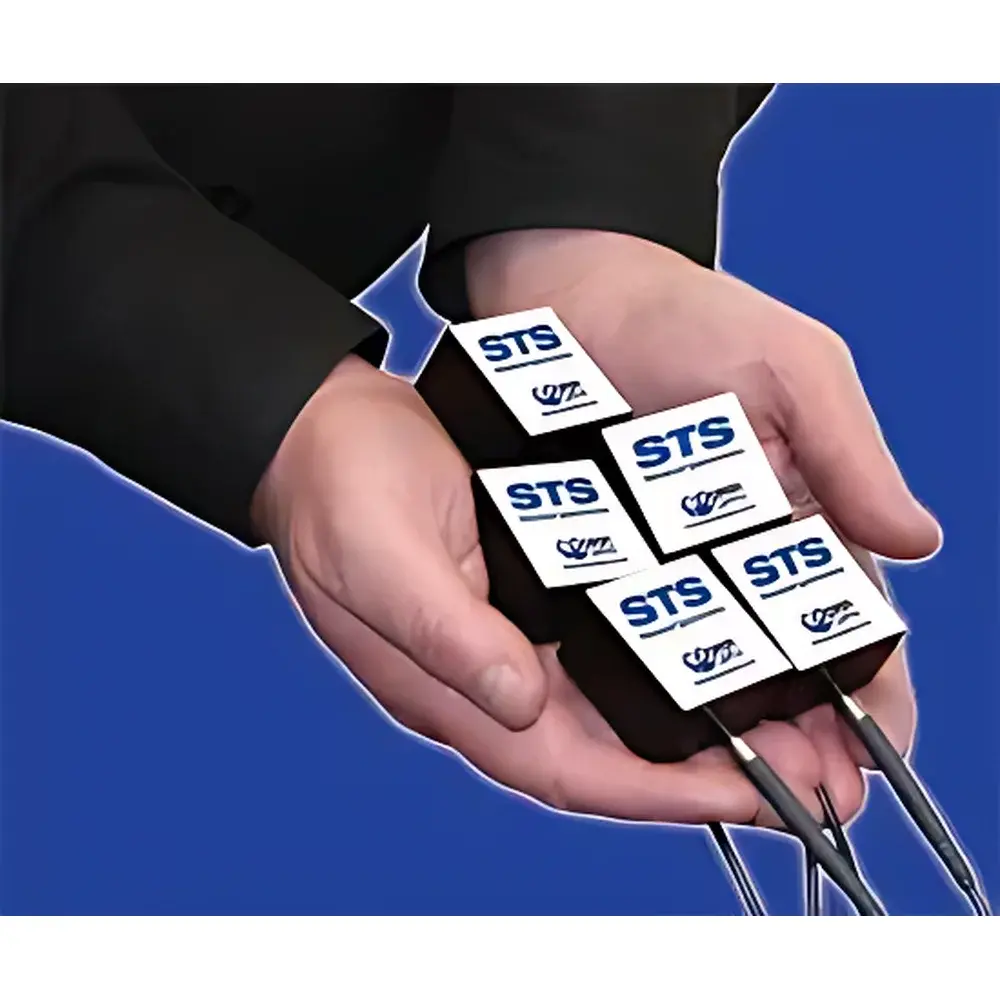
Ocean Optics STS-VIS/STS-NIR Miniature Fiber Optic Spectrometer
| Brand | Ocean Optics |
|---|---|
| Origin | USA |
| Model | STS-VIS / STS-NIR |
| Spectral Range | 350–800 nm (VIS) or 650–1100 nm (NIR) |
| Detector | ELIS1024 1024-pixel linear CMOS |
| Optical Resolution | 1.5 nm FWHM (with 25 µm slit) |
| SNR | >1500:1 |
| A/D Resolution | 14 bits |
| Dark Noise | <3 counts RMS |
| Dynamic Range | 6×10⁹ |
| Integration Time | 10 µs – 10 s |
| Dimensions | 40 mm × 42 mm × 24 mm |
| Weight | 68 g |
| Onboard Shutter | Yes |
| Power Consumption | 0.75 W |
Overview
The Ocean Optics STS-VIS and STS-NIR miniature fiber optic spectrometers are compact, OEM-optimized instruments engineered for high-fidelity spectral acquisition in space-constrained and embedded applications. Based on a robust Czerny-Turner optical architecture with a custom-designed collimating and focusing mirror pair and a 600 grooves/mm holographic grating, the STS delivers laboratory-grade performance in a footprint of just 40 × 42 × 24 mm and a mass of 68 g. Its core detector — the ELIS1024 1024-pixel linear CMOS sensor — features 7.8 × 125 µm pixels and enables full-spectrum capture across either the visible (350–800 nm) or near-infrared (650–1100 nm) range. Unlike conventional miniature spectrometers, the STS integrates a mechanical shutter directly into its optical path, enabling precise dark reference acquisition without external hardware or software synchronization. This design ensures traceable baseline correction and supports compliance with measurement protocols requiring rigorous background subtraction — essential for photometric calibration, absorbance quantification, and colorimetric analysis under GLP or ISO/IEC 17025-aligned workflows.
Key Features
- Embedded mechanical shutter for automated dark-spectrum acquisition and thermal drift compensation
- Czerny-Turner optical layout with optimized mirrors and 600 grooves/mm grating for low stray light (<0.05% at 600 nm)
- 14-bit analog-to-digital conversion with dynamic range up to 6×10⁹ (typical)
- High signal-to-noise ratio (>1500:1 at full well) enabled by low-noise CMOS architecture and on-chip correlated double sampling
- Adjustable integration time from 10 µs to 10 s, supporting both transient event capture and low-light steady-state measurements
- Low power consumption (0.75 W) and USB 2.0 interface for seamless integration into portable, battery-powered, or industrial control systems
- OEM-ready mechanical and electrical interfaces: standardized M3 mounting holes, 2×10-pin Samtec connectors for trigger, strobe, and shutter control
Sample Compatibility & Compliance
The STS series is compatible with standard SMA 905 fiber optic cables (core diameters 50–600 µm), integrating seamlessly with common light sources (LEDs, halogen, tungsten-halogen, pulsed lasers) and sample interfaces (transmission cuvettes, integrating spheres, reflection probes). It supports quantitative absorbance, transmittance, reflectance, and radiometric measurements per ASTM E308 (computing CIE tristimulus values), ISO/CIE 11664-3 (spectral irradiance), and USP (UV-Vis spectrophotometer verification). The onboard shutter and stable thermal design ensure repeatability better than ±0.005 absorbance units over 8-hour continuous operation — meeting internal QA requirements for inline process monitoring. While not pre-certified for FDA 21 CFR Part 11, the STS hardware architecture supports audit-trail-capable software integration when deployed with validated third-party platforms compliant with GMP/GLP data integrity standards.
Software & Data Management
Ocean Insight’s OceanView software (sold separately) provides full instrument control, including shutter actuation, real-time dark subtraction, spectral averaging, and mathematical operations (e.g., derivative, smoothing, peak detection). APIs are available for Python, MATLAB, LabVIEW, and .NET environments, enabling direct incorporation into custom SCADA, MES, or LIMS architectures. OEM customers may commission firmware-level modifications — such as user-defined wavelength calibration tables, custom trigger logic, or binary output protocols — via Ocean Insight’s Engineering Services group. All spectral data are exported in vendor-neutral formats (CSV, ASCII, HDF5), ensuring long-term archival compatibility and third-party analysis interoperability.
Applications
- LED binning and color consistency verification in manufacturing lines
- In-line monitoring of chemical concentration via UV-Vis absorbance (e.g., nitrate in wastewater, dye concentration in textile baths)
- Non-destructive quality assessment of agricultural produce using NIR reflectance signatures
- Embedded spectral feedback in laser diode stabilization loops and tunable filter calibration systems
- Portable environmental sensors for dissolved organic carbon (DOC) or chlorophyll-a estimation
- Educational labs requiring rugged, low-cost spectrometers with reproducible calibration traceability
FAQ
Can the STS operate without a PC?
Yes — the STS supports standalone operation via TTL-triggered acquisition and buffered spectral storage when paired with an external microcontroller (e.g., Raspberry Pi Pico or Arduino MKR series) using its digital I/O header.
Is wavelength calibration NIST-traceable?
Factory calibration uses Hg-Ne and tungsten spectral lines; NIST-traceable recalibration services are available through Ocean Insight’s Metrology Lab upon request.
What is the maximum achievable optical resolution?
With a custom 10 µm entrance slit and optimized grating alignment, sub-1.0 nm FWHM resolution is attainable — subject to optical alignment precision and thermal stability of the host system.
Does the STS support thermoelectric cooling?
No — the STS relies on passive thermal management. For applications requiring <–10 °C detector stabilization, the FX-series or QE Pro platforms are recommended alternatives.
Are OEM volume discounts and custom firmware options available?
Yes — qualified OEM partners receive tiered pricing, extended warranty terms, and access to firmware customization, including proprietary command sets and bootloader-level security provisioning.





