
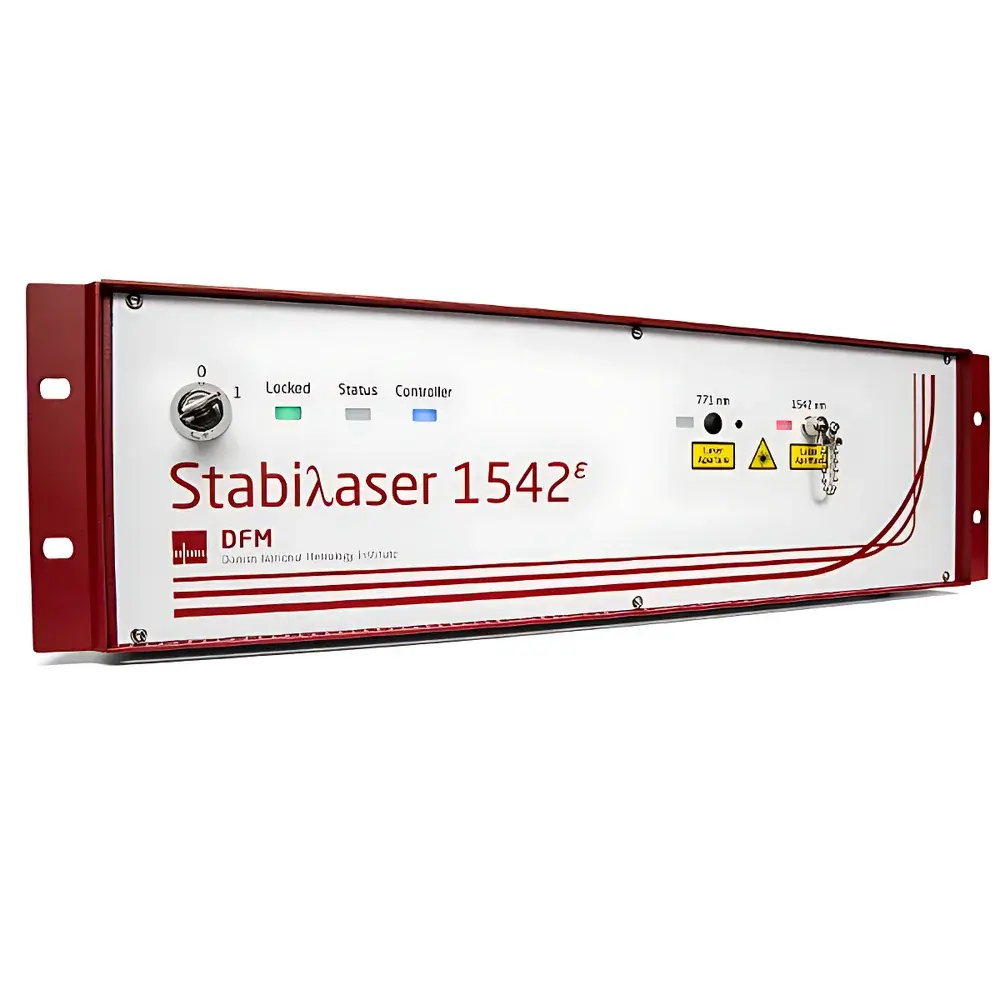
DFM Stabiλaser 1542ε Acetylene-Stabilized Narrow-Linewidth Fiber Laser
| Brand | DFM |
|---|---|
| Origin | Denmark |
| Model | Stabiλaser 1542ε, Stabiλaser 771 |
| Wavelength (vacuum) | 1542.3837 nm |
| Linewidth (short-term) | 300 Hz |
| Allan Deviation (ADEV ≥ 1 s) | ≤3×10⁻¹³ |
| Long-term accuracy | ≤2×10⁻¹² (annual drift) |
| Output power (locked) | 10 mW @ 1542 nm |
| Power supply | 100–240 VAC, 50/60 Hz |
| Dimensions | 13.3 cm × 48.3 cm × 49.6 cm |
| Compliance | CIPM-recommended frequency standard (uncertainty: 5 kHz) |
Overview
The DFM Stabiλaser 1542ε is a second-generation acetylene-stabilized narrow-linewidth fiber laser developed by the Danish Metrology Institute (DFM), a national metrology institute accredited under ISO/IEC 17025 and recognized by the International Committee for Weights and Measures (CIPM). Engineered for primary frequency standard applications, it operates at the vacuum wavelength of 1542.3837 nm—corresponding to the 13C2H2 P(16) (v1 + v3) molecular transition—and delivers an absolute frequency stability traceable to the SI second. Its core architecture integrates an ultra-low-noise distributed feedback (DFB) fiber laser with active stabilization via saturated absorption spectroscopy in a sealed acetylene cell. This configuration achieves sub-300 Hz intrinsic linewidth (Fourier-limited), long-term Allan deviation of ≤3×10⁻¹³ for averaging times ≥1 s, and absolute frequency uncertainty of ±5 kHz—meeting the CIPM’s criteria for recommended secondary frequency standards. The Stabiλaser 1542ε serves as a robust, turnkey optical reference for high-precision interferometry, optical frequency comb calibration, cavity-stabilized laser systems, and quantum metrology infrastructure requiring continuous, hands-off operation.
Key Features
- Primary-frequency-grade stability: Achieves ≤2×10⁻¹² annual frequency drift, validated through multi-year intercomparison campaigns with other national metrology institutes.
- Integrated control architecture: Embedded industrial PC with real-time FPGA-based lock electronics eliminates external hardware dependencies; all servo loops (Pound–Drever–Hall error signal generation, PID filtering, actuator drive) run deterministically onboard.
- Rack-mountable U3 chassis: 19-inch standard footprint (48.3 cm width × 49.6 cm depth × 13.3 cm height) with front-panel status indicators and rear-mounted TTL synchronization I/O for multi-laser coherence management.
- Optimized optical design: Monolithic fiber-coupled acetylene cell with temperature-controlled oven (±10 mK stability) and vibration-isolated optical path ensure reproducible locking performance across environmental fluctuations.
- Graphical user interface (GUI): Web-based HTML5 interface accessible via Ethernet; displays real-time ADEV plots, error signal spectra, laser current/temperature telemetry, and lock health diagnostics without requiring proprietary software installation.
Sample Compatibility & Compliance
The Stabiλaser 1542ε is designed for use in environments adhering to GLP and ISO/IEC 17025 laboratory accreditation requirements. Its frequency output is directly traceable to the SI second via the CIPM Mutual Recognition Arrangement (CIPM MRA), and its calibration protocol conforms to ISO 10110-5 (optical component testing) and ITU-T G.698.2 (coherent transmission system references). While not intended for direct sample interaction, the laser serves as a stable excitation or probe source in applications governed by ASTM E2912 (laser-based dimensional metrology) and EURAMET cg-19 (optical frequency standards). All firmware and control software implement audit-trail logging compliant with FDA 21 CFR Part 11 principles—including user authentication, immutable event timestamps, and electronic signature support—enabling deployment in regulated R&D and calibration laboratories.
Software & Data Management
The embedded Linux-based control system provides RESTful API endpoints for remote monitoring and automation integration (e.g., Python, LabVIEW, MATLAB). Raw ADEV data, lock error signals, and environmental sensor logs (laser diode temperature, cell oven setpoint, photodetector DC level) are stored in HDF5 format with ISO 8601 timestamps and metadata headers describing measurement conditions. Exported datasets include NIST-traceable calibration certificates (issued annually by DFM) and uncertainty budgets per GUM (JCGM 100:2008). Firmware updates are delivered via signed OTA packages verified using ECDSA-256 signatures, ensuring integrity and authenticity. No cloud connectivity is enabled by default; all data remains on-device unless explicitly exported via encrypted SFTP.
Applications
- Optical frequency comb referencing: Provides a stable 1542 nm anchor for f–2f self-referencing and comb line spacing calibration in femtosecond Er:fiber combs.
- Dual-comb spectroscopy: Serves as master oscillator in asynchronous optical sampling (ASOPS) systems requiring mutual coherence between two combs over >1-hour durations.
- Length metrology: Functions as displacement interferometer light source in vacuum-compatible coordinate measuring machines (CMMs) and atomic force microscope (AFM) calibration rigs per ISO 230-6.
- Quantum information processing: Supplies phase-coherent pump fields for trapped-ion qubit manipulation and cavity QED experiments demanding sub-Hz relative linewidth control.
- Gravitational wave detector auxiliary lasers: Used in LIGO-type interferometers for auxiliary cavity pre-stabilization and mode-matching optimization.
FAQ
Is the Stabiλaser 1542ε suitable for use as a primary frequency standard?
No—it is classified as a recommended secondary frequency standard per CIPM Recommendation 1 (2022), with an absolute uncertainty of ±5 kHz. Primary standards require caesium fountain or optical lattice clock architectures.
Can the laser be operated without the integrated control PC?
No—the FPGA-based lock electronics, thermal management, and safety interlocks are fully integrated into the U3 chassis; external controllers cannot replicate its closed-loop stabilization functionality.
What is the expected lifetime of the acetylene absorption cell?
DFM specifies a minimum operational lifetime of 10 years under continuous operation, supported by accelerated aging tests per MIL-STD-810H Method 502.7 (thermal cycling) and Method 507.6 (humidity exposure).
Does the Stabiλaser 771 variant support harmonic generation internally?
No—the 771 nm output is generated externally via a waveguide-based PPLN doubler; the Stabiλaser 771 itself emits only at 1542 nm, with 1 mW delivered at 771 nm after doubling and filtering.
How is traceability maintained during field deployment?
Each unit ships with a DFM-issued calibration certificate referencing BIPM Circular T, including measured ADEV curves, frequency offset vs. UTC, and uncertainty contributions from thermal drift, pressure effects, and servo bandwidth limitations.





