
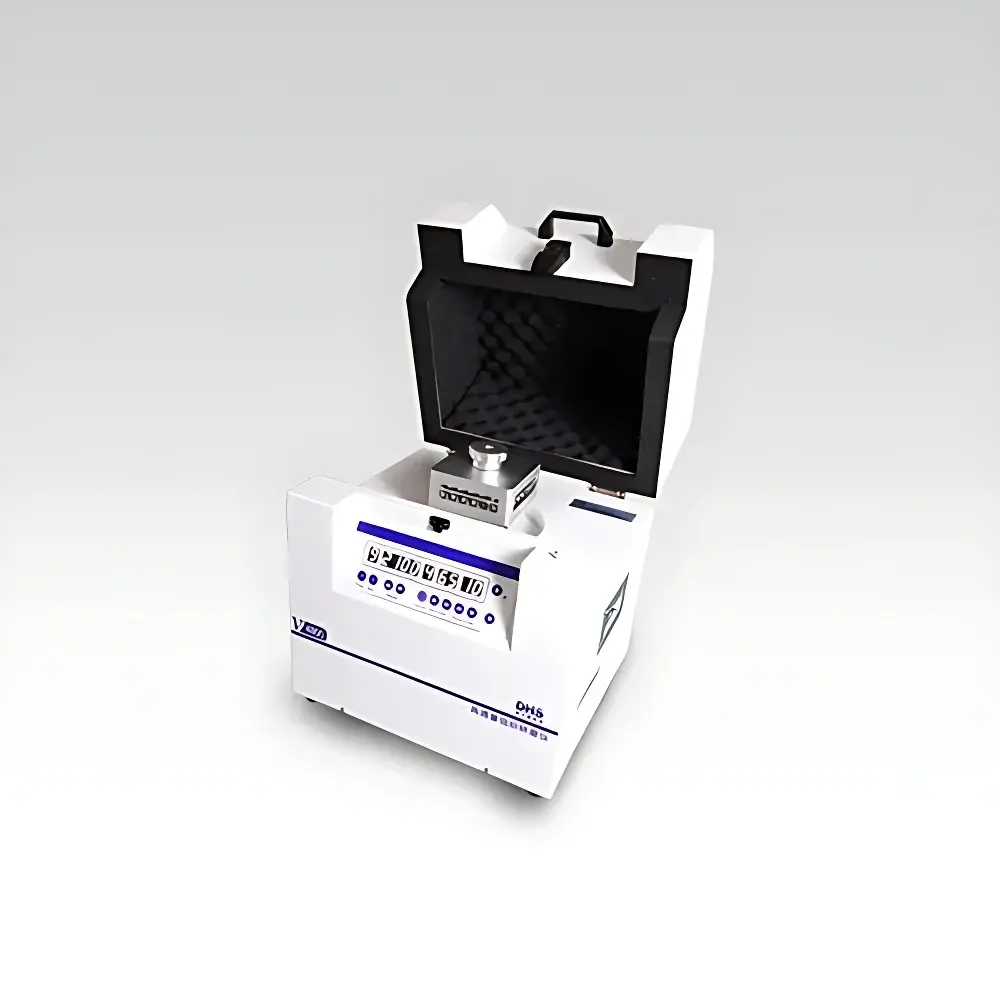
DHS V4800 High-Throughput Tissue Grinder
| Brand | DHS |
|---|---|
| Origin | Tianjin, China |
| Model | V4800 |
| Instrument Type | Benchtop Vertical Oscillating Ball Mill Grinder |
| Sample Compatibility | Hard, medium-hard, soft, brittle, elastic, and fibrous materials |
| Final Particle Size | ≤5 µm |
| Batch Capacity | 2×50 mL, 48×2 mL, 24×5 mL, 16×5 mL (rigid tubes), 12×10 mL, 4×15 mL |
| Vibration Frequency | 1000–2100 cycles/min |
| Processing Time | 1–99 sec (digital timer, adjustable in 1-sec increments) |
| Maximum Cycles per Run | 9 |
| Motor | Brushless DC |
| Power Input | 300 W |
| Dimensions (W×H×D) | 380×460×340 mm |
| Net Weight | 35 kg |
| Noise Level | <65 dB(A) |
| Safety | Full-cycle safety lock + anti-loosening clamping mechanism |
| Grinding Modes | Dry grinding, wet grinding, cryogenic grinding |
| Grinding Mechanism | Vertical reciprocating oscillation with impact, shear, and friction forces |
| Compliance | Designed for GLP-compliant laboratories |
Overview
The DHS V4800 High-Throughput Tissue Grinder is an engineered benchtop solution for rapid, reproducible mechanical homogenization of diverse biological and industrial samples. Utilizing vertical reciprocating oscillation—distinct from horizontal or rotary motion—it delivers controlled high-frequency impacts (1000–2100 cycles/min) between grinding beads and sample material within sealed tubes. This kinematic principle ensures efficient energy transfer for cell lysis, tissue pulverization, and particle size reduction down to ≤5 µm, while minimizing thermal buildup. Unlike rotor-stator or ultrasonic systems, the V4800 operates without continuous heat generation or probe contamination risk, making it especially suitable for temperature-sensitive biomolecules (e.g., RNA, enzymes, metabolites) and heterogeneous matrices such as plant stems, bone, soil aggregates, or polymer composites. Its rigid aluminum frame and precision-machined grinding platform provide mechanical stability essential for inter-run consistency across multi-sample workflows.
Key Features
- Vertical oscillation architecture optimized for uniform energy distribution across all tube positions—eliminating positional bias in high-throughput runs.
- Anti-loosening dual-lock clamping system with automatic centering ensures secure tube retention during high-frequency vibration, preventing tube ejection or misalignment.
- Full-cycle electronic safety lock engages before operation and remains active throughout the grinding cycle; motor halts immediately upon lid opening.
- Digital timer (1–99 seconds, 1-second resolution) and programmable cycle repetition (up to 9 cycles per run) enable precise method standardization for SOP-driven labs.
- Modular adapter system supports simultaneous processing of up to 48 × 2 mL tubes, 24 × 5 mL tubes, 16 × 5 mL rigid tubes, 12 × 10 mL tubes, or 4 × 15 mL tubes—configurable without tools.
- Brushless DC motor delivers consistent torque across speed range, low maintenance, and extended service life under daily high-load operation.
- Noise-dampened housing maintains ambient laboratory noise below 65 dB(A), meeting ISO 15712-1 acoustic requirements for shared lab environments.
Sample Compatibility & Compliance
The V4800 accommodates a broad spectrum of sample types—including hard tissues (bone, tooth), fibrous plant material, frozen microbial pellets, ceramic powders, and thermoplastic granules—without requiring pre-sizing. Sample integrity is preserved via fully enclosed tube processing: no aerosol generation, no cross-contamination between wells, and no operator exposure to hazardous particulates. The system supports cryogenic grinding using liquid nitrogen–precooled adapters and stainless-steel or tungsten carbide beads, enabling sub-zero embrittlement of elastic or lipid-rich samples. All grinding components (adapters, tube holders, base plate) are autoclavable or compatible with ethanol/IPA disinfection. The instrument meets mechanical safety requirements per IEC 61010-1 and is routinely deployed in GLP-regulated environments for sample preparation prior to HPLC, GC-MS, NGS library prep, and elemental analysis. While not FDA-cleared as a medical device, its operational parameters align with USP <1058> guidance on analytical instrument qualification for sample homogenization steps.
Software & Data Management
The V4800 operates via embedded firmware with local digital control—no PC interface or proprietary software required. All parameters (time, cycle count, pause intervals) are stored in non-volatile memory across 10 user-defined protocols. Each protocol includes timestamped execution logging (date/time, program ID, duration, cycle count), supporting basic audit trail functionality for internal QA review. For integration into LIMS or ELN ecosystems, optional RS-232 or USB-to-serial adapters allow ASCII-based command/response communication (e.g., “START”, “STATUS?”, “LOG”); raw log files can be exported for CSV parsing. The absence of cloud connectivity or remote access ensures compliance with data sovereignty policies common in academic, forensic, and pharmaceutical institutions.
Applications
- Molecular biology: Rapid lysis of mammalian, plant, and bacterial cells prior to DNA/RNA extraction; compatible with commercial kits (e.g., Qiagen DNeasy, Zymo Quick-DNA).
- Agricultural science: Homogenization of grain, leaf, root, and seed samples for mycotoxin screening, pesticide residue analysis, and genotyping-by-sequencing (GBS).
- Forensic toxicology: Disruption of hair, nail, and tissue specimens for LC-MS/MS quantification of drugs of abuse and metabolites.
- Materials science: Size reduction of ceramic precursors, metal alloys, and composite fragments for XRD phase identification and SEM-EDS elemental mapping.
- Environmental monitoring: Pulverization of soil cores, sediment, and biofilm samples for heavy metal digestion (EPA Method 3050B) and microbial community profiling.
- Pharmaceutical QC: Uniform blending and particle size reduction of excipients and active pharmaceutical ingredients (APIs) during formulation development.
FAQ
What types of grinding beads are recommended for different sample matrices?
Stainless steel beads (2–5 mm) are optimal for hard tissues and minerals; zirconia beads (1–3 mm) minimize metal leaching in trace-element analysis; silicone carbide beads suit abrasive ceramics; cryo-compatible polymer beads (e.g., PTFE-coated) prevent cold fracture in frozen samples.
Can the V4800 be used for enzymatic or protein-sensitive applications?
Yes—when operated at lower frequencies (1000–1400 cycles/min) with short durations (≤30 sec) and pre-chilled adapters/beads, the system achieves efficient lysis with minimal protease activation or denaturation.
Is validation documentation available for IQ/OQ/PQ protocols?
DHS provides a factory-verified performance qualification report (including frequency calibration, timer accuracy, and safety interlock verification); users may extend this with in-house testing per ASTM E2500 or Annex 15 guidelines.
How is maintenance performed on the drive mechanism?
The brushless DC motor requires no scheduled lubrication or brush replacement; periodic inspection of the eccentric drive shaft coupling and cleaning of the adapter seating surface with isopropanol is sufficient for >5-year operational reliability.
Does the instrument support regulatory-compliant electronic records?
While the V4800 lacks 21 CFR Part 11–compliant electronic signatures, its local parameter logging and protocol storage meet ALCOA+ principles for attributable, legible, contemporaneous, original, and accurate records when paired with lab-controlled procedural documentation.



