
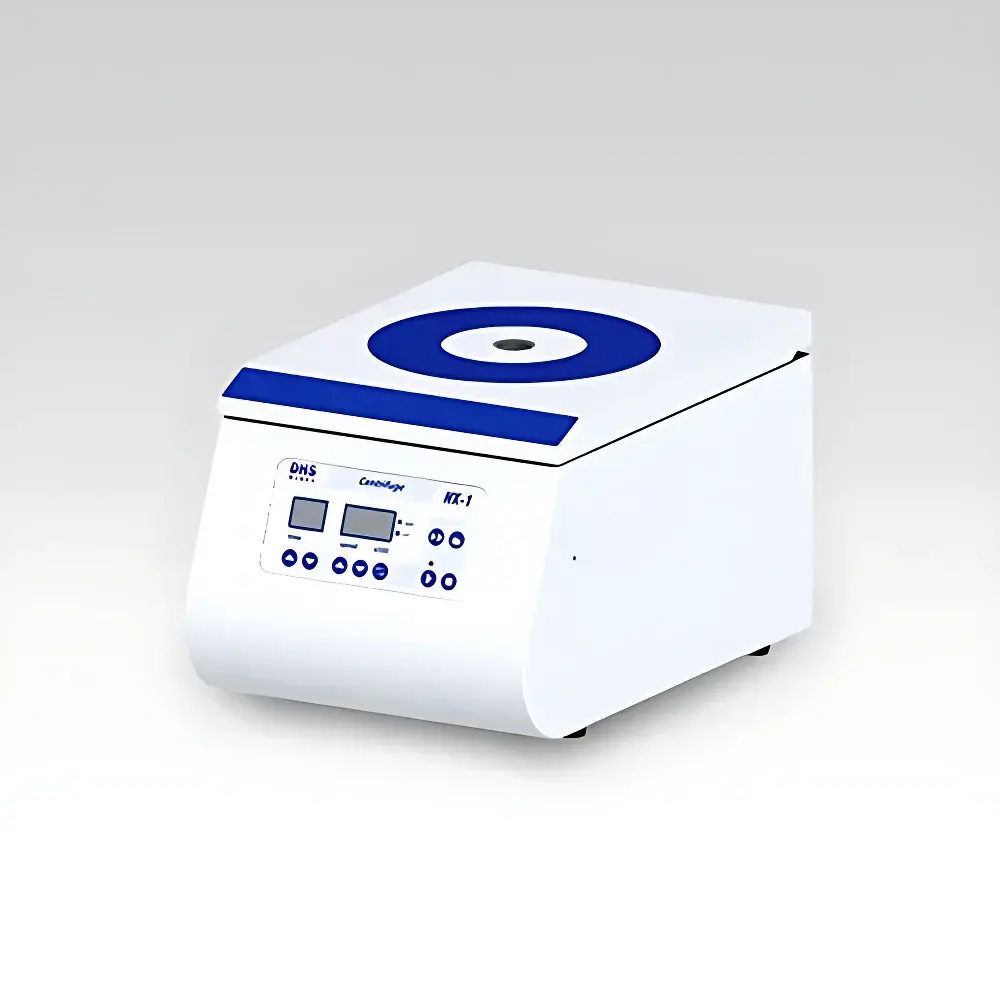
DHS NX-1 24-Position High-Speed Microcentrifuge
| Brand | DHS |
|---|---|
| Origin | Beijing, China |
| Model | NX-1 |
| Centrifuge Type | Benchtop High-Speed Centrifuge |
| Rotor Type | Fixed-Angle Rotors |
| Max Speed | 17500 rpm |
| Max RCF | 23300 × g |
| Max Capacity | 12 × 5.0 mL |
| Dimensions (W×D×H) | 235 × 400 × 270 mm |
| Net Weight | 16 kg |
| Noise Level | <60 dB(A) at Max Speed |
| Temperature Rise | <10 °C after 20 min at Max Speed |
| Speed Range | 300–17500 rpm (100 rpm increments) |
| Time Setting | 1 s–99 min, Continuous, Soft-Stop, Pulse Mode |
| Power Supply | 220 V / 50 Hz |
| Rotor Options | 12×1.5/2.0 mL, 24×1.5/2.0 mL, 12×5.0 mL, 18×2.0 mL spin columns, 8×8×0.2 mL PCR strip rotor |
Overview
The DHS NX-1 is a precision-engineered benchtop high-speed microcentrifuge designed for routine and demanding separation tasks in molecular biology, biochemistry, and clinical laboratories. Utilizing fixed-angle rotor architecture and optimized air-flow dynamics, the NX-1 achieves stable, reproducible centrifugation across a wide operational range — from gentle pelleting of cellular debris to high-resolution isolation of nucleic acids, proteins, and subcellular organelles. Its core mechanical design adheres to ISO 15195:2018 (requirements for centrifuge performance verification) and supports GLP-compliant workflows through consistent RCF delivery, precise speed control, and thermal stability during extended runs.
Key Features
- Ultra-low acoustic signature: <60 dB(A) at maximum speed — engineered via balanced rotor-hub interface, vibration-dampening chassis mount, and aerodynamically profiled rotor housing.
- Thermally stable operation: Internal temperature rise limited to <10 °C after 20 minutes at 17500 rpm; chamber reaches only ~30 °C under sustained load — critical for heat-sensitive samples such as RNA, enzymes, or antibody complexes.
- Robust all-metal construction: CNC-machined aluminum alloy rotor bodies with anodized surface finish ensure dimensional stability, corrosion resistance, and long-term rotor integrity under repeated thermal cycling.
- Modular rotor compatibility: Five interchangeable fixed-angle rotors support diverse sample formats — including standard microtubes (1.5/2.0 mL), 5.0 mL conical tubes, spin-column cartridges, and 96-well PCR strip configurations — enabling method standardization across purification, extraction, and cleanup protocols.
- Precision digital control system: 100-rpm incremental speed adjustment, programmable time intervals from 1 second to 99 minutes, plus pulse (short-run) and continuous modes — all with real-time RPM/RCF display and automatic rotor recognition logic.
- Comprehensive safety architecture: Automatic lid lock with dual mechanical interlocks, imbalance detection (<5 g mass differential), overspeed protection, and rotor lifetime tracking via embedded EEPROM memory.
Sample Compatibility & Compliance
The NX-1 accommodates common low-volume consumables used in nucleic acid isolation (e.g., Qiagen, Thermo Fisher, Zymo spin columns), protein precipitation workflows, and small-volume cell lysate clarification. All rotors are certified per IEC 61010-2-020 (safety requirements for laboratory centrifuges) and validated for use with polypropylene, polycarbonate, and polyethylene microcentrifuge tubes rated for ≥23300 × g. The instrument supports compliance with ISO/IEC 17025:2017 (for testing laboratories) when operated within defined calibration intervals and documented maintenance schedules. It is suitable for environments requiring adherence to CLIA, CAP, or ISO 15189 standards for clinical specimen processing.
Software & Data Management
The NX-1 operates as a standalone instrument with no proprietary software dependency. All parameters are set and monitored via its integrated LED interface with tactile membrane keys. For traceability in regulated environments, users may integrate the device into laboratory information management systems (LIMS) via external timer logs or manual entry of run records. While the NX-1 does not feature built-in audit trail or electronic signatures, its repeatable mechanical performance and calibrated speed/RCF output meet foundational requirements for 21 CFR Part 11 readiness when paired with procedural controls and SOP documentation.
Applications
- Routine pelleting of bacterial and yeast cells prior to lysis.
- Clarification of crude lysates and supernatant recovery in protein expression workflows.
- Spin-column-based DNA/RNA purification and clean-up (e.g., column binding/wash/elution steps).
- Micro-volume precipitation of oligonucleotides or synthetic peptides.
- PCR product cleanup and post-sequencing library preparation.
- Centrifugal concentration of dilute protein samples using ultrafiltration devices (compatible with 2.0 mL spin filters).
FAQ
What is the maximum relative centrifugal force (RCF) achievable with the NX-1?
The NX-1 delivers up to 23300 × g using the 12×1.5/2.0 mL rotor at 17500 rpm.
Is the NX-1 suitable for use with radioactive or hazardous biological samples?
Yes — when equipped with sealed rotors and operated inside appropriate biosafety cabinets or fume hoods, in accordance with institutional biosafety level (BSL-2/3) protocols.
Does the NX-1 require routine calibration?
Annual speed and timer calibration is recommended per ISO/IEC 17025 guidelines; DHS provides traceable calibration certificates upon request.
Can the NX-1 be used for clinical diagnostic applications?
It meets general requirements for centrifugal separation in clinical labs; validation against specific assay kits (e.g., Roche cobas, Abbott Alinity) must be performed by the end user per CLIA and CAP guidelines.
Are replacement rotors and accessories available globally?
DHS-certified rotors, adaptors, and consumable trays are distributed through authorized international partners with documented lot traceability and material certifications.



