
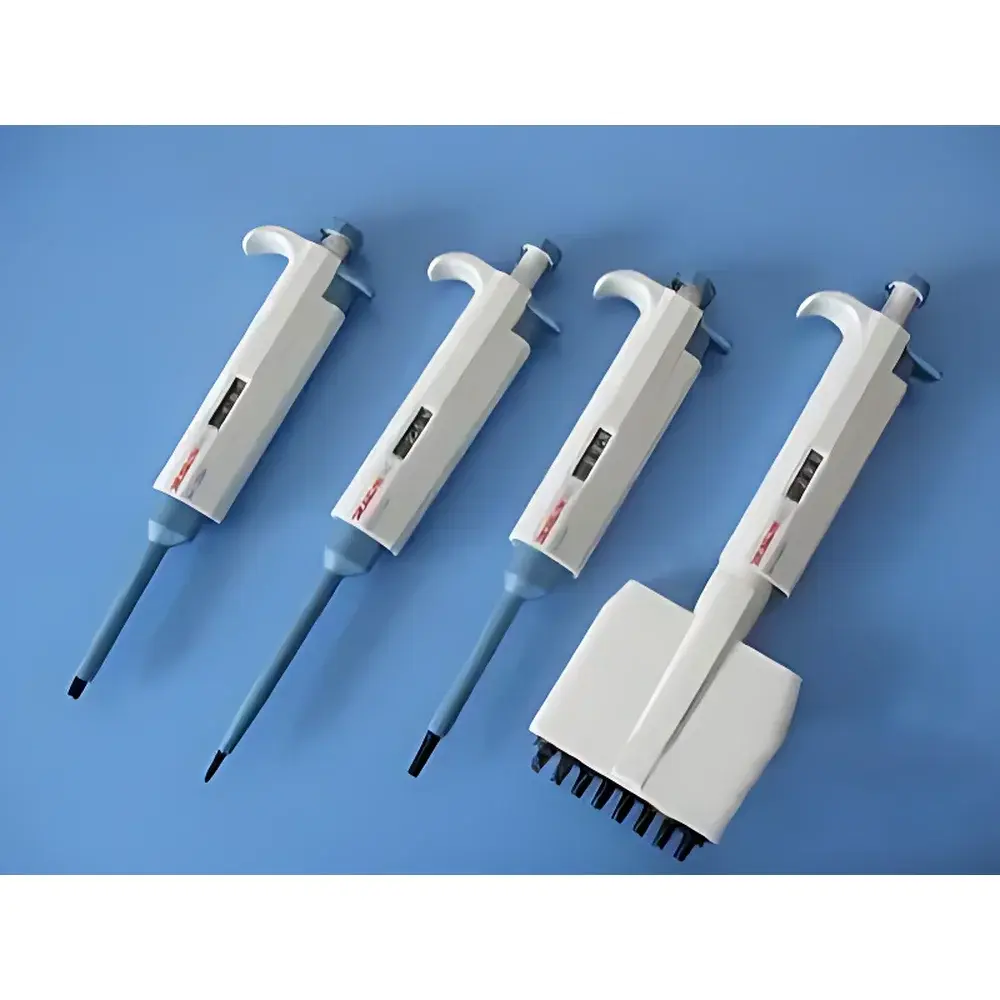
DLAB TopPette Single-Channel Adjustable-Volume Manual Pipette
| Brand | DLAB |
|---|---|
| Origin | Beijing, China |
| Model | 50–200 µL |
| Volume Range | 50–200 µL |
| Maximum Capacity | 200 µL |
| Accuracy | ±2.5% |
| Precision (CV) | ±0.15% |
| Operating Principle | Air-displacement positive displacement |
| Channel Configuration | Single-channel |
| Automation Level | Manual |
| Tip Compatibility | Standard conical 300 µL universal pipette tips |
| Sterilization | Autoclavable (121 °C, 20 min, fully assembled) |
| Tip Ejector | Integrated lightweight push-button ejector |
| Calibration | Tool-assisted field calibration compliant with ISO 8655-2 |
| Regulatory Compliance | Designed to support GLP/GMP workflows and ISO/IEC 17025 traceability requirements |
Overview
The DLAB TopPette Single-Channel Adjustable-Volume Manual Pipette (Model: 50–200 µL) is a precision-engineered air-displacement pipetting instrument designed for routine and critical liquid handling in life science, clinical diagnostics, pharmaceutical quality control, and academic research laboratories. Built upon ISO 8655-compliant mechanical architecture, it delivers reproducible volumetric delivery across its full range through a high-tolerance piston-cylinder system with low-friction PTFE-coated components. The device operates on the principle of controlled air displacement: depression of the plunger creates a vacuum within the sealed chamber, drawing liquid into a disposable tip; subsequent controlled plunger release dispenses the exact preset volume. Its robust aluminum-magnesium alloy housing ensures dimensional stability under repeated thermal and mechanical stress, while maintaining ergonomic weight distribution (<105 g) to minimize operator fatigue during extended use.
Key Features
- Ergonomic contoured grip with textured matte finish and optimized palm contour—reduces hand strain and enhances tactile control during repetitive pipetting cycles.
- Large, high-contrast digital volume window with parallax-free viewing—enables rapid verification of set volume without repositioning the hand or instrument.
- Rotary volume adjustment dial with tactile click feedback and dual-range locking mechanism—prevents accidental volume drift during operation or transport.
- Fully autoclavable lower assembly (including tip cone, O-rings, and piston)—validated for 121 °C, 20 min steam sterilization without disassembly or performance degradation.
- Replaceable hydrophobic filter barrier integrated into the tip cone—blocks aerosol contamination from entering the internal piston chamber and protects against sample carryover and cross-contamination.
- Modular tip cone design with chemical-resistant PEEK and ETFE components—resistant to common solvents including ethanol, isopropanol, acetone, and dilute acids/bases (pH 2–12).
- Tool-assisted calibration interface compliant with ISO 8655-6—supports user-performed adjustment using standard calibration tools and certified reference weights, with documented traceability to national metrology institutes.
Sample Compatibility & Compliance
The TopPette 50–200 µL pipette accommodates standard conical 300 µL universal tips (ISO 8655-3 compliant), ensuring compatibility with major third-party tip manufacturers. It maintains accuracy and precision when dispensing aqueous buffers, cell suspensions, serum, DNA/RNA solutions, and viscous reagents up to 10 cP (e.g., glycerol–water mixtures ≤20% v/v). All materials contacting fluid paths meet USP Class VI biocompatibility standards. Device construction and documentation support compliance with ISO/IEC 17025:2017 (for accredited calibration labs), CLSI EP10-A3 (evaluation of pipette performance), and FDA 21 CFR Part 11–aligned electronic record practices when used in conjunction with validated calibration management software.
Software & Data Management
While the TopPette is a manual pipette and contains no embedded electronics or connectivity, its design enables seamless integration into digitally governed laboratory environments. Each unit carries a unique serial number engraved on the body for asset tracking. Calibration records—including date, technician ID, adjustment values, uncertainty budgets, and reference standard IDs—can be maintained in LIMS or ELN platforms supporting ISO/IEC 17025 audit trails. DLAB provides downloadable calibration log templates (PDF/Excel) and traceable certificate-of-conformance documentation aligned with ISO 17025 clause 7.7 requirements.
Applications
- Quantitative preparation of PCR master mixes and NGS library dilutions
- Serial dilution of standards for ELISA, immunoassays, and spectrophotometric calibration curves
- Cell seeding and media supplementation in adherent and suspension culture workflows
- Sample aliquoting for HPLC, LC-MS, and GC-MS analysis
- Reagent dispensing in microplate-based enzymatic assays (e.g., kinase, protease, ATPase activity)
- Quality control testing per USP , , and EP 2.6.17 protocols
FAQ
Is this pipette suitable for handling corrosive or organic solvents?
Yes—the tip cone and internal wetted components are constructed from chemically inert PEEK, ETFE, and fluorosilicone elastomers, offering resistance to alcohols, chlorinated solvents, and weak acids/bases. For aggressive solvents (e.g., DMSO, THF), consult the DLAB Chemical Compatibility Guide before extended use.
Can the entire pipette be autoclaved?
No—only the lower assembly (tip cone, piston sleeve, and O-rings) is fully autoclavable at 121 °C for 20 minutes. The upper housing and volume adjustment mechanism must remain unsterilized to preserve calibration integrity and mechanical function.
What calibration standards does it comply with?
It conforms to ISO 8655 Parts 1–6 for specification, testing, and calibration of piston-operated volumetric apparatus. Calibration procedures follow gravimetric methodology per ISO 8655-6 using certified Class E2 weights and distilled water at 20 °C.
Does DLAB provide service documentation for regulatory audits?
Yes—each unit ships with a Certificate of Conformance, and DLAB’s authorized service centers issue ISO/IEC 17025-accredited calibration certificates upon request, including measurement uncertainty, environmental conditions, and metrological traceability statements.
How often should routine calibration be performed?
Per CLSI EP10-A3 and ISO 8655-6 recommendations, calibration frequency depends on usage intensity and risk assessment: typically every 3–6 months for daily use in regulated environments; quarterly for high-throughput QC labs; and before/after critical experiments or after physical impact or maintenance.



