
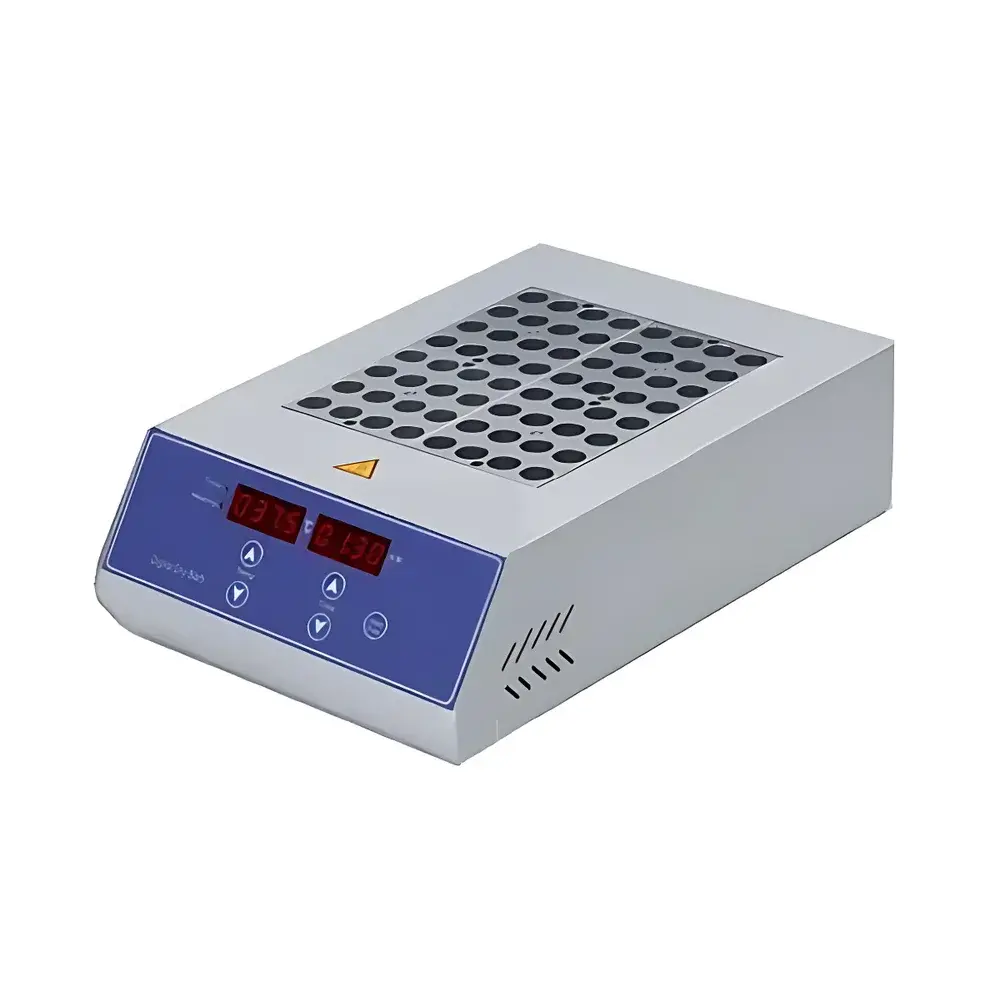
MENTS JY200-4 Advanced Dry Block Metal Bath
| Brand | MENTS |
|---|---|
| Origin | Beijing, China |
| Manufacturer Type | Direct Manufacturer |
| Model | JY200-4 |
| Temperature Range | Ambient +5°C to 130°C |
| Temperature Accuracy | ±0.5°C (@40°C), ±1.0°C (@120°C) |
| Heating Time | ≤20 min (25°C → 130°C) |
| Dimensions (L×W×H) | 360 × 220 × 100 mm |
| Net Weight | 3 kg |
| Power Rating | 600 W |
| Input Voltage | AC 220 V |
| Display Resolution | 0.1°C |
| Temperature Uniformity | ±0.5°C |
| Timer Range | 1–99 h 59 min |
| Block Capacity | 4 interchangeable blocks |
| Safety Features | Over-temperature protection, auto-fault detection & alarm, user-accessible temperature offset calibration |
Overview
The MENTS JY200-4 Advanced Dry Block Metal Bath is a precision-engineered thermal incubation system designed for consistent, contact-based heat transfer in molecular biology, clinical diagnostics, and quality control laboratories. Unlike water baths—whose performance is limited by evaporation, contamination risk, and slow thermal response—the JY200-4 employs a high-purity aluminum heating block architecture to deliver rapid, uniform, and maintenance-free temperature control across a wide operational range (ambient +5°C to 130°C). Its microprocessor-based PID control system ensures stable thermal output with minimal overshoot, making it suitable for time-critical protocols such as DNA denaturation prior to PCR, serum coagulation assays, enzyme reaction incubation, and sample thawing or preheating in regulated environments.
Key Features
- Four independently configurable aluminum heating blocks enable parallel processing of multiple sample formats without cross-contamination or thermal crosstalk.
- High-resolution digital display (0.1°C resolution) with real-time temperature readout and countdown timer (1–99 h 59 min) supports GLP-compliant documentation workflows.
- Integrated safety architecture includes dual-stage over-temperature protection, automatic fault detection with audible/visual alerts, and user-adjustable temperature offset calibration for traceable instrument verification.
- Rapid thermal ramp-up (≤20 minutes from 25°C to 130°C) minimizes protocol downtime while maintaining ±0.5°C uniformity across the block surface at mid-range setpoints.
- Modular design allows quick, tool-free block exchange—facilitating cleaning, sterilization (autoclavable blocks available upon request), and seamless adaptation to evolving assay requirements.
Sample Compatibility & Compliance
The JY200-4 supports a broad spectrum of tube and plate formats via 13 standard interchangeable blocks—including configurations for 0.2 mL, 0.5 mL, and 1.5 mL microcentrifuge tubes; 6–40 mm diameter test tubes; 96-well PCR plates; and custom geometries (OEM block design available). All blocks are machined from aerospace-grade aluminum alloy (6061-T6) with optimized thermal conductivity and low thermal mass. The device complies with IEC 61010-1:2010 safety standards for laboratory electrical equipment and meets electromagnetic compatibility (EMC) requirements per EN 61326-1. While not certified for IVD or GMP production use out-of-the-box, its deterministic temperature behavior, audit-ready timer logs, and calibration traceability support validation under ISO/IEC 17025, CLIA, and FDA 21 CFR Part 11–aligned data integrity frameworks when deployed with appropriate SOPs.
Software & Data Management
The JY200-4 operates as a standalone benchtop instrument with no embedded software or network interface—ensuring reliability, zero firmware vulnerabilities, and uninterrupted operation in air-gapped lab environments. All operational parameters (setpoint, actual temperature, elapsed time, alarm status) are displayed locally in real time. For laboratories requiring electronic record retention, optional RS-232 or USB-to-serial adapters (sold separately) enable passive data logging via third-party acquisition software (e.g., LabVIEW, Python-based PySerial scripts). Timestamped temperature logs can be exported for inclusion in batch records, deviation investigations, or internal calibration reports—supporting ALCOA+ principles (Attributable, Legible, Contemporaneous, Original, Accurate, Complete, Consistent, Enduring, Available).
Applications
- DNA/RNA denaturation and hybridization steps in nucleic acid amplification workflows (e.g., pre-PCR heat activation, restriction digest incubation).
- Serum and plasma coagulation testing per CLSI H21-A5 guidelines, where precise 37°C incubation is required for clot formation assessment.
- Enzyme kinetics studies requiring tightly controlled thermal conditions between 25°C and 70°C.
- Sample preparation for HPLC, GC, and mass spectrometry—including derivatization reactions and solvent evaporation pre-concentration steps.
- Quality assurance of reagent stability during accelerated shelf-life testing at elevated temperatures (e.g., 45°C, 60°C, 85°C).
FAQ
What is the maximum recommended continuous operating temperature?
The JY200-4 is rated for sustained operation up to 130°C. Prolonged use above 120°C may reduce long-term thermal stability of certain block materials; refer to block-specific datasheets for thermal cycling limits.
Can the unit be validated for ISO 17025 compliance?
Yes—its deterministic temperature control, documented accuracy specifications, and user-accessible calibration offset function allow integration into accredited lab validation protocols using external reference thermometers (e.g., NIST-traceable Pt100 probes).
Are replacement blocks supplied with calibration certificates?
Standard blocks are supplied with dimensional and material certifications. Optional NIST-traceable temperature calibration certificates (per ASTM E2251) are available upon request at additional cost.
Is the device compatible with LIMS integration?
While the base unit lacks native LIMS connectivity, its serial output enables bidirectional communication with middleware systems supporting Modbus RTU or ASCII command protocols—enabling automated start/stop triggers and temperature logging within enterprise lab informatics platforms.
What maintenance is required for long-term reliability?
No routine lubrication or consumables are required. Annual verification of temperature accuracy using a calibrated reference probe and visual inspection of block seating integrity are recommended best practices.



