
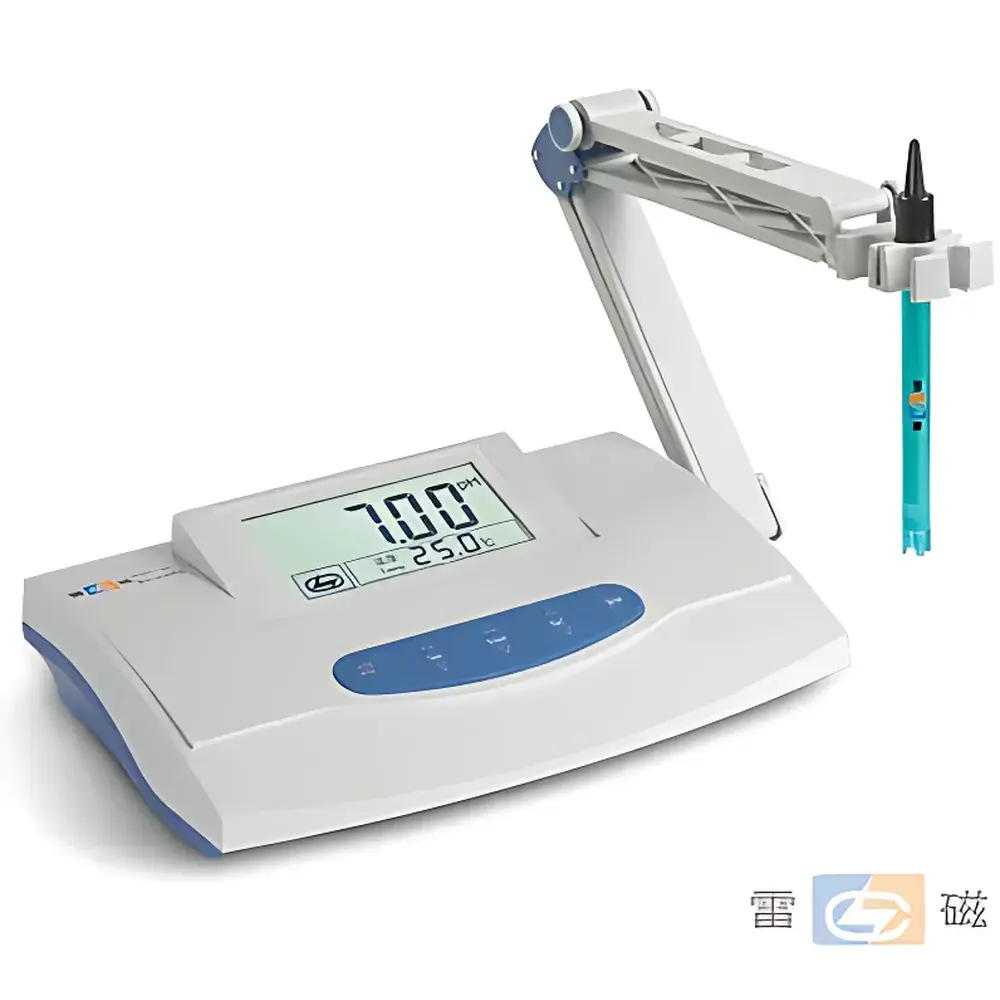
Leici PHS-3C Benchtop pH Meter
| Brand | Leici |
|---|---|
| Origin | Shanghai, China |
| Instrument Type | Benchtop |
| Parameter Type | Single-parameter (pH/mV) |
| pH Measurement Range | 0.00–14.00 pH |
| mV Range | ±1800 mV |
| Resolution | 0.01 pH / 1 mV |
| Accuracy | ±0.01 pH ±1 digit / ±1 mV ±1 digit |
| Input Impedance | ≥1 × 10¹² Ω |
| Temperature Compensation Range | 0–60 °C |
| Sample Temperature Range | 5–60 °C |
| Stability | ±0.01 pH ±1 digit / 3 h |
| Display | 3½-digit LED |
| Calibration Modes | One-point or two-point |
| Electrode Compatibility | E-201-C combination pH electrode |
| Compliance | Meets GB/T 11165–2022 (Chinese national standard for laboratory pH meters), aligned with ISO 7888 and ASTM D1293 principles |
Overview
The Leici PHS-3C is a precision benchtop pH meter engineered for routine laboratory pH and millivolt measurements in quality control, academic teaching labs, environmental monitoring, and industrial process support. Operating on the fundamental principle of potentiometric measurement, the instrument detects the electromotive force (EMF) generated across a high-impedance electrochemical cell comprising a glass pH-sensing electrode and a reference electrode—typically the factory-matched E-201-C combination electrode. This EMF is converted to pH via the Nernst equation, with temperature-dependent slope correction applied manually within the 0–60 °C range. Designed to meet the performance criteria of Class 0.01 pH instruments per GB/T 11165–2022, the PHS-3C delivers stable, repeatable readings suitable for applications requiring traceable, intermediate-level accuracy without automated calibration or data logging.
Key Features
- 3½-digit LED display providing clear, glare-resistant readouts of pH (0.00–14.00) and mV (±1800) values
- Manual temperature compensation (MTC) with adjustable setting from 0 to 60 °C, enabling accurate slope correction for non-ambient measurements
- Flexible calibration architecture supporting both single-point (e.g., pH 7.00 buffer) and two-point (e.g., pH 4.01 and 7.00, or 7.00 and 10.01) calibration protocols
- High-input-impedance amplifier (≥1 × 10¹² Ω) minimizing loading effects on high-resistance electrodes and ensuring signal integrity with aged or low-ionic-strength samples
- Stability specification of ±0.01 pH ±1 digit over 3 hours—validated under controlled thermal and electrical conditions per standard test methodology
- Dedicated compatibility with the Leici E-201-C pH combination electrode, featuring a low-resistance Ag/AgCl reference system and integrated junction design optimized for aqueous solutions
Sample Compatibility & Compliance
The PHS-3C is intended for use with aqueous or low-viscosity liquid samples within a temperature range of 5–60 °C. It is not designed for non-aqueous solvents, highly viscous suspensions, or gaseous phases. Electrode selection must align with sample chemistry: the E-201-C is appropriate for general-purpose measurements in drinking water, buffer solutions, food extracts, and mild chemical effluents. For aggressive media (e.g., strong acids/bases, HF-containing solutions, or organic solvents), alternative electrode configurations are required and not supported by this model. The instrument conforms to GB/T 11165–2022, the People’s Republic of China national standard for laboratory pH meters, and its operational principles align with internationally recognized methodologies including ISO 7888 (water quality — determination of pH) and ASTM D1293 (standard test method for pH of water). While not FDA 21 CFR Part 11–compliant due to lack of audit trail or electronic signature functionality, it supports GLP/GMP-aligned manual recordkeeping when used with standardized calibration logs and sample worksheets.
Software & Data Management
The PHS-3C operates as a standalone analog-digital hybrid instrument with no embedded microprocessor-based software, firmware updates, or connectivity interfaces (e.g., USB, RS-232, Bluetooth). All calibration coefficients, temperature settings, and measurement modes are configured directly via front-panel controls. Data output is limited to real-time visual display; no internal memory, timestamping, or export capability is provided. Users must manually transcribe readings into laboratory notebooks or external spreadsheets. This architecture prioritizes mechanical robustness, electromagnetic immunity, and long-term reliability in environments where networked instrumentation introduces unnecessary complexity or cybersecurity exposure. Calibration records—including date, buffer lot numbers, measured mV/pH values, and electrode ID—must be maintained externally to satisfy ISO/IEC 17025 documentation requirements.
Applications
- Academic instruction in analytical chemistry and environmental science laboratories
- Routine pH verification in municipal water treatment facilities and wastewater discharge monitoring
- Quality assurance testing of pharmaceutical excipients, cosmetics, and food-grade buffers
- Calibration verification of higher-tier pH systems using certified reference materials
- Field-deployable lab backup instrumentation where portability and battery independence are secondary to stability and simplicity
FAQ
Does the PHS-3C support automatic temperature compensation (ATC)?
No. It features manual temperature compensation only; users must input the measured sample temperature using the front-panel controls.
Can I use third-party pH electrodes with this meter?
Yes, provided they conform to standard BNC connectors and exhibit input impedance compatible with ≥1 × 10¹² Ω amplifiers—but optimal performance and warranty coverage require use of the Leici E-201-C electrode.
Is the instrument suitable for ISO/IEC 17025-accredited testing?
It may be used within an accredited scope if supported by documented procedures, traceable calibration standards (e.g., NIST-traceable buffers), and controlled environmental conditions—but its lack of data logging necessitates rigorous manual recordkeeping.
What is the recommended recalibration frequency?
Per ISO 7888, recalibration is required before each analytical batch, after electrode cleaning or replacement, and following any significant ambient temperature shift exceeding ±2 °C.
Does the PHS-3C comply with FDA 21 CFR Part 11?
No. It lacks electronic audit trails, user access controls, and secure data storage—features required for regulated pharmaceutical or clinical diagnostics workflows.




