
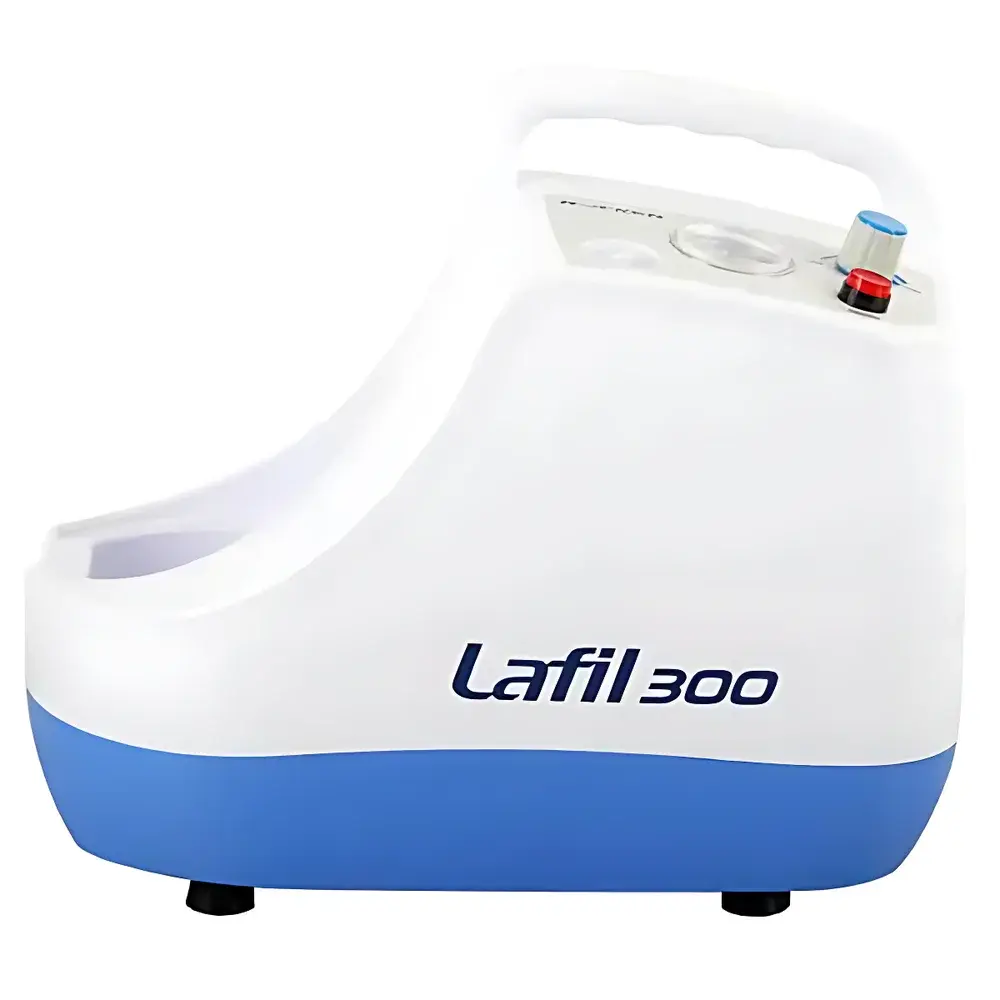
ROCKER Lafil300 Oil-Free Diaphragm Vacuum Pump
| Brand | ROCKER |
|---|---|
| Origin | Taiwan |
| Model | Lafil300 |
| Pump Type | Diaphragm Vacuum Pump |
| Oil-Free Design | Yes |
| Ultimate Vacuum | 99 mbar |
| Flow Rate | 23 L/min |
| Dimensions (W×D×H) | 35 × 24.3 × 29 cm |
| Weight | 5.9 kg |
| Motor Power | 60 W |
| Noise Level | 50 dB(A) |
| Input Voltage/Frequency | 220 V / 50 Hz |
| Current Draw | 0.3 A |
| Motor Speed | 1450 rpm |
| Built-in Vacuum Regulator | Yes |
| Inlet Filter Assembly | Included |
| Safety Certification | CE |
Overview
The ROCKER Lafil300 is an oil-free diaphragm vacuum pump engineered for precision, reliability, and low-maintenance operation in academic, clinical, and industrial laboratory environments. Unlike rotary vane or piston pumps requiring lubricating oil, the Lafil300 employs a corrosion-resistant PTFE-coated diaphragm and dual-head mechanical design to generate vacuum via positive displacement—eliminating oil carryover, vapor contamination, and routine oil changes. Its ultimate vacuum of 99 mbar (equivalent to ~685 mmHg) and stable flow rate of 23 L/min at atmospheric pressure make it suitable for continuous-duty applications such as vacuum filtration, solvent recovery, and sample concentration where clean, dry vacuum is critical. The pump’s compact footprint (35 × 24.3 × 29 cm) and lightweight construction (5.9 kg) enable flexible benchtop integration without compromising structural rigidity or thermal stability.
Key Features
- Oil-free operation ensures zero hydrocarbon contamination—essential for sensitive analytical workflows including HPLC sample prep, microbiological membrane filtration, and environmental water testing.
- Integrated inlet particulate filter prevents ingress of dust, moisture, and aerosolized debris, extending diaphragm service life and maintaining consistent vacuum performance over time.
- Thermal cut-off protection automatically de-energizes the motor when internal temperature exceeds safe operating thresholds; restart occurs only after passive cooling, preventing coil damage and ensuring long-term operational integrity.
- Built-in vacuum regulator allows real-time adjustment of suction pressure across the full operating range (99–1013 mbar), enabling precise control during delicate filtration of fragile biological membranes or viscous suspensions.
- CE-marked compliance confirms adherence to EU Machinery Directive 2006/42/EC and Low Voltage Directive 2014/35/EU—supporting lab-wide conformity with ISO/IEC 17025 quality management systems and GLP audit requirements.
- Low-noise operation (50 dB[A]) minimizes acoustic interference in shared lab spaces, while the 60 W brushless motor delivers energy-efficient performance with minimal heat dissipation.
Sample Compatibility & Compliance
The Lafil300 is routinely deployed in applications governed by standardized test methods including ASTM D5907 (suspended solids in water), ISO 7899-2 (coliform enumeration), and USP <61> (microbial limits testing). Its oil-free architecture meets the vacuum purity requirements specified in CLSI EP10-A3 for diagnostic reagent preparation and FDA 21 CFR Part 11–aligned workflows where trace organic residue must be excluded from final extracts or filtrates. The pump interfaces seamlessly with standard 5/16″ (8 mm) ID vacuum tubing and common filter flask configurations (e.g., 500 mL to 2 L borosilicate glass flasks with side-arm ports). No additional condensate traps or cold traps are required for aqueous or mildly volatile solvent use under ambient conditions.
Software & Data Management
While the Lafil300 operates as a standalone analog device without digital connectivity, its mechanical design supports integration into validated laboratory information management systems (LIMS) through external pressure transducers and programmable logic controllers (PLCs). Vacuum setpoints and runtime can be logged via third-party data acquisition modules compliant with IEEE 1451.2 transducer interface standards. For GxP-regulated environments, the pump’s CE certification, documented thermal safety protocol, and absence of software-based control logic simplify qualification (IQ/OQ/PQ) and reduce validation burden compared to microprocessor-driven alternatives.
Applications
- Vacuum-assisted filtration of microbiological samples (e.g., membrane filtration of drinking water per EPA Method 1603)
- Removal of suspended solids in environmental wastewater analysis (ISO 11923)
- Concentration of protein solutions and nucleic acid extracts using centrifugal vacuum concentrators
- Evaporation of low-boiling solvents in preparative chemistry workflows
- Supporting vacuum desiccation of hygroscopic reference standards in metrology labs
- Backing high-vacuum systems where oil backstreaming must be avoided (e.g., prior to turbomolecular pump staging)
FAQ
Is the Lafil300 suitable for use with organic solvents?
Yes—its PTFE diaphragm and stainless-steel valve components provide chemical resistance to alcohols, acetone, ethyl acetate, and dilute acids/bases. However, prolonged exposure to chlorinated or highly polar aprotic solvents (e.g., DMF, DMSO) is not recommended without inline cold trapping.
Does the pump require periodic calibration?
No—vacuum output is mechanically determined and does not drift over time. Verification of ultimate vacuum and flow rate may be performed annually using traceable pressure gauges and calibrated rotameters per ISO 5167 guidelines.
Can the Lafil300 be used in Class II biosafety cabinets?
Yes—the pump’s low electromagnetic emissions, absence of oil mist, and surface-mount design allow safe placement inside or adjacent to BSCs without compromising containment integrity or airflow uniformity.
What maintenance is required beyond filter replacement?
None. The diaphragm assembly is rated for ≥10,000 hours of continuous operation. Only the inlet filter element requires replacement every 6–12 months depending on particulate load.
Is technical documentation available in English for regulatory submission?
Yes—ROCKER provides full CE Declaration of Conformity, RoHS compliance statements, dimensional drawings, and electrical schematics in English upon request for inclusion in facility validation dossiers.



