
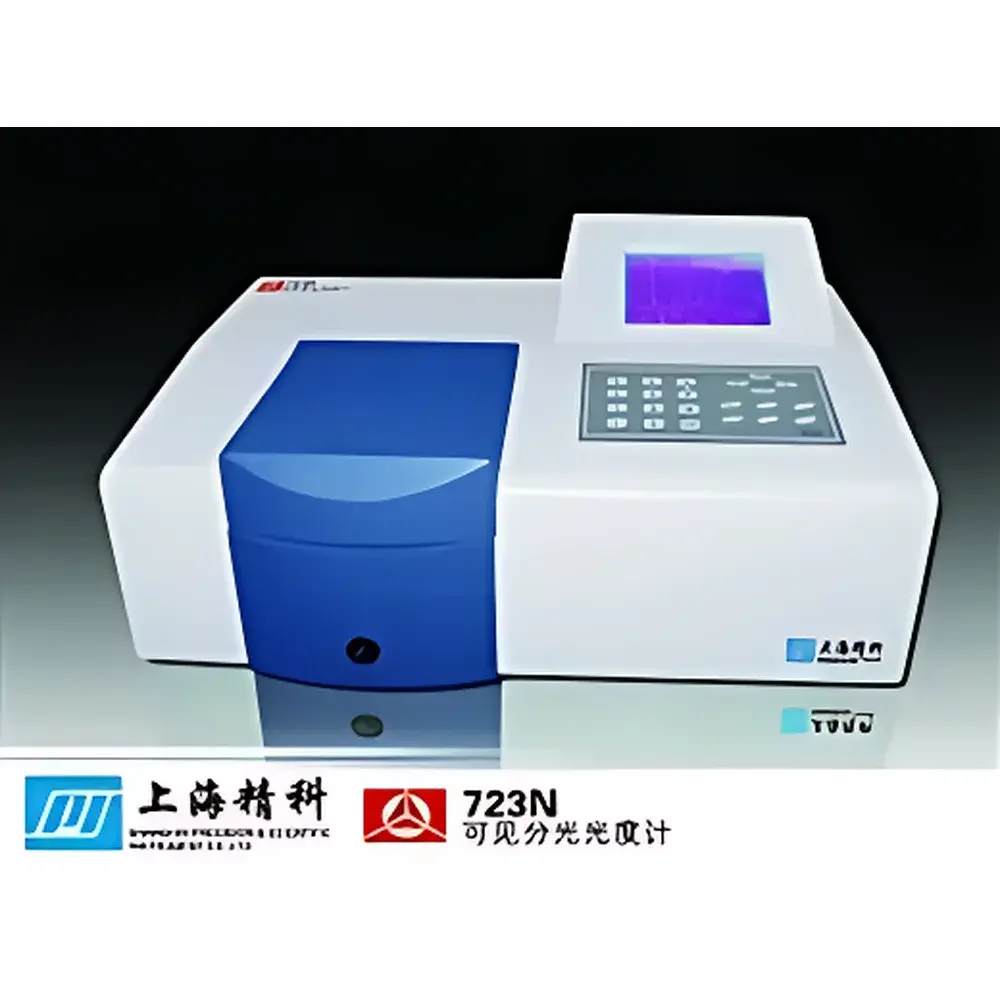
Shanghai INESA 723N UV-Vis Spectrophotometer
| Origin | Shanghai, China |
|---|---|
| Manufacturer Type | Authorized Distributor |
| Origin Category | Domestic (PRC) |
| Model | 723N |
| Price | USD 920 (FOB Shanghai) |
| Wavelength Range | 325–1000 nm |
| Wavelength Accuracy | ±1 nm |
| Wavelength Repeatability | ≤0.5 nm |
| Spectral Bandwidth | 4 nm |
| Stray Light | ≤0.3% τ (at 360 nm, NaNO₂ reference |
| typical measured | 0.1% τ) |
| Transmittance Range | 0.0–200.0% τ |
| Transmittance Accuracy | ±0.5% τ (certified NIST-traceable NBS 930D filter) |
| Transmittance Repeatability | ≤0.2% τ |
| Absorbance Range | –0.301 to 4.000 A |
| Baseline Flatness | ±0.005 A |
| Drift | ≤0.004 A/h |
| Sampling Interval Options | 0.1, 0.2, 0.5, 1, 2, or 4 nm |
| Display | 5″ LCD graphical interface |
| Output | Integrated thermal printer (optional external USB/RS-232 connectivity) |
Overview
The Shanghai INESA 723N UV-Vis Spectrophotometer is a fixed-slit, single-beam optical instrument engineered for routine quantitative and qualitative analysis in the ultraviolet and visible spectral regions (325–1000 nm). It operates on the fundamental principle of Beer–Lambert law-based absorbance measurement, where sample-induced attenuation of monochromatic light is correlated to analyte concentration and path length. Designed for robustness and operational simplicity, the 723N employs a high-stability tungsten-halogen lamp (visible) and deuterium lamp (UV), coupled with a precision Czerny–Turner monochromator and fixed 4 nm spectral bandwidth. Its mechanical and optical architecture supports high photometric reproducibility under ambient laboratory conditions—making it suitable for method transfer, QC release testing, and educational applications where regulatory traceability and method consistency are required but full GLP-compliant audit trails are not mandated.
Key Features
- 5-inch graphical LCD display with intuitive icon-driven menu navigation and real-time spectrum preview during scanning
- Integrated thermal printer enabling immediate hard-copy documentation of spectra, calibration reports, and quantitative results—supporting paper-based record retention per internal SOPs
- Five operational modes: Photometric (single-wavelength absorbance/transmittance), Wavelength Scan (full-spectrum acquisition), Quantitative Analysis (with coefficient entry, single-point, or multi-point calibration), Kinetic Measurement (time-resolved absorbance monitoring), and Multi-Wavelength Analysis (up to 10 user-defined wavelengths)
- Automatic zeroing and 100% transmittance calibration routines reduce operator-dependent error and improve inter-day repeatability
- Adjustable wavelength sampling interval (0.1–4 nm) allows optimization between resolution and scan speed—e.g., 0.5 nm for fine-structure verification in pharmaceutical impurity profiling, or 2 nm for rapid QC checks in water quality labs
- Matched-cuvette correction algorithm minimizes path-length and refractive-index variability effects when using multiple quartz or glass cuvettes—particularly valuable in high-throughput clinical chemistry workflows
- Baseline flatness of ±0.005 A across 325–1000 nm ensures reliable quantitation in low-absorbance regions (e.g., dilute protein assays or low-concentration metal chelates)
Sample Compatibility & Compliance
The 723N accommodates standard 10 mm square-path quartz or optical-grade glass cuvettes (1.0–5.0 mL volume), as well as optional micro-volume adapters (e.g., 50–500 µL capillary cells). It complies with core performance criteria defined in ISO 6223:2021 (Spectrophotometers — Performance specifications) and meets essential requirements of ASTM E275–22 (Standard Practices for Describing and Measuring Performance of UV-Vis Spectrophotometers). While not pre-certified for FDA 21 CFR Part 11 compliance out-of-the-box, its data export functionality (via RS-232 or USB-to-serial) enables integration into validated LIMS environments where electronic records are governed by organizational validation protocols. The instrument satisfies minimum acceptance criteria for USP (Spectrophotometry and Light-Scattering) for non-GMP-controlled assay verification in R&D and stability studies.
Software & Data Management
The 723N operates via embedded firmware with no external PC dependency. All measurement data—including raw absorbance values, scanned spectra, calibration coefficients, and kinetic time-series—are stored in non-volatile memory (up to 200 test records). Export is supported through ASCII-formatted text files via serial interface, compatible with Microsoft Excel, OriginLab, or custom Python/Pandas parsing scripts. Thermal printouts include timestamp, operator ID field (manually entered), wavelength settings, and reference standard identification—facilitating manual audit trail reconstruction. For laboratories requiring electronic signature and change control, third-party middleware solutions can be deployed to log instrument events and enforce user-level access permissions consistent with GLP Annex 11 principles.
Applications
- Pharmaceutical: Dissolution testing of solid oral dosage forms (e.g., USP Apparatus II at 220 nm), excipient purity screening, and content uniformity verification
- Clinical Diagnostics: Serum bilirubin, creatinine, and uric acid quantification using standardized colorimetric kits (e.g., Jaffe reaction)
- Environmental Monitoring: Nitrate/nitrite determination in drinking water (EPA Method 353.2), phosphate analysis in wastewater effluents (APHA 4500-P E)
- Food & Beverage: Color index (AOAC 993.02), anthocyanin content in fruit juices, and preservative (e.g., benzoate) quantification
- Academic Teaching: Fundamental spectroscopy experiments including Lambert–Beer law validation, λmax determination, and molecular extinction coefficient calculation
FAQ
Is the 723N compliant with ISO/IEC 17025 for accredited testing laboratories?
The instrument meets metrological performance requirements referenced in ISO/IEC 17025:2017 Clause 6.4 (Equipment), but formal accreditation requires laboratory-specific verification, uncertainty budgeting, and documented calibration against NIST-traceable standards.
Can the 723N perform DNA/RNA quantification at 260 nm?
Yes—its ±1 nm wavelength accuracy and ±0.5% τ transmittance accuracy meet the minimum performance thresholds specified in Molecular Biology Protocols for nucleic acid A260/A280 ratio assessment, provided matched quartz cuvettes and appropriate blanking procedures are used.
What maintenance is required to sustain long-term photometric stability?
Annual lamp replacement (deuterium and tungsten-halogen), quarterly cleaning of optical windows with spectroscopic-grade methanol, and biannual verification using NIST SRM 930D filters are recommended per manufacturer guidelines.
Does the thermal printer support barcode label generation for sample tracking?
No—the integrated thermal printer outputs only alphanumeric text and basic numeric plots; external label printers must be integrated via host PC software if barcode-based sample ID management is required.
Is remote operation or network connectivity available?
The 723N lacks built-in Ethernet or Wi-Fi; however, RS-232 output can be bridged to TCP/IP networks using industrial serial servers, enabling centralized data aggregation in facility-wide instrumentation networks.



